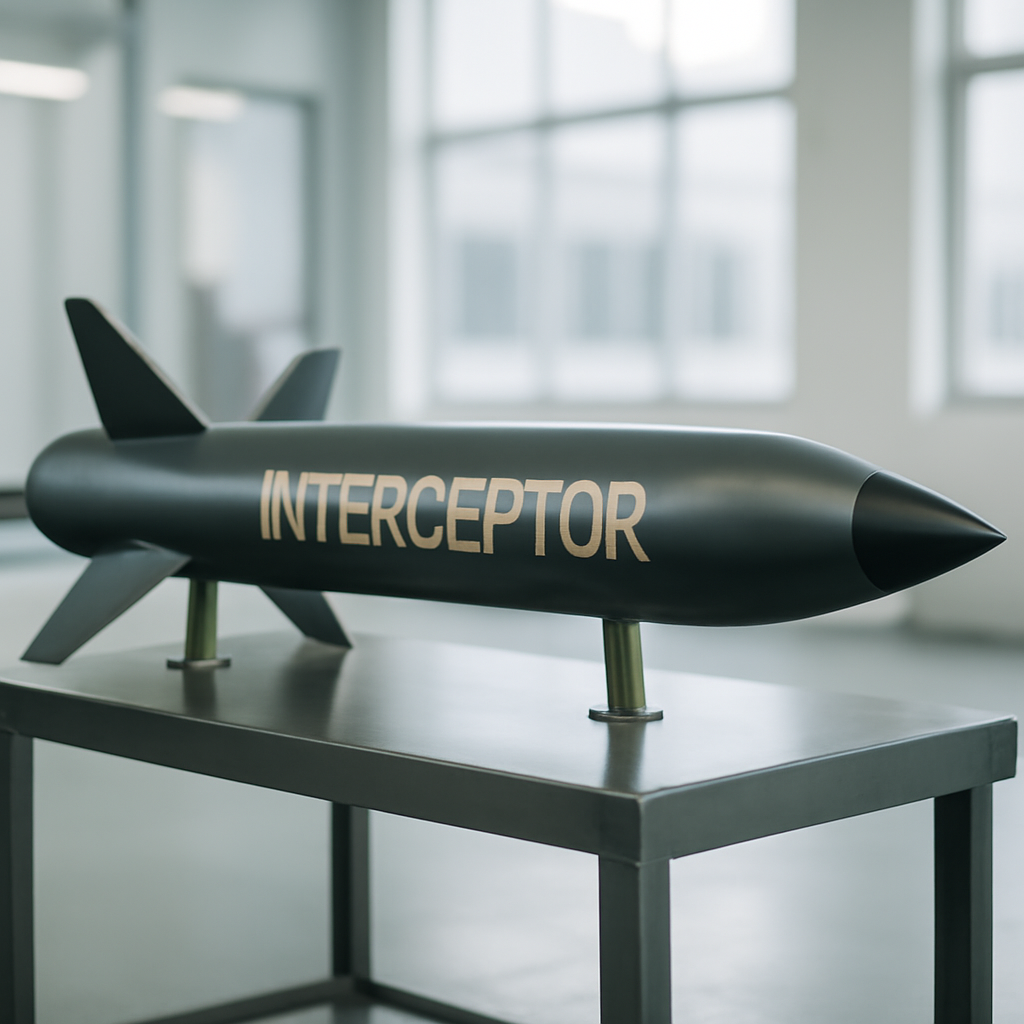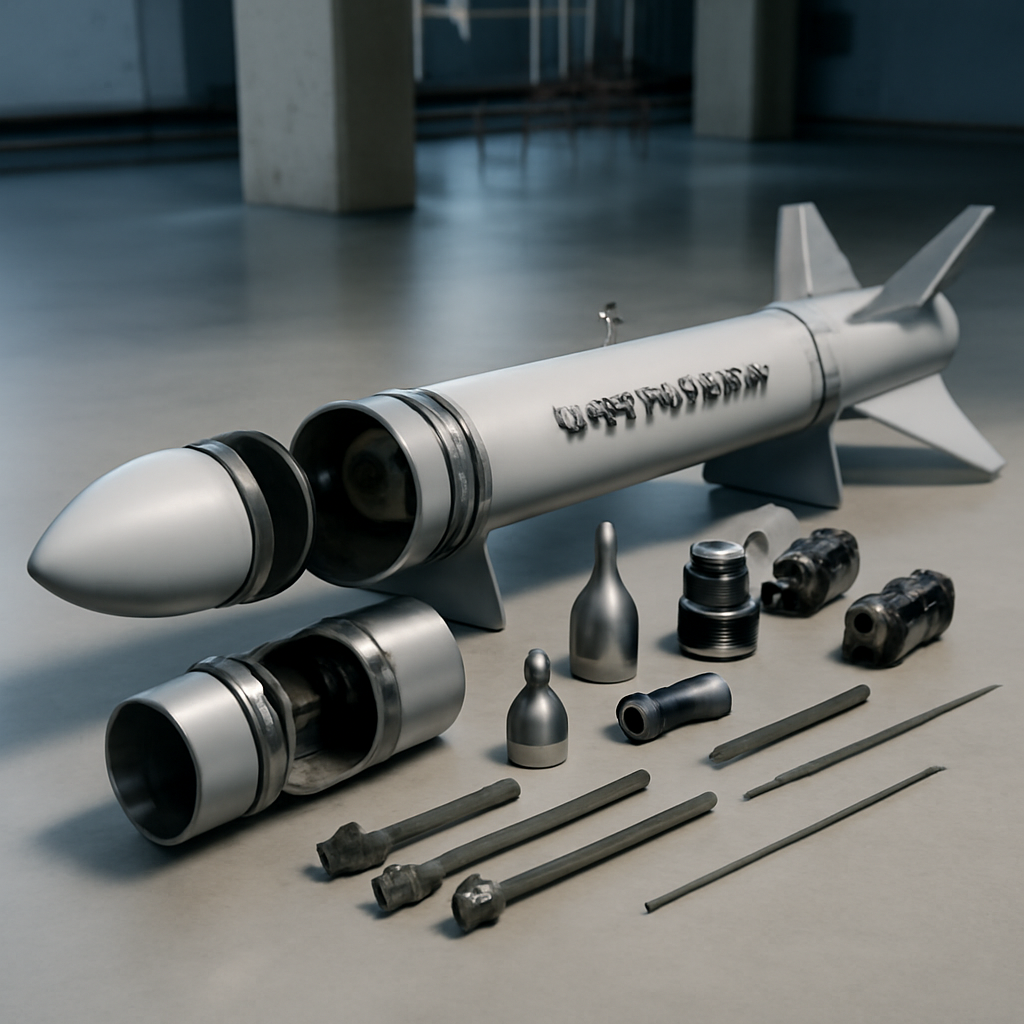
“It is an open system, so the ability to fly it with different rocket motors, different seekers, to be able to swap these components out, to be able to reconfigure the system for a range of different threats is a feature that we built into this,” said Christian Brose, president and chief strategy officer at Anduril.
Design: a common two-stage architecture
Anduril unveiled Steelfin as a family of surface-to-air interceptor missiles built around a common two-stage design: a booster first stage and a terminal-stage interceptor as the second. The company says the terminal stage will share a baseline airframe, avionics, software, flight control system, and interfaces across variants while allowing mission-specific boosters and terminal components to be swapped in during final assembly. Anduril plans to offer both hit-to-kill and blast-fragmentation terminal-stage interceptors.
Claimed mission set and performance framing
Anduril positions Steelfin to cover missions from point defense and lower-tier integrated air and missile defense up to upper-tier ballistic missile defense, explicitly naming cruise, ballistic, and hypersonic missiles among the threats the family is designed to address. The announcement states the family would cover much of the air-and-missile-defense spectrum but “does not extend to exoatmospheric midcourse interception.” The company did not publish engagement envelopes, detailed performance specifications, or which specific variants would address each threat class.

This site is the portfolio.
OSINTSights runs on Cloudflare Workers, D1, R2, and Vectorize, with an AI pipeline on Hetzner ARM. Nubivance designed, built, and operates it. We do the same for clients.
See what we buildModularity, production scale, and industrial logic
Steelfin’s central industrial argument is commonality: shared production lines, tooling, and equipment, with mission-specific boosters and terminal-stage components introduced late in assembly. Anduril says this approach would allow manufacturing capacity to be redirected toward whichever variant is most in demand. The company is planning near-term production “on the order of several thousand missiles annually,” with capacity designed to expand or shift according to requirements. Anduril has not, however, provided a detailed production schedule or contracted quantities demonstrating how quickly it could reach that scale.
Compatibility with current launchers and systems
Anduril says Steelfin will be compatible with a range of existing land- and sea-based launch infrastructure, including the M903A2 launcher used by newer PAC-3 series interceptors, the Mk 41 Vertical Launch System, Typhon, and emerging containerized launchers. The company also cites compatibility with established fire-control systems such as AEGIS and the Army’s Integrated Battle Command System (IBCS). Brose said Anduril is examining boosters sized at 10-inch, 18-inch, and 21-inch diameters, and options for dual- and quad-pack configurations in Mk 41 cells to produce different range and altitude performance.
Cost comparisons and market context
Anduril offered comparative cost framing rather than list prices. Steve Milano, lead for Air Dominance & Strike at Anduril, suggested a “more exquisite version” of Steelfin would sit cost-wise above PAC-3 MSE and below THAAD while accomplishing “100 percent of the THAAD mission at a fraction of the cost.” He further suggested a PAC-3-type Steelfin would accomplish 80 percent of that mission at less than 50 percent of PAC-3 MSE cost. The story supplies reference prices: a single THAAD interceptor at around $15.5 million, a PAC-3 MSE interceptor at approximately $5.3 million (Army fiscal 2027 budget), and an SM-2 Block IIIC at about $2.5 million. Anduril has not disclosed Steelfin unit prices or detailed cost breakdowns.
What this means for the U.S. military, the Navy, and procurement leaders
- The U.S. military: Planning and inventory managers focused on expanding air-defense stocks will see Steelfin’s pitch—modularity tied to high-volume production—as a possible way to match interceptors to threat levels and preserve higher-end weapons for the most demanding engagements. Anduril says it has developed Steelfin with investment from multiple customers and completed ballistic testing with representative air vehicles; flight testing of variants is planned for 2027.
- The Navy: The Navy’s own Naval Modular Missile initiative envisions modular terminal-stage families and has a stated ambition to reach production of 1,000 missiles annually within five years of a contract award. Steelfin’s emphasis on dual- and quad-pack Mk 41 configurations and compatibility with the Mk 41 cell aligns with that modular concept.
- Procurement leaders: The Army and Navy are already pursuing lower-cost interceptor paths—examples cited include an Army solicitation for a Patriot-compatible interceptor with a target unit cost below $1 million and Lockheed Martin’s PAC-3 Adapted Capability Effector (ACE), which the company says will cost less than half of PAC-3 MSE—so buyers will evaluate Steelfin against those cost-and-performance tradeoffs.
Steelfin adds Anduril’s modular-production pitch to a market increasingly focused on lower-cost interceptors that can be manufactured at scale and integrated into existing ecosystems. Anduril has experience related to countering aerial threats through its Roadrunner system but has not yet developed or produced a surface-to-air missile. The company plans flight testing in 2027 and says it is already working “with a number of different customers to get into the field.” Whether Steelfin can translate modular design into the promised combination of capability, affordability, and the several-thousand-per-year production scale Anduril describes will be decided in the coming rounds of flight testing and procurement decisions.