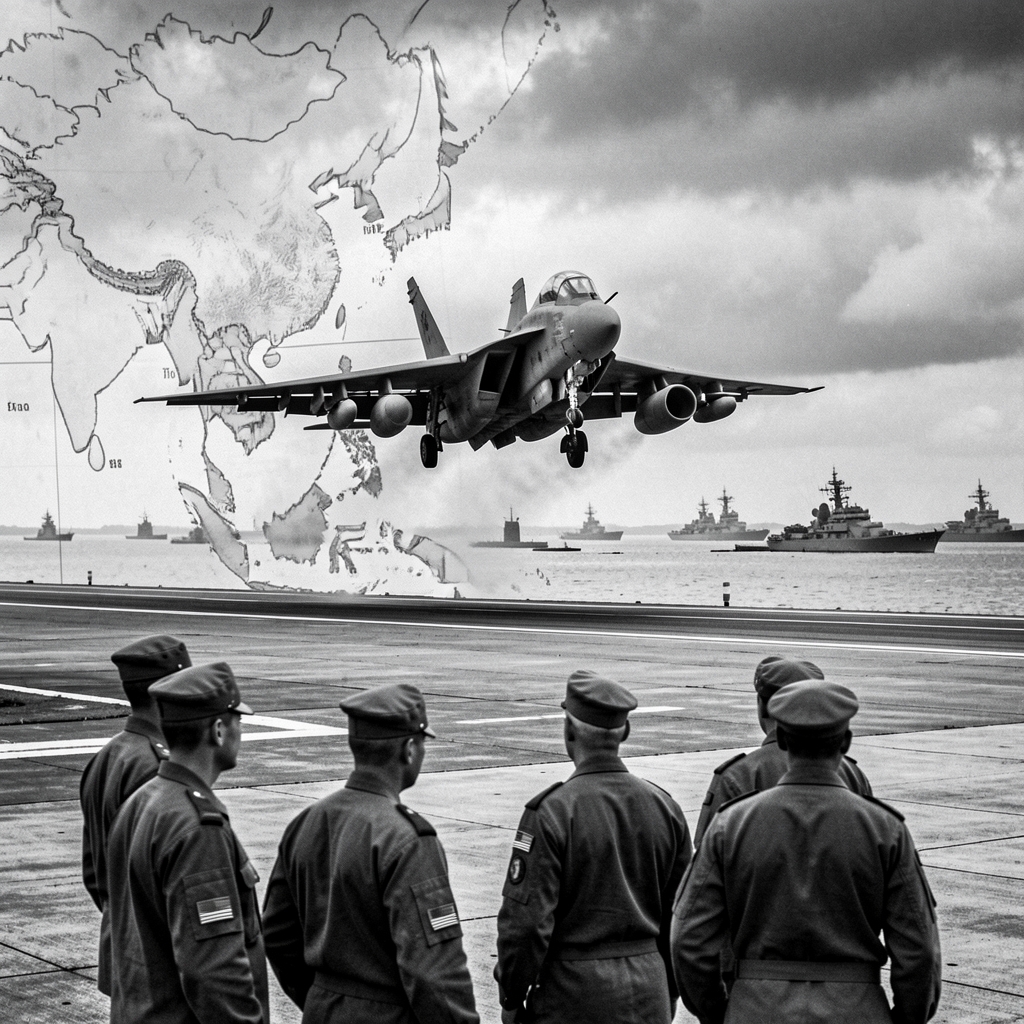
What do you do when a major military exercise between two treaty partners becomes both a reassurance and a potential provocation? That is the tension at the heart of the largest-ever Balikatan drills — a joint Philippines–United States exercise staged close to regional flashpoints — as U.S. officials, the reporting says, move to reassure Asian allies while an Iran war simmers thousands of miles away.
A drill described as the largest ever, staged near friction points
The exercise in question is presented by the reporting as the largest Balikatan to date, involving the Philippines and the United States and taking place close to regional flashpoints. The characterization “largest ever” signals scale, while the description “close to regional flashpoints” frames the drills not as routine training but as activity with immediate geographic and political sensitivity.
Why timing matters: a distant conflict puts local signaling under a microscope
The same report links the exercise’s timing to a broader geopolitical climate by noting that “with the Iran war simmering, U.S. officials will seek to reassure Asian allies that they remain a reliable and committed partner.” That sentence compresses two facts: a separate conflict is active elsewhere, and U.S. officials intend to use the exercises to send a message of reassurance to partners in Asia.
Putting large-scale joint training on display while another war simmers abroad changes the optics. Exercises that might otherwise be read as routine readiness drills can, in this environment, be interpreted through the prism of alliance signaling and crisis management. The report suggests U.S. officials see reassurance as an explicit objective.

This site is the portfolio.
OSINTSights runs on Cloudflare Workers, D1, R2, and Vectorize, with an AI pipeline on Hetzner ARM. Nubivance designed, built, and operates it. We do the same for clients.
See what we buildThe dual role of high-profile military exercises: training and messaging
Large joint exercises typically serve at least two purposes: operational readiness and strategic messaging. The report’s emphasis on both the scale of the Balikatan exercise and its proximity to flashpoints implies an intent to accomplish both simultaneously. Operationally, bigger drills can test logistics, command-and-control, and interoperability; strategically, their visibility sends signals to allies and to potential challengers.
Here, the reporting explicitly frames the exercises as part of a reassurance effort. That underscores the planners’ desire that partners interpret the activity as support and continuity rather than as escalation.
How different audiences may interpret the same activity
- Policymakers: For defense and diplomatic decisionmakers, the reporting suggests a calculus: use a large, visible exercise to demonstrate commitment, while calibrating language and posture to avoid creating unnecessary friction near volatile areas.
- Technologists and planners: Those concerned with the practicalities of modern exercises may see an emphasis on interoperability and systems integration implicit in a “largest ever” event, even though the report doesn’t enumerate specific capabilities.
- Local populations and users: Citizens near the drills’ locations may perceive reassurance or disruption depending on their proximity and the level of public communication accompanying the exercise — public messaging matters in shaping local interpretation.
- Adversaries and external observers: Parties watching from afar may interpret size and proximity to flashpoints as deterrence or as coercion; the report’s framing that U.S. officials seek to reassure allies indicates that Washington expects those messages to reach both partners and challengers.
Signaling versus escalation: a careful balancing act
The report implies a delicate balance. On one hand, a large joint exercise close to sensitive areas can reassure partners that commitments are tangible. On the other hand, visibility and scale can be read as a provocative show of force if accompanying diplomatic context is insufficient. According to the reporting, U.S. officials are explicitly attempting to craft reassurance — which implies an awareness of the potential for misperception.
This tension is not resolved simply by conducting the exercise; messaging, transparency, and diplomatic engagement before, during, and after the drills will condition how the activity is received. The report’s brief but pointed note that U.S. officials will seek to reassure allies frames those officials as actively managing the perception side of the operation.
Unstated variables and the limits of public reporting
The report provides two clear factual anchors — the scale and location of the exercise, and the expressed intention by U.S. officials to reassure Asian allies amid a simmering Iran war — but leaves other details unstated. It does not enumerate participating units, the duration of the drills, nor the specific flashpoints referenced. Those absences matter: they limit the public’s ability to assess the exercises’ operational scope and the precise contours of the reassurance being offered.
That opacity can be a deliberate choice. Too much public detail can complicate operational security; too little can increase the risk of misinterpretation. The reporting highlights the tension between transparency for reassurance and discretion for security.
What to watch next and why it matters
Observers, policymakers, and stakeholders should track several strands implied by the report’s facts. First is how U.S. officials articulate reassurance — whether through statements, bilateral engagements, or coordinated communications with partners. Second is the reaction of regional actors: do they publicly welcome the exercise as affirmation of commitment, or do they express concern about proximity to flashpoints? Third is whether the exercise’s scale and location alter regional security dynamics in measurable ways.
All of this matters because, as the report suggests, reassurance needs credibility. Conducting a large, visible exercise near contested or sensitive areas while an unrelated war smolders elsewhere transforms routine training into a diplomatic instrument. How that instrument is wielded will influence regional stability and perceptions of alliance cohesion.
In the end, the juxtaposition reported — the largest-ever Balikatan drills near flashpoints and a parallel effort by U.S. officials to reassure allies amid a distant war — raises a central question: can high-profile military demonstrations deliver reassurance without creating new risks of misperception? The answer will depend on the clarity of message, the care of execution, and the responses of partners and adversaries alike.