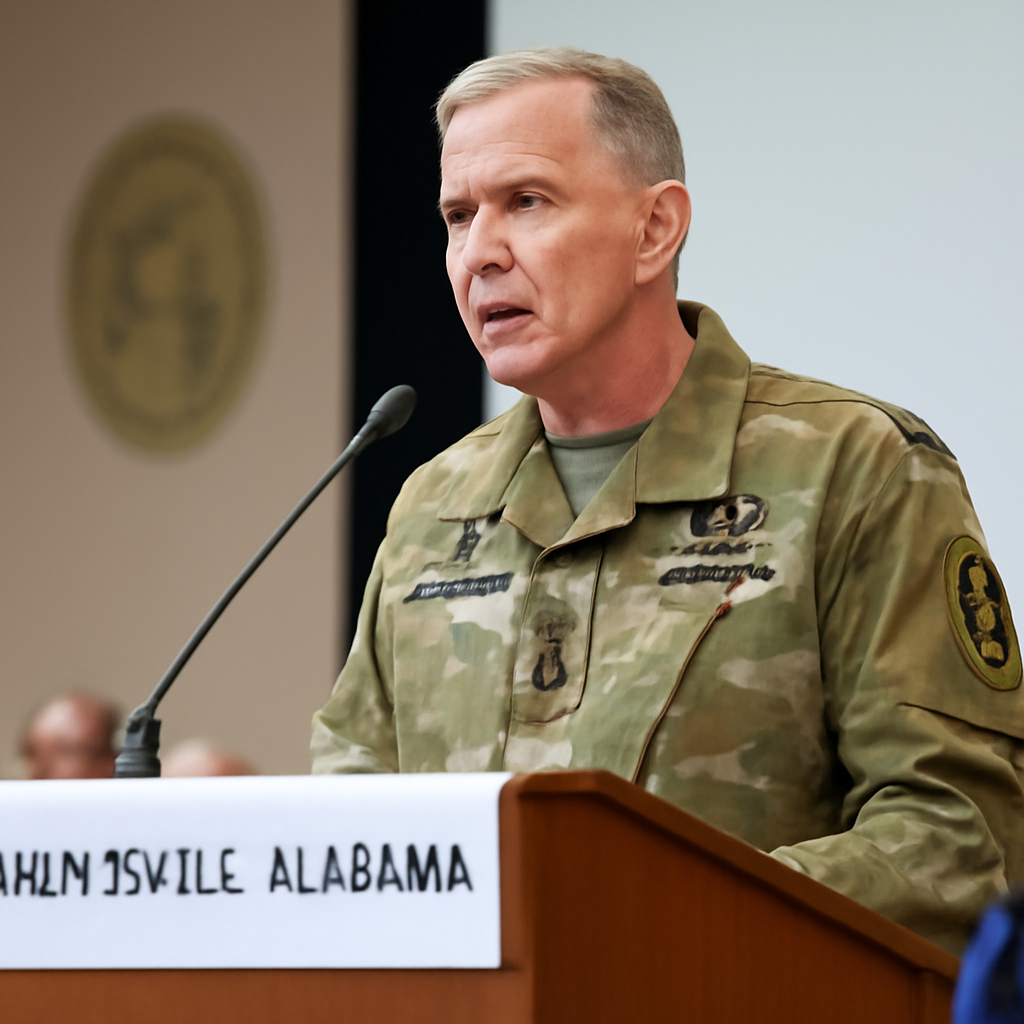
"Interceptors alone won't," Lt. Gen. John Rafferty told an audience in Huntsville, Ala., as he laid out the need for what he called a "comprehensive missile defeat strategy."
Lt. Gen. John Rafferty: a broader approach than more interceptors
Speaking this morning at the annual symposium in Huntsville, Ala., Lt. Gen. John Rafferty, who assumed command of Army Space and Missile Defense Command (SMDC) in late April, described "critical gaps" in the air defense arena that go beyond simple stockpile counts. Rafferty said the Army must emphasize not only "magazine depth" and "cheaper and a wide-ranging mix of interceptors," but also "non-kinetic effects, both electronic warfare and directed energy," and improvements in "the type of targeting in C2 [command and control] enabled by that data strategy."
Magazine depth and interceptor counts
Rafferty framed his remarks against a backdrop of stressed air defense inventories. The Center for Strategic and International Studies (CSIS) reported that there were approximately 2,330 Patriot interceptors in the U.S. inventory before the conflict started and that those numbers had fallen to roughly 759 to 827 by the time of CSIS’s recent accounting. CSIS also estimated approximately 452 THAAD interceptors in late February, with those stocks dropping to between 234 and 278 by the end of July. The general did not cite those figures directly today, but he tied operational strain to the broader demand on the force.

Audit-ready is a season. It shouldn't be.
Evidence in spreadsheets, controls drifting between audits, frameworks multiplying on flat headcount. Nubivance runs continuous compliance on Rapid7 Cyber GRC - SOC 2, HIPAA, ISO 27001, PCI, CMMC.
End the scrambleNon-kinetic effects, data-enabled C2, and cross-domain solutions
"We need a more comprehensive missile defeat strategy that focuses on interceptors, [but also] equally so on non-kinetic effects, both electronic warfare and directed energy," Rafferty said, adding that this must be paired with "the type of targeting in C2 enabled by that data strategy, and a cross-domain solution ... that will enable us to use that data to make decisions to engage targets faster." In his account, capability integration and faster decision-making are as critical as increasing the number of interceptors.
Operational pressure on training, readiness, and modernization
Rafferty warned the current demand is squeezing time for preparation. "You’ve got less time to train and prepare, and test," he said, and described being "challenged to complete our modernization path because of the demand on the force." He added, "Clearly, this places … a huge strain on soldier readiness and unit readiness," linking inventory pressures and sustained operations to broader impacts on force health and future capability development.
What this means for policymakers, soldiers, and procurement leaders
- Policymakers and planners: Rafferty’s framing places a premium on decisions that balance replenishing magazine depth with investment in cheaper interceptors and non-kinetic systems, and on shaping a data strategy that supports faster C2 targeting decisions.
- Soldiers and units: The general’s comments underscore shorter training windows and elevated demand, with direct effects on "soldier readiness and unit readiness" as operations continue to pull assets and time away from scheduled modernization and testing.
- Procurement leaders: The call for "cheaper and a wide-ranging mix of interceptors" and expanded non-kinetic options points to contracting and acquisition choices that will need to address both quantity (magazine depth) and diversity of effects (EW, directed energy, and integrated C2).
Rafferty made his remarks nearly six months after the U.S. and Israel launched a wide-scale attack on Iran, a campaign that, the general and other analysts say, has produced "fits and starts" and is stressing air defense forces. The Trump administration has publicly sought to downplay concerns about U.S. stockpiles and has threatened to "hunt down" leakers sharing information about dwindling munitions inventories, according to reporting cited by CSIS and noted in coverage of recent weeks.
Rafferty’s prescription is straightforward in tone if complex in execution: rebuild magazine depth, procure cheaper interceptors to widen capacity, and invest in non-kinetic systems and data-enabled C2 so that decision-making and cross-domain engagement can keep pace with threats. How the Army will translate that mix into procurement schedules, training cycles, and fielded capability remains the central operational question left by today’s public remarks.