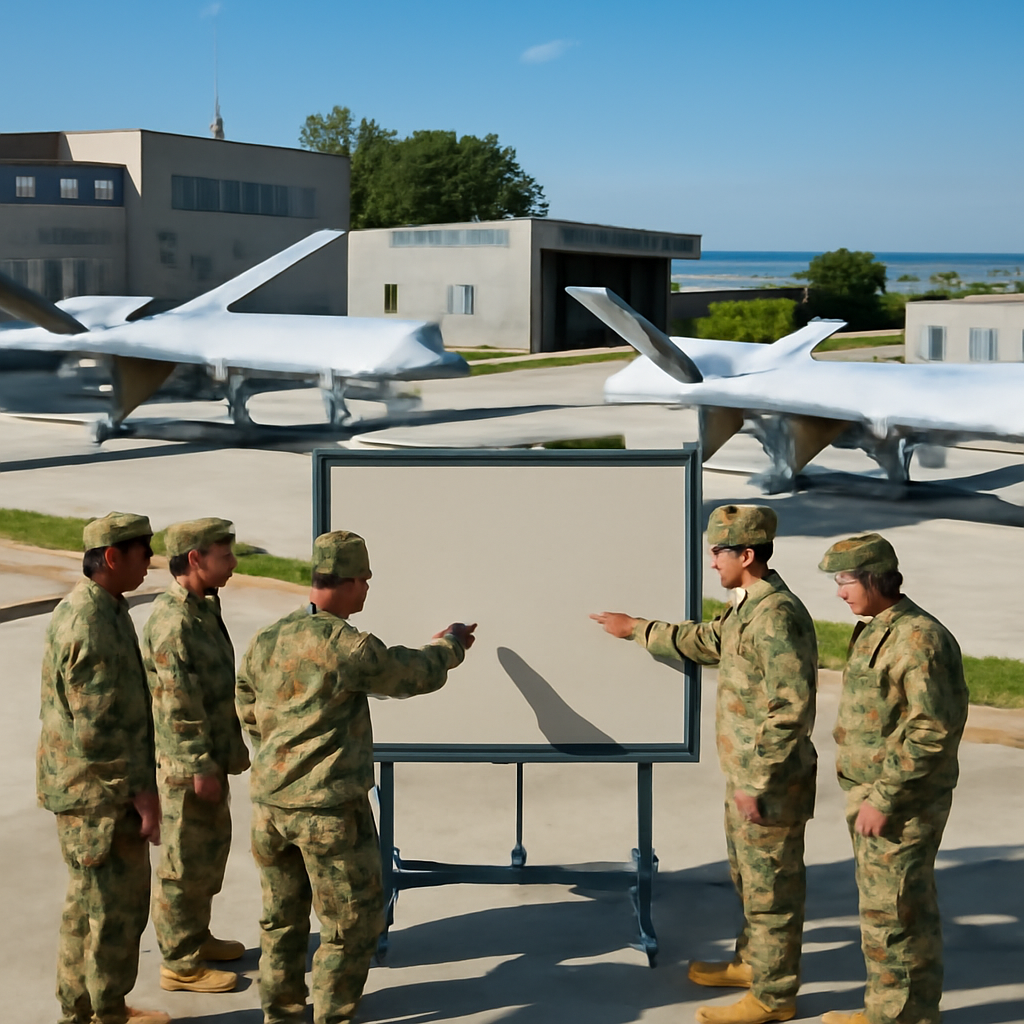
“We have learned, particularly looking at Ukraine, there really is no sanctuary area that is protected from observation and potential targeting,” Maj. Gen. Bernard J. Harrington said as he outlined a new U.S. Army unit that will fuse maneuver formations with layered drone and multi-domain effects.
What 7th Infantry Division Multi-Domain Command – Pacific is
The unit — called the 7th Infantry Division Multi-Domain Command – Pacific (7th ID MDC-PAC) — stood up on Thursday under U.S. Army Pacific (USARPAC). Headquartered at Joint Base Lewis-McChord in Washington, it merges the 7th Infantry Division and the 1st Multi-Domain Task Force (MDTF). The intent, as described by commanders at a media roundtable, is to combine the maneuver capabilities of the 7th ID’s two Stryker brigades with the MDTF’s long‑range sensing, fires, cyber, space, electronic warfare, and information capabilities to operate inside anti‑access/area denial environments in the Pacific.
Maj. Gen. Bernard J. Harrington on drone volume and AI-enabled C2
Harrington said he wants the command to “saturate any future adversary with so many drones they have trouble operating.” He described a concept that pairs a wide family of drones — “not just traditional sense‑and‑strike drones” — with an “adaptive and agentic C2 [command and control system]” that can move data, reposition sensors, and match targets to shooters without requiring human approval for every step.
Harrington explicitly characterized the system as “soldier‑on‑the‑loop, not in‑the‑loop,” meaning a human would monitor and retain the ability to override the system’s actions rather than manually approving each automated decision.

Audit-ready is a season. It shouldn't be.
Evidence in spreadsheets, controls drifting between audits, frameworks multiplying on flat headcount. Nubivance runs continuous compliance on Rapid7 Cyber GRC - SOC 2, HIPAA, ISO 27001, PCI, CMMC.
End the scrambleDecoys, electronic warfare, and lessons from recent conflicts
Drawing lessons from Ukraine and conflicts in the Middle East, Harrington emphasized the utility of decoy drones to “confuse and potentially deceive an adversary” and to “deplete potential magazine depth.” The narrative cites how Russian forces used decoys to provoke and exhaust Ukrainian air‑defense interceptors, and how Ukraine responded with its own decoys. The report also references a Jan. 16, 2025, tweet describing a Parodiya decoy drone that overflew Kyiv and triggered an air‑defense response.
Harrington added that electronic warfare drones will be used “to help isolate, and then enable other drones to be effective,” underscoring a vision of paired roles within a family of systems: sensors, decoys, electronic warfare platforms, and long‑range one‑way attack systems working together to get “sensor to shooter most effectively.”
Fielding, vendors, and examples in use
Officials declined to list specific airframes the new command plans to field, though the story includes imagery and examples of systems being handled by soldiers: a PDW C100 multi‑mission small UAS, a Kraus Hamdani Aerospace K1000 Ultra Long‑Endurance solar‑powered UAS, and an Archer Block 1, hotel variant, one‑way 8‑inch FPV drone. Harrington noted close cooperation with multiple vendors to close the gap between sensing range and engagement range, and the story references U.S. Central Command’s recent use of Low‑Cost Uncrewed Combat Attack System (LUCAS) kamikaze drones — a design the piece describes as reverse‑engineered from the Iranian Shahed‑136 — in the war against Iran.
Operational constraints across the Pacific and force posture
Gen. Ronald Clark, the USARPAC commander, framed the operational problem in geographic terms: troops will need different drones and employment techniques for “Arctic steppe in Alaska,” jungle environments in Hawaii or Malaysia, and deserts in the Australian Outback. Clark also illustrated the distances involved by asking listeners to imagine a 2,000‑nautical‑mile box starting in Cambodia and extending to the Philippines, Indonesia and Malaysia — roughly comparable, he said, to a box over Western Europe from the UK to Finland to Turkey to Spain.
What this means for troops, allies and adversaries
- Troops and unit leaders: commanders intend to put drones into soldiers’ hands across varied Pacific environments so novices and experienced troopers can test what works and what does not, relying on frontline feedback because, as Gen. Clark said, “their buddies’ lives depend on it.”
- Allies and partners: Maj. Gen. James (Jay) Bartholomees told AUSA last year the capability needs fast development and testing “in our region; we also need to work with our allies and partners to do the same,” signaling coordination will be a part of fielding and exercises.
- Adversaries and defense planners: the report flags concern about foreign investments in low‑end drone warfare and the capacity to mass‑produce drones rapidly on a large scale. U.S. leaders quoted in the piece say the Army is “behind on long‑range sensing and long‑range launched‑effect strike” and needs to build that capability quickly.
7th ID MDC‑PAC is essentially only a day old, and the Army’s commanders acknowledge a long runway ahead: commanders have not specified exactly which drones the division will seek, how many are needed, or the procurement timelines. The initial steps are clear — fuse maneuver brigades with multi‑domain sensors and automated C2, get systems into soldiers’ hands across the Pacific’s varied environments, and test whether volume, deception, and paired electronic warfare can achieve the “overwhelm” leaders envision.