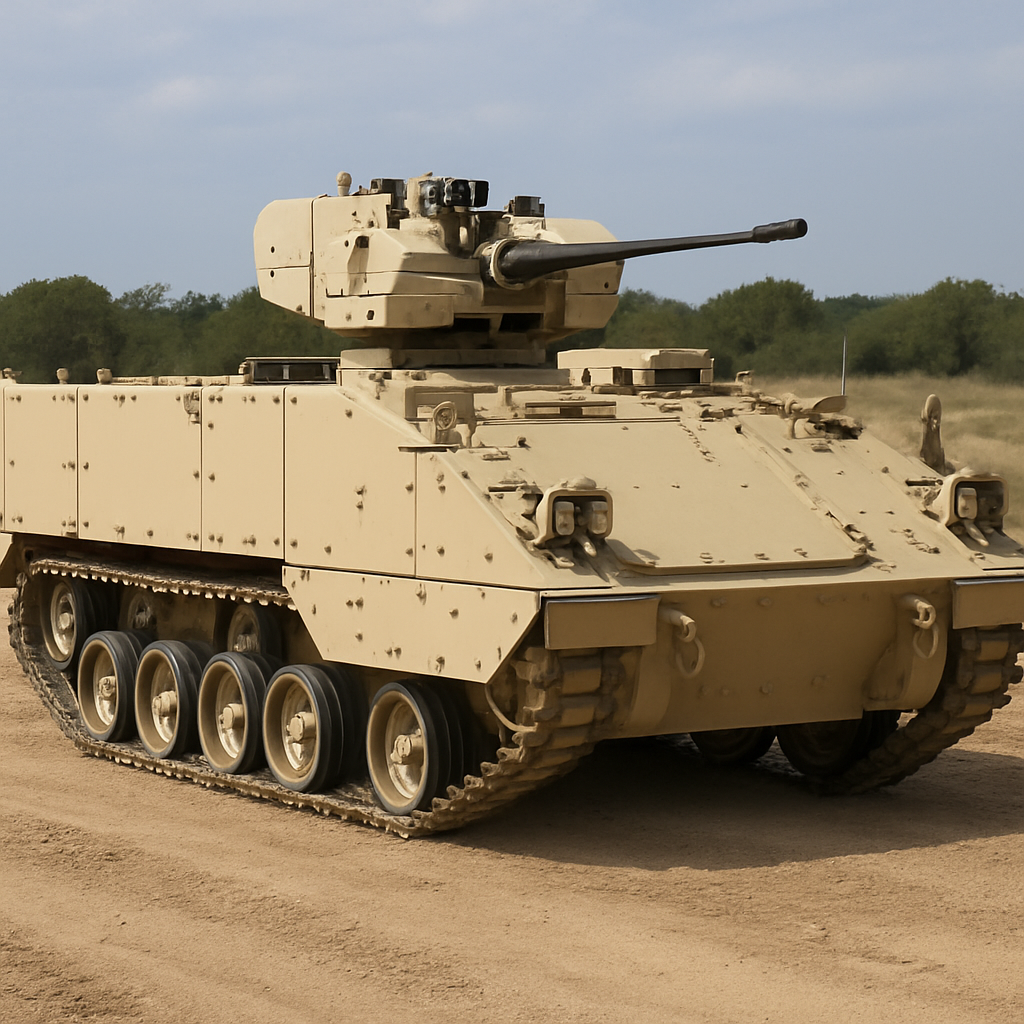
"Big news! The 1st Cavalry Division has just received the Army’s FIRST AMPV 30mm prototypes," the unit posted on X on April 30 — a line that set off a wave of headlines and social sharing. The reality, clarified by both the U.S. Army and BAE Systems, is more prosaic: two company-funded prototype vehicles arrived at Fort Hood this week for testing, not an Army purchase or an immediate change to its fleet.
What the 1st Cavalry showed and what the pictures said
The 1st Cavalry Division shared photos and a caption distributed via the Defense Visual Information Distribution Service describing "a remote 30mm turret capable of using programmable airburst ammunition, designed to target small drones and unarmored ground threats." Those images and the initial post generated widespread impressions that a newly armed AMPV variant had entered service.
Army and BAE Systems: prototypes for testing, not procurement
An Army spokesperson told TWZ the vehicles are "an internal research and development type effort from BAE Systems" and "it is not something the Army procured, nor is there a requirement for the system at this time." BAE Systems confirmed it "provided two prototype AMPV 30s to the U.S. Army to participate in the upcoming Transformation in Contact (TiC) 2.0 initiative." The company said the vehicles were developed through self-investment and will be run through field evaluations "over the next several months" to benchmark capabilities against soldier requirements.

This site is the portfolio.
OSINTSights runs on Cloudflare Workers, D1, R2, and Vectorize, with an AI pipeline on Hetzner ARM. Nubivance designed, built, and operates it. We do the same for clients.
See what we buildTechnical fit: the MCT-30 turret, Mk 44 cannon, and ExMEP
BAE confirmed the turret fitted to these prototypes is the Medium Caliber Turret-30 (MCT-30) from Kongsberg Defense. The MCT-30 is a remotely operated design carrying a Mk 44 Bushmaster II automatic cannon and a fire-control suite with electro-optical and infrared cameras. BAE has also promoted an External Mission Equipment Package (ExMEP) — a top plate intended to allow the relatively rapid integration of various turrets — and has said ExMEP can accommodate "more than 30 turret systems."
How the AMPV 30 relates to existing and prior AMPV work
The Armored Multi-Purpose Vehicle (AMPV) was selected in 2014 as the Bradley-based replacement for the M113 family. The Army's current program of record includes five turretless AMPV variants: the M1283 general-purpose personnel carrier, the M1284 medical evacuation vehicle, the M1285 medical treatment vehicle, the M1286 command and control version, and the M1287 mortar carrier vehicle. BAE has previously delivered other turreted AMPV prototypes for evaluation — including a 2024 AMPV fitted with a NEMO 120mm rapid-firing mortar (supplied by Patria and Kongsberg) and a 2024 public showing of an AMPV with an MCT-30 plus a Javelin anti-tank guided missile launcher.
What this means for the 1st Cavalry, BAE Systems, and the Army
- 1st Cavalry Division: The unit will host the prototypes and allow soldiers to assess how a turreted AMPV operates in a formation already using Bradley-derived vehicles, per the delivery and photos at Fort Hood.
- BAE Systems: If evaluations go well, a positive Army assessment could be a marketing boon; the company emphasized speed, innovation, and cost-efficiency in developing the prototypes and integrating the MCT-30.
- The Army: Officials will run the AMPV 30s through TIC 2.0 field evaluations to "benchmark the platform's capabilities against what Soldiers require." The Army has explicitly stated there is currently no requirement and no plan to procure this AMPV variant.
Context inside Army modernization: counter-drone missions and the XM30 program
One stated use case for the AMPV 30 is countering small drones; the prototype's programmable airburst ammunition and remote sensors are cited to address that threat. The service historically had the M6 Linebacker air-defense Bradley variant, which used Stinger missiles and was later converted into standard Bradleys in the mid-2000s; the Army did not acquire a direct replacement. Separately, the Army is pursuing a Bradley replacement tentatively designated the XM30, to be armed with a 50mm cannon. Designs from American Rheinmetall and General Dynamics Land Systems have competed for XM30, but a program pause and a new request for information earlier this year "have raised questions about the XM30’s overall future." If those plans change, the Army could reassess how turreted AMPVs fit into force structure.
For now, the record is clear on two points: BAE Systems invested in and delivered two AMPV 30 prototypes, and the Army will test them as part of Transformation in Contact 2.0. But, as the service and contractor repeat, the delivery does not equal procurement — the Army has no current requirement for, nor plans to buy, the AMPV 30.