"The agreement provides for the accelerated delivery of six prototype MTC systems, with an option for an additional 12," the U.S. Army said in its announcement, marking a notable step toward replacing the service's towed 155mm M777 howitzers with a new wheeled design.
Hanwha Defense USA and the K9 Mobile Howitzer
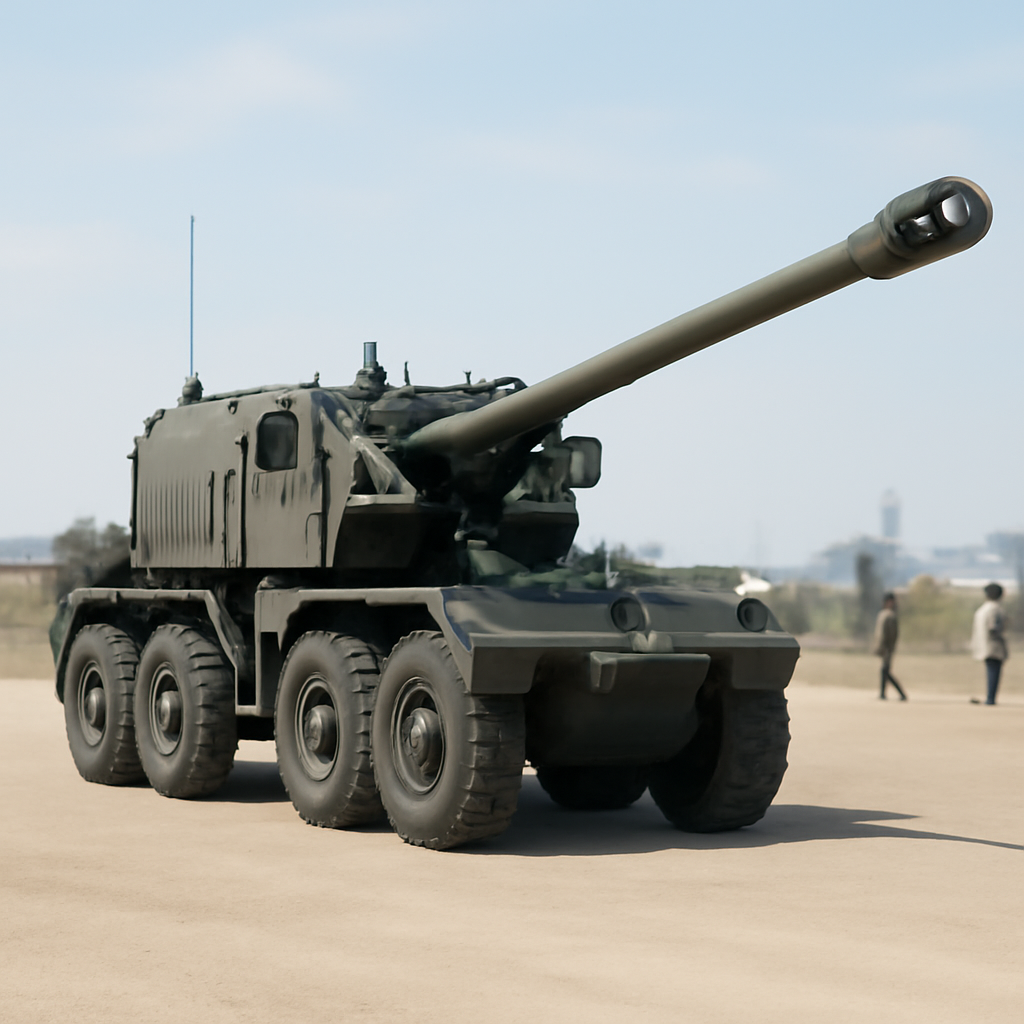
The Army selected Hanwha Defense USA, Arlington, Virginia, to develop prototypes under the Mobile Tactical Cannon (MTC) program. While the Army's release did not explicitly name the model, Hanwha confirmed in its own statement that it will supply its wheeled 155mm K9 Mobile Howitzer (K9MH), also referred to as the K9A2. Hanwha says it will build a U.S.-anchored manufacturing network with Opelika, Alabama, as the current phase I launch point.
The Army's MTC agreement: scope, schedule, and cost
The award was made competitively under an Other Transaction Authority (10 U.S.C. Section 4022) as a firm-fixed-price agreement that will provide up to 18 wheeled self-propelled howitzer systems for rapid prototyping, testing, and Soldier experimentation. The action obligates $100,302,961 now, with a total cumulative face value of $262,903,274, and covers an estimated four-year period of performance. Hanwha will deliver six prototype systems initially, with options to add 12 more for operational experiments.

Audit-ready is a season. It shouldn't be.
Evidence in spreadsheets, controls drifting between audits, frameworks multiplying on flat headcount. Nubivance runs continuous compliance on Rapid7 Cyber GRC - SOC 2, HIPAA, ISO 27001, PCI, CMMC.
End the scrambleCapabilities claimed for the K9MH: range, mobility, and sustainment
Both the tracked and wheeled K9 variants share a 52‑caliber 155mm cannon; the report notes a 52‑caliber 155mm barrel is just under 26½ feet long. By contrast, the M777’s barrel measures 39 calibers, or about 16.7 feet. Hanwha states the K9MH has a maximum range of just over 37 miles (60 kilometers), although the company acknowledges it is unclear whether that figure assumes rocket‑assisted or other specialized ammunition. The M777’s stated maximum range, even when using specialized rounds, is just under 20 miles.
As a wheeled self‑propelled design, the 8×8 K9MH integrates mobility and ammunition carriage. Hanwha’s website claims emplacement/displacement times under 30 seconds to enable “shoot and scoot” tactics, and the vehicle can carry 40 rounds onboard. The K9MH can be rapidly reloaded in the field via a companion K10 resupply vehicle.
Program context: SPH‑M, MTC focus, and past efforts (XM1299, XM2001 Crusader)
MTC is part of the broader Self‑Propelled Howitzer‑Modernization (SPH‑M) effort and focuses on replacing the towed M777 in select formations. The Army has pursued wheeled self‑propelled howitzers since at least 2019 and has held prior shoot‑offs of competing designs. Other firms that had been in the running for MTC include American Rheinmetall, BAE Systems, General Dynamics Land Systems, and Elbit Systems USA.
The Army has a history of abortive tracked howitzer efforts: the XM2001 Crusader program was canceled in 2002 amid rising costs, and the more recent XM1299—developed under the Extended Range Cannon Artillery (ECRA) effort—was axed in 2024. The XM1299 featured a 58‑caliber cannon and had a demonstrated range of 40 miles (just over 60 kilometers); the Army previously said barrel length presented technical challenges contributing to that program’s cancellation.
What this means for the U.S. Army, Hanwha Defense USA, and allied operators
- U.S. Army: The service will use soldier‑centred, experiment‑driven testing to assess performance, reliability, and supportability. The Army cautioned that advancing Hanwha’s prototypes to testing does not guarantee fielding; “data and insights gained from these experiments will directly inform senior leaders’ decisions on future fielding,” the release said. Initial contracting notices indicate the first focus is on replacing M777s in Brigade Combat Teams equipped with Stryker wheeled vehicles, though other towed‑howitzer formations such as airborne, airmobile, and foot infantry brigades operate M777s as well.
- Hanwha Defense USA: The award gives Hanwha a potential inroad into the U.S. market and the chance to localize production. Jason Pak, Hanwha Defense USA Head of Land Systems‑Artillery, said the company was “focused on creating a U.S.‑anchored K9 Mobile Howitzer manufacturing network,” and CEO Michael Coulter described localization as “central to Hanwha’s global business model.”
- Allied and export customers: The K9 family has seen wide international adoption—variants and derivatives are already in service in South Korea, Australia, Egypt, Estonia, Finland, India, Norway, Poland, and Turkey—and Poland has been singled out as a major customer. Progress in the Army’s MTC program could therefore be a significant export milestone for South Korea’s defense industry.
Secretary of the Army Dan Driscoll has framed the debate over tracked versus wheeled systems in blunt operational terms. At a House Appropriations Committee hearing earlier this year, he said, “If you look at the [fight] in Ukraine on either side, it’s really hard to move out and get fires ready to go. … The Paladin is just incapable of it at speed,” comments he made while defending the budget omission of additional M109A7 funding for Fiscal Year 2027.
The Army’s award to Hanwha advances a concrete, near‑term experiment: up to 18 wheeled 155mm systems will be prototyped, pushed into Soldier experiments, and evaluated over roughly four years. The decision is deliberate: it leaves options open, centers soldier feedback, and makes clear that final fielding will hinge on the data those experiments produce.