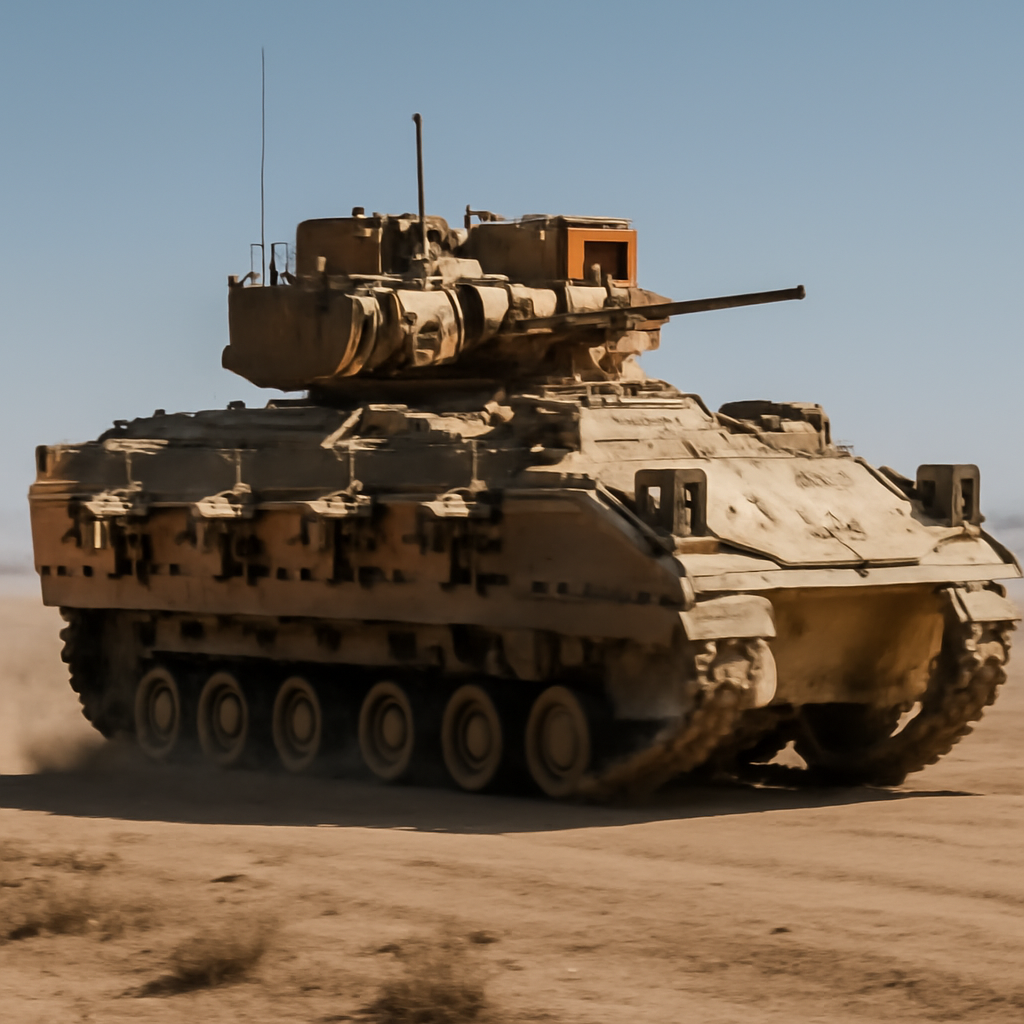
“Weighing around 27 kg, FireAnt is a low-cost attritable robotic system designed for AI-enabled swarm operations,” Swarmbotics AI said — and a U.S. Army M2A4 Bradley Infantry Fighting Vehicle was recently filmed carrying five of those vehicles on its side storage racks during a 1st Cavalry Division test exercise.
What was seen at Pegasus Charge 3
Swarmbotics AI posted a video on its LinkedIn page yesterday showing a Bradley loaded with five FireAnt uncrewed ground vehicles (UGVs) attached to the vehicle’s side. The footage, visually confirmed by a user on X identified as @lfx160219 and highlighted by TWZ, was taken during Pegasus Charge 3 — the third iteration of a 1st Cavalry Division-led test exercise tied to the Army’s Transformation In Contact (TiC) modernization initiative.
FireAnt: configurations, weight, and claimed autonomy
Swarmbotics AI describes FireAnt as “a low-cost attritable robotic system” that can be configured for multiple missions. The company’s February press release and previous public material outline modular payloads for reconnaissance and surveillance, electronic warfare, signal relay, counter-drone roles, and an anti-armor option armed with an explosively formed penetrator (EFP) warhead. The firm’s materials state the platform “weighing around 27 kg,” while TWZ’s item refers to the UGVs as “roughly 70-pound FireAnts.”

This site is the portfolio.
OSINTSights runs on Cloudflare Workers, D1, R2, and Vectorize, with an AI pipeline on Hetzner ARM. Nubivance designed, built, and operates it. We do the same for clients.
See what we buildHow control, deployment, and teaming were characterized
Swarmbotics AI has said human operators direct groups of FireAnts, and the company’s February release noted a squad-sized Army unit operated 10 FireAnts during the xTech Overwatch competition. The firm also emphasizes a “significant degree of artificial intelligence (AI) driven autonomy,” and that when networked in a swarm the UGVs are capable of “coordinated behavior across mixed teams and missions.”
From the Pegasus Charge 3 video it is unclear whether the Bradley released FireAnts remotely from inside the vehicle or whether personnel unloaded them manually. The side storage area where the UGVs are shown stowed is commonly occupied by explosive reactive armor (ERA) blocks on Bradleys; the article notes a Bradley could also carry FireAnts internally and deploy them via the rear ramp. TWZ also cites prior Army testing that demonstrated Bradleys functioning as forward control nodes for UGVs and other experiments where FireAnts were deployed from larger UGVs.
How Swarmbotics AI and the Army have positioned the program
Swarmbotics AI announced in February that the Army selected the company “to build swarming, attritable, small unmanned ground vehicles (sUGVs) to advance Transformation in Contact (TiC) with the 1st Cavalry Division,” a decision the company said resulted from participation in the xTech Overwatch competition. xTech is an in-house Army technology accelerator that runs innovation challenges to surface capabilities of interest; Swarmbotics AI’s February release said the evaluation process was facilitated by T2COM (the Army’s Transformation and Training Command) and “key stakeholders.”
Company leadership framed the approach in mass and cost terms: Stephen Houghton, Swarmbotics AI’s CEO, said in the February statement, “Mass is our objective, by employing swarms of heterogeneous small sUGVs [small UGVs] we create multiple dilemmas for our adversaries at fractions of the cost of exquisite platforms.” Drew Watson, the company CTO, added that “robot swarms are here to stay” and that work with the 1st Cavalry in 2026 would “baseline concepts for hundreds of robots deployed on the X and at the breach.”
What this means for soldiers, procurement, and adversaries
- Soldiers and tactical units: Units assigned to the 1st Cavalry Division have been testing and evaluating these capabilities through Pegasus Charge events; the demonstrated ability for Bradleys to carry and potentially control small UGVs could move robotic teammates closer to the front and permit handoffs between crewed and uncrewed nodes.
- Procurement and program managers: The selection via xTech Overwatch and the involvement of T2COM indicate an acquisition pathway that blends competition and rapid evaluation. Modular payloads and attritable cost arguments are central to how Swarmbotics AI pitches FireAnt for broader adoption.
- Adversaries and electronic warfare planners: Swarmbotics AI highlights sensor and electronic warfare payloads as potential functions, and TWZ notes that on contemporary battlefields small UGVs face the same EW threats as aerial systems — a dynamic that has already prompted hardened designs such as fiber-optic control links in other conflicts.
UGVs similar in size to FireAnt have already appeared in the ongoing conflict in Ukraine, deployed in kamikaze configurations and as larger systems carrying missiles, grenades, or machine guns; TWZ pointed to their visibility in a recent Independence Day parade in Kyiv. Those operational examples underscore why swarming small ground robots — whether for ISR, signal relay, or one-way attack roles — are getting renewed attention in U.S. testing.
The image of an M2A4 Bradley bearing a load of FireAnts at Pegasus Charge 3 is, in the words TWZ cited, “a sign of things to come.” How FireAnt specifically will be integrated into the Army’s force structure, how these systems will be released and controlled from crewed vehicles in contested environments, and how doctrine and defenses will adapt remain explicit, recorded follow-ups from the tests themselves.