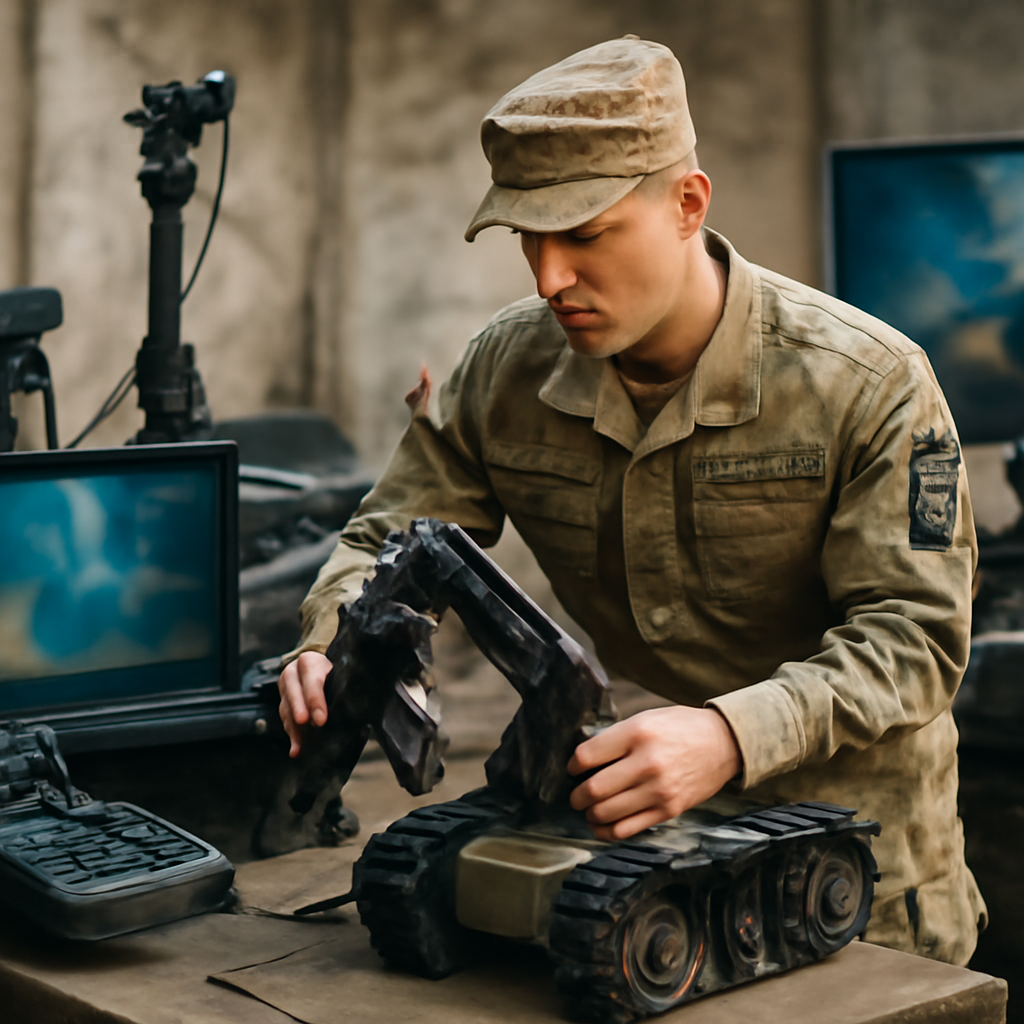
“It's important that it's not a pilot. We're not building a pilot. What we're building is a soldier that can adapt a piece of robotic kit to the mission, to the enemy, to the terrain,” Maj. Gen. Jason Slider said, capturing the Army’s shift from remote control toward on-the-ground adaptation.
What the 390A robotics technician role actually is
On Oct. 2, 10 warrant officers became the Army’s first robotics technicians under the new 390A military occupational specialty. Army leaders described the role as intentionally broader than traditional drone piloting or maintenance. Chief Warrant Officer 5 Michael Updike, one of the architects of the program, said the specialty “will include aspects of intelligence analysis, command and control, communications, software development under extremely difficult and disconnected conditions, and even acquisition.”
Updike summarized the breadth this way: “What it encompasses is different pillars of not only software engineering and mechanical engineering but your data science, understanding research and development.” He added that technicians will have to innovate “in the field without…large-language models that are connected to the internet.”
Training designed to force adaptation — and failure
The 390A course is a 19-week program at the U.S. Army John F. Kennedy Special Warfare Center and School at Fort Bragg. Slider told an audience at a Defense One event on the sidelines of the AUSA annual conference that course designers intentionally “drive failure” to force students to reassess and iterate tactics and systems. When students began “outpacing the curriculum” four weeks in, Slider said he worked “with academics, sources, and international partners to make the course more difficult,” adding weeks until the culminating exercise aligned better with what the operational force needed.

Audit-ready is a season. It shouldn't be.
Evidence in spreadsheets, controls drifting between audits, frameworks multiplying on flat headcount. Nubivance runs continuous compliance on Rapid7 Cyber GRC - SOC 2, HIPAA, ISO 27001, PCI, CMMC.
End the scrambleField innovation: mesh networking under electronic attack
During the first phase of training, students tackled electromagnetic interference and jamming by reengineering hardware and software to preserve drone communications. Updike described an exercise in which trainees “took a high-definition, $1,000 camera, put it on this quadcopter. They were being jammed in frequencies but they were using a mesh network. So, even though one node was taken out, they had multiple nodes where they could still have communications with the quadcopter or the unmanned drone to be able to still accomplish that mission.”
The example anchors the program’s emphasis on improvised, resilient solutions that combine modest commercial components with tactical networking techniques rather than relying on a single, high-end system.
Lessons drawn from Nagorno-Karabakh and recent Middle East operations
Slider said the program’s doctrinal approach grew from observations of recent conflicts. He cited Nagorno-Karabakh and Ukraine and said the school is “studying the ongoing conflicts in the Middle East.” The 2021 Center for Army Lessons Learned report described an Azerbaijani tactic in Nagorno-Karabakh where “remotely piloted Soviet-era AN-2 biplanes flew at low altitudes as decoys to force the Armenians to respond against the perceived threat,” a use of remotely piloted platforms for surprise and confusion rather than a narrow strike role.
Slider also noted the United States used a similar approach “in the Middle East at the outset of Operation Epic Fury earlier this year, swarming Iranian forces with cheap drones modeled after the Shahed drones that Iran was using against U.S. forces.” Both examples were cited to underline the advantage of deploying autonomy and semiautonomy in ways adversaries do not anticipate.
What this means for Special Operations, acquisition teams, and operational commanders
- Special Operations units: The new specialty is starting at Fort Bragg and within special warfare institutions but was designed with exportability in mind; Slider and course architects are building trainers and doctrine that respond to operational requests from the field.
- Acquisition and contractor partners: Updike noted robotics technicians will need to “do all that innovation in the field” and “work with contractors who can do so as well,” signaling closer, faster collaboration between operators and vendors on modular fixes and software adjustments.
- Operational commanders: The program’s emphasis on mesh networking, disconnected software development, and multidisciplinary skills suggests commanders can expect technicians who will adapt off-the-shelf gear and local networks to contested electromagnetic and communications environments.
Expansion beyond special forces and next institutional steps
Acting Army Secretary Adam Telle addressed the specialty’s future, noting that historically similar military occupational specialties “might live at — with the special forces and never be proliferated throughout the Army.” He said his office was “working with the office responsible for special operations and low-intensity conflict to expand the specialty” but did not provide further details about timelines or scope.
The Army’s immediate next steps are concrete: field a cadre that can fuse software, mechanical fixes, and operational tradecraft; refine a curriculum that can keep pace with learners who “outpace” the instruction; and, as Telle signaled, decide how and when to proliferate those skills beyond special warfare units. The 390A experiment is therefore as much about institutional learning as it is about individual training — building soldiers who can improvisationally adapt robotics on the battlefield and then teaching the rest of the force how to do the same.