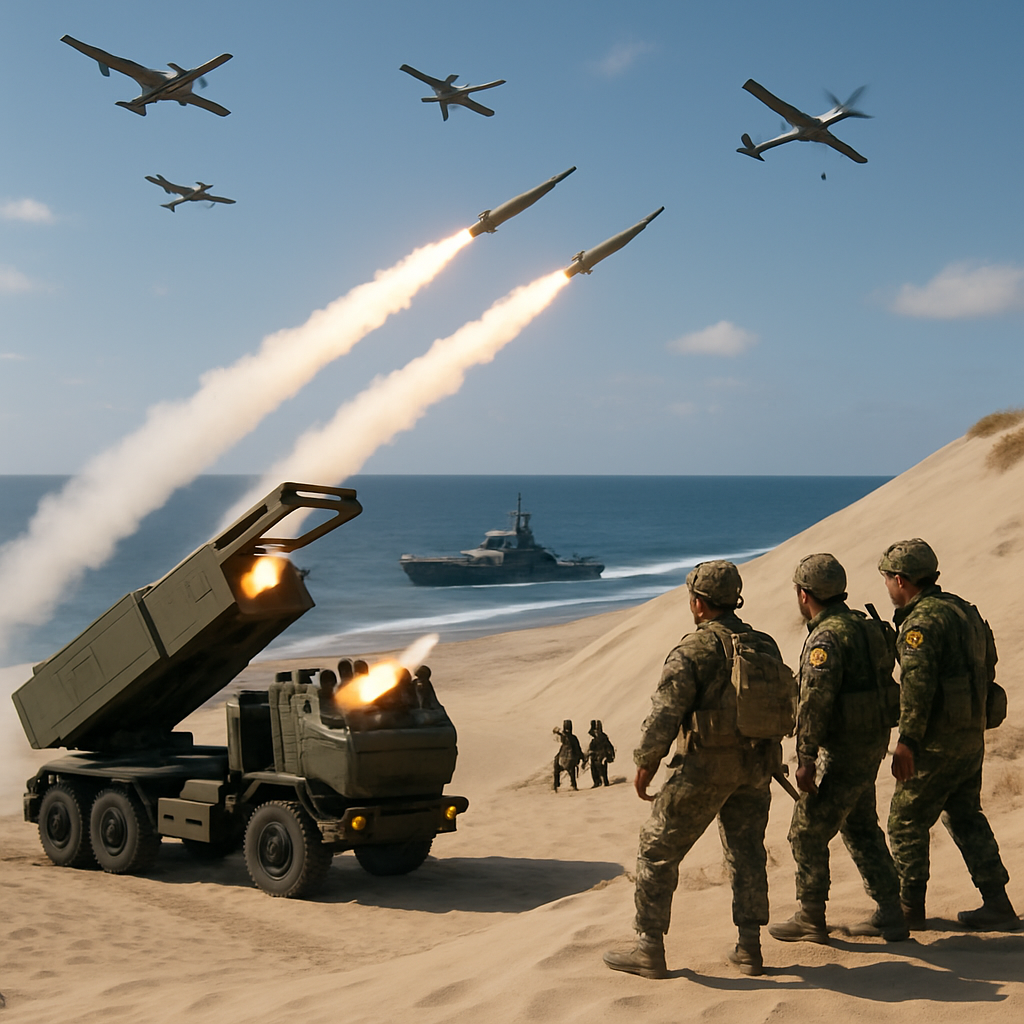
"This is the modernization of our Army. This is the modernization of joint forces. This is how we prevail in the Pacific under Adm. [Samuel] Paparo’s vision," Maj. Gen. James Bartholomees said as rockets and drones cut through the air over La Paz Sand Dunes.
La Paz Sand Dunes: counter-landing live-fire at Balikatan
At La Paz Sand Dunes, near LAOAG in the Philippines and “less than 400 miles from the southern tip of Taiwan,” American, Filipino, and Japanese soldiers watched a staged amphibious assault unfold. A camouflage-painted unmanned vessel moved through the South China Sea toward the shore while drones buzzed ahead; nearby, two rockets fired from HIMARS launchers concealed in sand dunes toward simulated enemy warships in deep water. Automatic weapons and rifles engaged targets in the shallows while longer‑range munitions produced sprays of sea water and billowing gray smoke farther out.
25th Infantry Division's new systems: HIMARS, Stalker, Lightning Lab drones
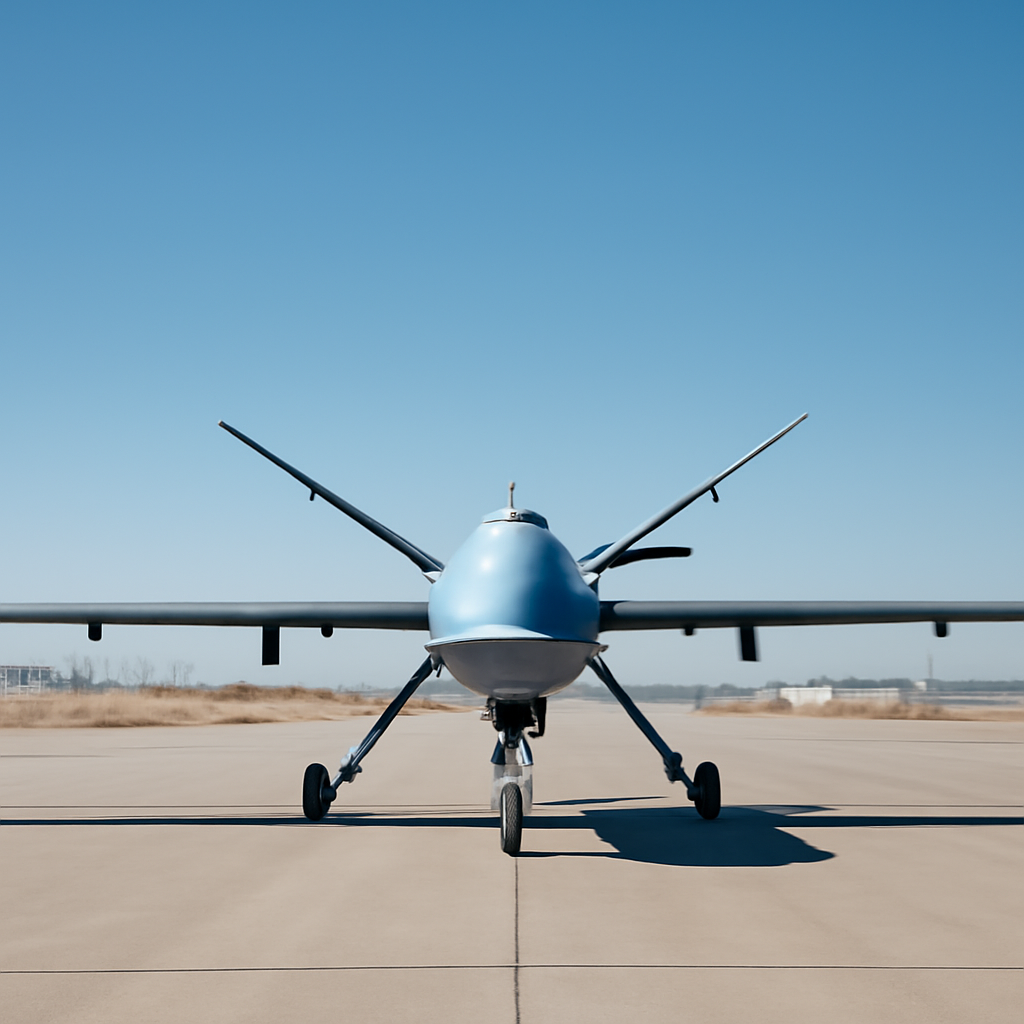
The U.S. Army’s 25th Infantry Division brought systems that were new to this year’s Balikatan exercise. The division’s artillery battalion coordinated fires from a combination of assets: HIMARS launchers, one‑way attack drones, 105‑millimeter artillery, Stalker long‑range reconnaissance drones, multiple short‑ and medium‑range loitering aerial drones, and unmanned surface vessels. The unit’s Lightning Lab contributed buzzing orange and neon‑green drones built in‑house to draw incoming fire. Further out at sea, Apache helicopters and “Navy and Air Force assets” hunted robotic boats.

The cyber insurance questionnaire just landed. Now what?
SOC 2, HIPAA, insurance renewals - someone has to own security strategy. Nubivance provides fractional CISO leadership without the full-time salary.
Get a security leadMaritime deep battle and joint force integration
Col. Daniel Von Benken, commander of 25th Infantry Division Artillery, described the exercise as an attempt to clarify where Army echelons "connect with joint services like the Navy and Marines" and partner forces on the flanks. He framed the mission as “maritime deep battle”: echeloning fires into the maritime environment to shape an enemy toward a beach where friendly forces could finish the fight. Bartholomees emphasized that synchronization—“synchronize sensing through fires in a coordinated manner”—must be proven with live munitions to be real, from brigade level down to the individual foxhole.
What this means for the U.S. Army, Philippine and Japanese forces, and Indo‑Pacific deterrence
- U.S. Army: The 25th Infantry Division treated Balikatan as an experiment in modernization, testing which combinations of drones, HIMARS, and traditional artillery best “mass fires.” Leaders said they are balancing new capabilities with core functions—artillery, infantry, and combined arms—to ensure modernization augments rather than overwhelms fundamental skills.
- Philippine and Japanese forces: The exercise involved American, Filipino, and Japanese soldiers in close proximity to an amphibious scenario and integrated fires. That joint participation matched Indo‑Pacific Command’s stated aim—delivered by Adm. Samuel Paparo to the Senate Armed Services Committee—that allies strengthen networks to deny a rival the ability to achieve objectives by military aggression.
- Indo‑Pacific deterrence: Adm. Paparo framed the strategic purpose directly: “We must deny China the ability to achieve its objectives through military aggression while strengthening the network of alliances and partnerships,” and to make credible, prompt, and sustained combat power visible across the region. The live‑fire counter‑landing was presented as an operational demonstration intended to support that deterrent posture.
Training as experimentation: balancing modernization with core competencies
Von Benken described the exercise as part of a rapid pace of change: many of the weapons and drones used this year were new to the division since last year’s Balikatan. He said the purpose was to determine the “best solution in terms of massing fires” while keeping the unit’s core competencies intact. His litmus test is practical: “Can I shoot farther? Can I see faster? Can I sense faster?” If the answer is yes, he said, those capabilities should be folded back into core artillery and combined arms practices.
The 25th Infantry Division invoked its history—activated three months before Pearl Harbor in 1941—to frame a present emphasis on island and forward fighting. This Balikatan iteration aimed less at demonstration for its own sake than at proving whether integrated sensing and fires truly work under live conditions; leaders repeatedly returned to the need to validate synchronization with actual munitions rather than simulations alone.
The division will use the results of these live experiments to refine which systems and concepts become standard: massed fires that connect land units, unmanned vessels and aerial loitering drones to extend sensing, and concealed fires that can reach maritime targets. That practical judgment—testing whether new capabilities can be woven back into what artillery and infantry do best—remains the central, named next step leaders described.