USS Theodore Roosevelt: from Yokosuka to Keen Sword 27
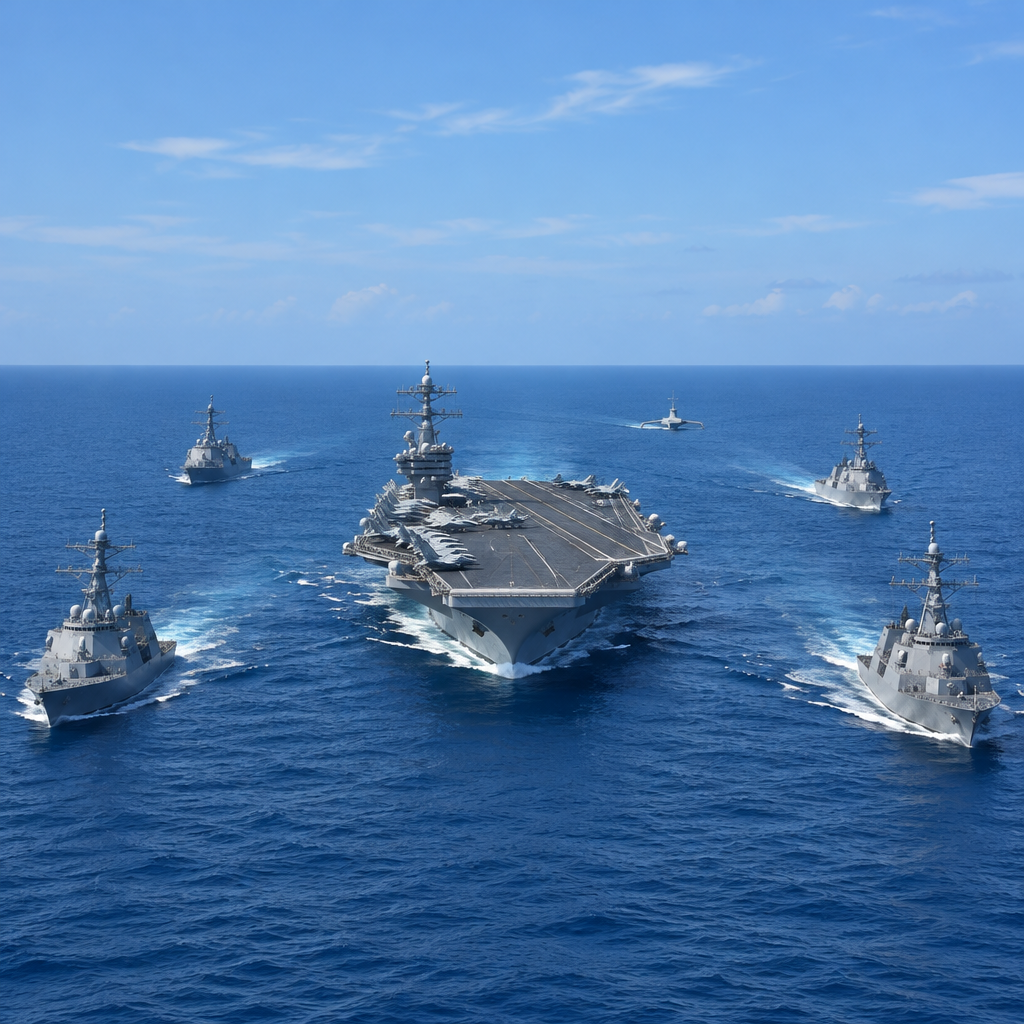
Theodore Roosevelt steamed out of Commander, Fleet Activities Yokosuka on October 19 after a three-day port call and joined large-scale Exercise Keen Sword 27 in the Philippine Sea. Roosevelt deployed on September 27 and was the first non-resident American carrier to visit Yokosuka in more than four years. The Roosevelt strike group in the exercise included guided-missile cruisers and destroyers such as USS Chosin, USS Decatur and—identified by a Navy official to TWZ—USS Paul Hamilton and USS Carl M. Levin.
During Keen Sword 27, more than 45,000 Japan Self-Defense Forces personnel and 11,000 U.S. service members are participating. Roosevelt-launched F/A-18E Super Hornets and F-35Cs, along with land-based forces and Japanese destroyers JS Kongo and JS Maya acting as the red team, conducted a simulated strike against a target in the East Sea/Sea of Japan; the specific location and munitions were not disclosed. The exercise runs through October 29.
Reinforcements headed to CENTCOM and regional force posture
The Makin Island Amphibious Ready Group tied up in Yokosuka on Monday, a week after Theodore Roosevelt departed, and both groups are reportedly destined for the Middle East, two U.S. officials told Fox News. If those movements occur as reported, the United States would have three carrier strike groups (CSGs) and two amphibious ready groups (ARGs) in the U.S. Central Command (CENTCOM) area of responsibility sometime in November—unless a group departs before arrival.
The reporting also notes more than 10 guided-missile destroyers operating independently in the region as the U.S. bolsters posture ahead of the possibility of renewed hostilities with Iran. The article places USS George H.W. Bush and USS George Washington enforcing an ongoing blockade of Iranian ports; both ships have been dark on AIS since arriving in the Middle East. George H.W. Bush was 210 days into her deployment and recently returned to CENTCOM after a five-day port call in Phuket, Thailand, while George Washington was recorded conducting flight operations on DVIDS on October 24.

The cyber insurance questionnaire just landed. Now what?
SOC 2, HIPAA, insurance renewals - someone has to own security strategy. Nubivance provides fractional CISO leadership without the full-time salary.
Get a security leadUSS Ronald Reagan and the MQ-25A: a carrier-linked, beyond-line-of-sight test
The USS Ronald Reagan used an onboard Unmanned Air Warfare Center (UAWC) and an MD-5C ground control station to connect with an MQ-25A Stingray more than 2,100 miles away at a Boeing facility in Illinois, the Navy said. The test was described as the first-ever underway connection between a carrier-based UAWC and an MQ-25A, carried out during a preliminary sea trial meant to validate procedures, networks and interfaces.
Acting SECNAV Hung Cao said the MQ-25A’s carrier-based refueling capabilities enable F/A-18 Super Hornets to fly farther and longer, and Capt. Daniel Fucito, program manager at PMA-268, said the link “proves that the Carrier Air Wing of tomorrow is a reality today.” Reagan moored at Kilo Pier, Naval Air Station North Island, in San Diego on October 27 after completing fleet replacement squadron and carrier qualifications.
USS Abraham Lincoln: 321-day deployment and a homeport shift to Bremerton
USS Abraham Lincoln returned home on October 8 after a 321-day deployment—the carrier was less than a week short of the longest carrier deployment in the post‑Vietnam era. The Navy confirmed Lincoln will complete a permanent homeport shift to Bremerton, Washington, for an overhaul following the extended deployment; the release did not disclose the length of the availability.
Commander, Naval Air Forces said in a statement that Lincoln “repeatedly demonstrated unmatched multi-theater combat lethality and safeguarded critical sea lanes across the Indo-Pacific and Middle Eastern theaters,” and characterized homeport shifts as part of the Navy’s “continued commitment to the strategic dispersal of ships.” The change of station is permanent for the crew and their families.
What this means for CENTCOM, Japan Self-Defense Forces, and carrier crews
- CENTCOM commanders: an overlap of up to three CSGs and two ARGs would temporarily increase afloat manpower by roughly 10,000 sailors and Marines, according to TWZ’s arithmetic, creating a higher-concentration deterrent but one that the reporting notes is sustainable only for a limited time given normal rotations.
- Japan Self-Defense Forces and regional allies: Keen Sword 27’s scale—45,000 Japanese and 11,000 U.S. participants—and the participation of Australian, Canadian and French warships signal interoperable, high-end joint training across air, sea and land components.
- Carrier crews and families: extended deployments and homeport shifts have operational and personal consequences; Lincoln’s 321-day deployment and the announced permanent move of her crew to Bremerton underscore both the strain of long deployments and the Navy’s logistics and personnel adjustments that follow.
The current posture, as reported, pairs experimental capability—Reagan’s UAWC and an MQ-25A link—with high-tempo operational movements into CENTCOM. The coming weeks will show whether the strike groups and amphibious forces transit as reported and how long any overlap in the Middle East endures.
Original story: Where Are The Aircraft Carriers?: October 27, 2026