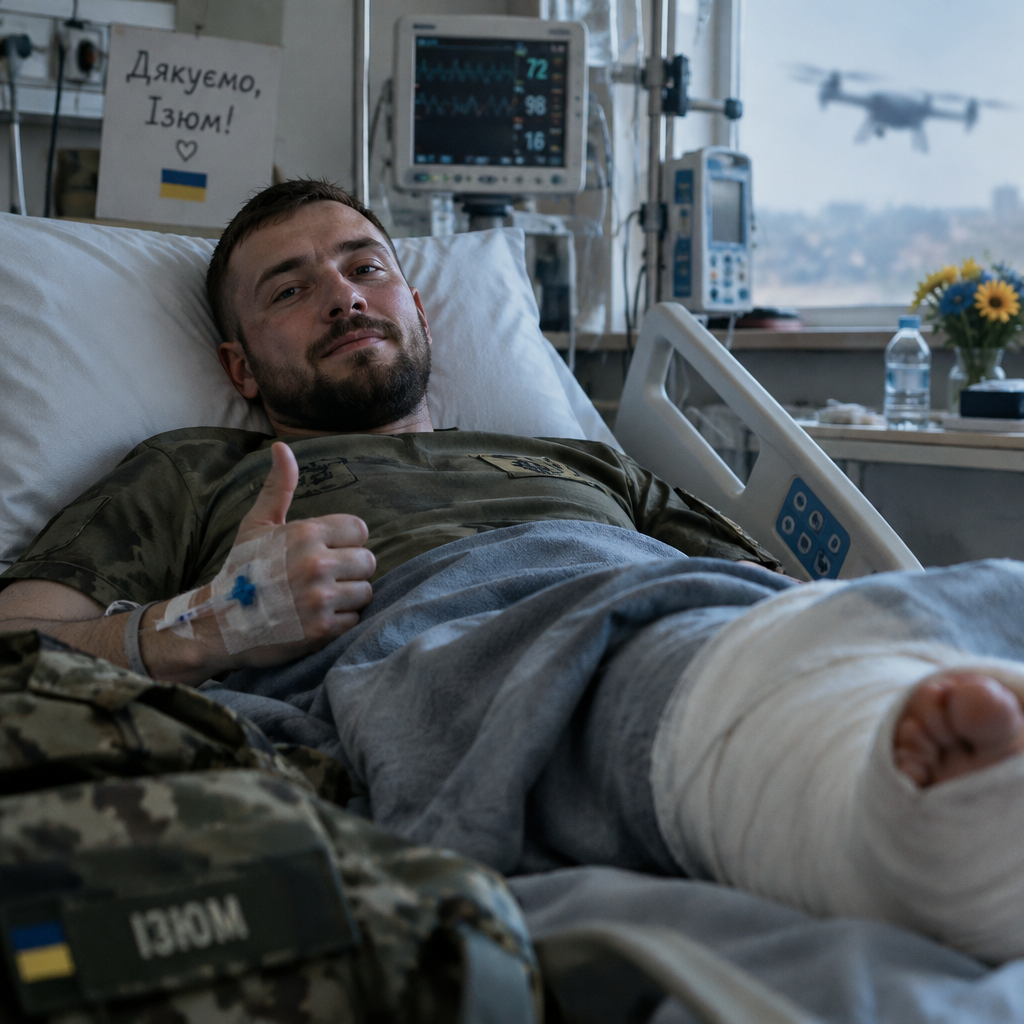
“The injury tore off half of my foot, so a lot of blood was lost already,” Izyum said from his hospital bed, crediting an uncrewed aerial platform with saving him when ground rescue was impossible.
CODE 9.2’s two CASEVAC missions
Ukraine’s 475th Separate Assault Regiment, known as CODE 9.2, says it conducted two complex aerial casualty evacuations in the space of a week using the StarGate uncrewed aerial platform. The wounded were 25‑year‑old Yevhen, callsign “Izyum,” and 24‑year‑old Artem, callsign “Kolobok,” both from adjacent units and injured while holding positions in a so‑called gray zone about three miles from the Russian border.
According to CODE 9.2 on its Facebook page, terrain obstacles — including water features — and the threat from Russian first‑person‑view (FPV) drones prevented ground vehicles from reaching the casualties, leaving air extraction as the only viable option. The missions required coordination among multiple units, additional forces and equipment, and dedicated fire support, the regiment said — a logistical profile the unit likened to traditional casualty evacuation operations using crewed helicopters.
StarGate: a purpose‑built CASEVAC drone from SkyFall
StarGate was developed and manufactured by Ukrainian company SkyFall and was designed specifically for casualty evacuation when conventional ground transport cannot safely reach wounded personnel. Its stated specifications include a payload capacity of up to 330 pounds and a maximum speed of approximately 65 miles per hour. The evacuation module is based on a covered, medical‑grade stretcher intended to protect a casualty from the elements and allow a secure, prone position during transport.
SkyFall personnel supported CODE 9.2 in planning and executing the missions, which the regiment said depended on the platform’s onboard artificial intelligence‑based navigation after Russian electronic warfare systems reportedly attempted to suppress satellite navigation signals in the area. The regiment did not specify the exact navigation technologies the platform used.

Audit-ready is a season. It shouldn't be.
Evidence in spreadsheets, controls drifting between audits, frameworks multiplying on flat headcount. Nubivance runs continuous compliance on Rapid7 Cyber GRC - SOC 2, HIPAA, ISO 27001, PCI, CMMC.
End the scrambleContested airspace, electronic warfare, and mission profile
One of the reported missions saw StarGate fly nearly 20 miles to reach a casualty and then roughly the same distance on the return leg with the wounded serviceman aboard. CODE 9.2 said Vampire heavy strike drones were employed to suppress enemy positions during the operations, underscoring the need for strike and escort elements even when the extraction platform is uncrewed.
CODE 9.2 also noted operational constraints that limit StarGate’s use: the casualty often needs assistance to be put on the stretcher; the platform is only an option if already available nearby; and flying in contested airspace under electronic warfare remains a core risk. The regiment signaled an intent to use lessons from the two missions to train crews and institutionalize aerial evacuation by creating a dedicated aerial medical evacuation unit within its medical company.
Earlier improvised aerial evacuations: the Gurzuf/Audag‑6 hexacopter case
The StarGate missions follow a separate reported operation by the 92nd Assault Brigade, which described an improvised evacuation using a heavy‑lift hexacopter produced by Gurzuf Defense. That drone, reportedly an Audag‑6 model, is said to be capable of carrying a 200‑pound payload up to 15 miles. In the brigade’s incident a soldier was clipped to the underside of the hexacopter via a harness and flown to safety because mines and intense Russian drone activity made ground recovery impossible.
Compared with purpose‑built StarGate, the hexacopter approach carries specific drawbacks cited by observers in the report: casualty stability and exposure to the elements, the risk of swinging during flight, and the difficulty of safely lifting and lowering a severely injured person. In the Audag‑6 incident the soldier involved, Kostiantyn Vlasenko, later emerged as having been forced to amputate his own foot during a 491‑day ordeal on a frontline position before the aerial extraction.
What this means for CODE 9.2, SkyFall, and the U.S. military
- CODE 9.2: The regiment plans to formalize the capability — using its operational experience to train crews and establish a dedicated aerial medical evacuation element inside its medical company.
- SkyFall and drone manufacturers: SkyFall’s role in planning and executing the missions positions StarGate as a more standardized CASEVAC option compared with improvised lift solutions; the platform’s specifications and covered stretcher offer clearer protection and a repeatable procedure for loading and transport.
- The U.S. military: The report notes that other armed forces are likely to study these developments; it specifically says the U.S. military has long looked at the potential of uncrewed aerial systems to effect casualty evacuation missions, suggesting international defense observers will follow StarGate’s operational record.
CODE 9.2’s account marks what the regiment calls the first time StarGate has performed battlefield evacuations, and the unit’s next steps—training crews and standing up an aerial medical element—will be the immediate test of whether the missions were isolated rescues or the start of a repeatable capability. The operations also highlight the combined needs of suppression, navigation resilience under electronic warfare, and proximity of assets: even a purpose‑built CASEVAC drone depends on a larger, coordinated combat and support architecture to get wounded troops out of harm’s way.
https://www.twz.com/air/ukraines-stargate-drone-now-evacuating-wounded-soldiers