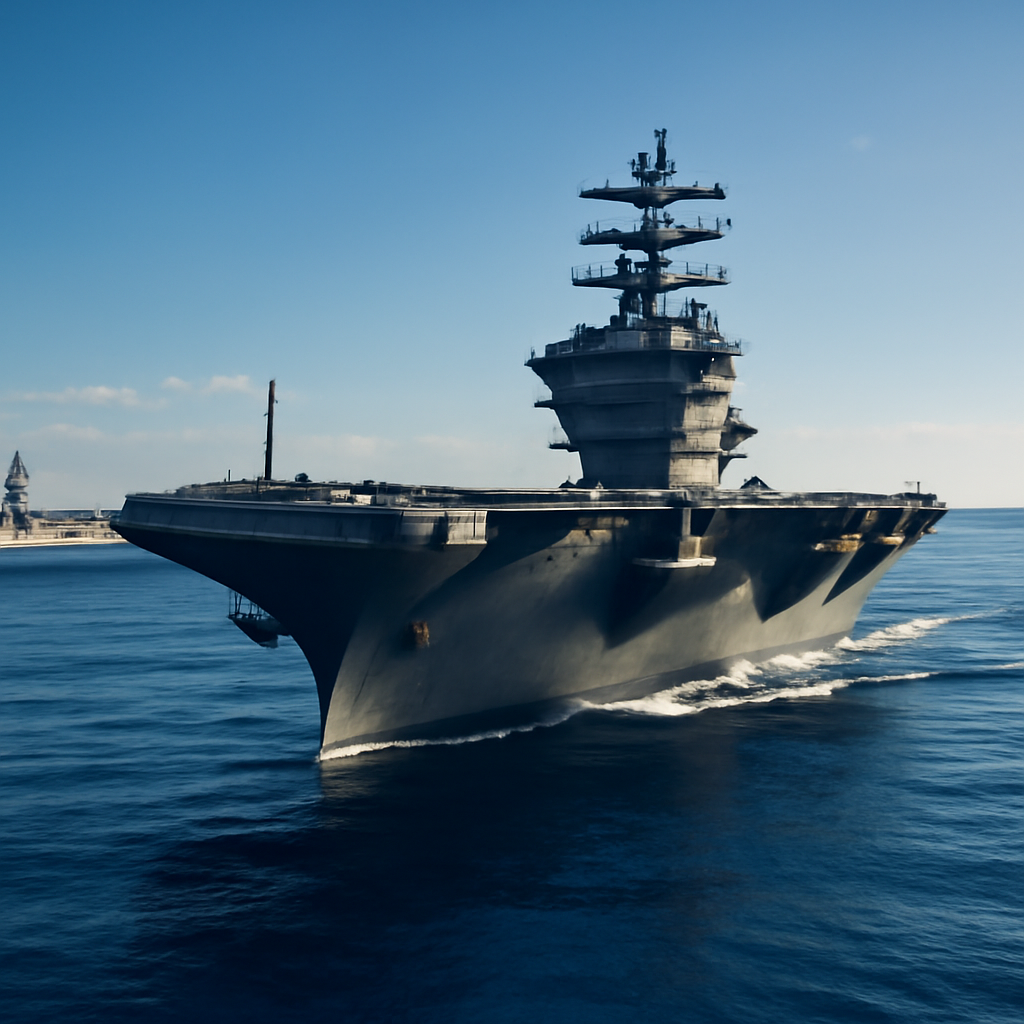
The Abraham Lincoln Carrier Strike Group has been deployed for 277 days, as of publication — a deployment that the reporting calls one of the longest in the modern carrier era.
Abraham Lincoln: finishing a long combat tour and heading home
The Lincoln CSG left the U.S. Central Command (CENTCOM) area of responsibility over the weekend and was transiting eastbound in the Indian Ocean under U.S. Pacific Command (PACOM) at the time of reporting. The carrier will reportedly make a port call in Thailand, according to USA Today, before continuing on to Naval Base San Diego. That will be the first liberty port call since Lincoln departed late last year; most Sailors and Marines aboard last set foot on solid ground in November 2025.
Lincoln served as the tip of the spear during Operation Epic Fury and helped enforce two rounds of blockades afterward. Carrier Air Wing (CVW) 9, the air component aboard Lincoln, “launched more than 10,000 sorties and dropped over 1.5 million pounds of ordnance in support of both operations,” according to a statement from the acting Secretary of the Navy. The carrier is scheduled to enter a Drydocking Planned Incremental Availability (DPIA) after returning home, per budget documents reviewed by TWZ, although the length of that availability is uncertain given the ship’s extended time at sea.
George Washington and George H.W. Bush: maintaining CENTCOM coverage
USS George Washington has relieved Lincoln in the Arabian Sea and joined USS George H.W. Bush so the Navy maintains dual-carrier coverage in theater “to support maritime security and stability in the Middle East” as the conflict with Iran approaches the half-year mark without a negotiated deal in sight. George H.W. Bush has been deployed for more than four months and was observed on DVIDS conducting daytime and nighttime flight operations over the past two weeks.
George Washington, America’s only forward-deployed carrier, transited from the Western Pacific through the Malacca Strait to relieve Lincoln. Prior to deploying, Washington completed a pierside Planned Incremental Availability (PIA) in Japan “to service critical systems and conduct repairs,” the ship’s Assistant Public Affairs Officer told TWZ earlier this year.

Audit-ready is a season. It shouldn't be.
Evidence in spreadsheets, controls drifting between audits, frameworks multiplying on flat headcount. Nubivance runs continuous compliance on Rapid7 Cyber GRC - SOC 2, HIPAA, ISO 27001, PCI, CMMC.
End the scrambleGeorge Washington’s aviation milestone and air wing composition
Shortly before entering the CENTCOM area, George Washington surpassed 200,000 fixed-wing traps, a milestone the commander of Carrier Strike Group 5, Rear Adm. Jeffrey L. Heames, framed as a measure of naval aviation readiness: “Two hundred thousand traps is not just a number, it is a testament to the enduring strength of American naval aviation and the unmatching professionalism of the Sailors who make it possible,” he said.
The ship’s public affairs office noted that Washington is “capable of landing one aircraft on deck per minute, and typically lands 70 aircraft across several events throughout the day.” TWZ confirmed the carrier’s embarked air wing as follows:
- Carrier Air Wing (CVW) 5
- Strike Fighter Squadron (VFA) 147 “Argonauts” – F-35C Lightning II (Navy-operated)
- Strike Fighter Squadron (VFA) 102 “Diamondbacks” – F/A-18F Super Hornets
- Strike Fighter Squadron (VFA) 27 “Royal Maces” – F/A-18E Super Hornets
- Strike Fighter Squadron (VFA) 195 “Dambusters” – F/A-18E Super Hornets
- Electronic Attack Squadron (VAQ) 141 “Shadowhawks” – EA-18G Growlers
- Airborne Command and Control Squadron (VAW) 125 “Tigertails” – E-2D Hawkeyes
- Helicopter Sea Combat Squadron (HSC) 12 “Golden Falcons” – MH-60S Seahawks
- Helicopter Maritime Strike Squadron (HSM) 77 “Saberhawks” – MH-60R Seahawks
- Fleet Logistics Multi-Mission Squadron (VRM) 30 Det. 5 “Titans” – CMV-22B Ospreys
Like Lincoln, Washington carries a single F-35C squadron and three F/A-18E/F squadrons, but the F-35C aboard Washington is Navy-operated while Lincoln’s is flown by the Marine Corps. TWZ also notes the Integrated Air and Missile Defense (IAMD) commander for CSG-5 is classified.
Carrier activity and readiness in the continental United States
On the U.S. coasts, two carriers are currently underway and conducting workup activity. USS Dwight D. Eisenhower got underway on August 21 and was operating 35 nautical miles off the coast with her AIS transponder on. USS Carl Vinson departed San Diego on August 10 and is conducting Tailored Ship’s Training Availability (TSTA) and Final Evaluation Period (FEP). USS Theodore Roosevelt remains pierside in San Diego based on commercial satellite imagery.
TWZ’s accounting across the carrier force is this: three carriers deployed (one of those heading home), one preparing to deploy in the near term, two working up in various states of readiness, four in maintenance, and one being used primarily for training before deactivation next year. On the amphibious side, one Amphibious Ready Group (ARG) is deployed, one is forward-deployed, four are working up or in port, and three are in maintenance. The report notes positions shown are general approximations.
What this means for crews, regional commanders, and maintenance planners
Crew members aboard Lincoln will soon gain relief with the ship’s return and an anticipated liberty port call in Thailand, while many have gone months without a liberty call — the carrier’s only previous stops since deployment were a day in Guam in December 2025 and an early-July stop at an unnamed friendly port. Regional commanders retain dual-carrier coverage in the Arabian Sea with George Washington and George H.W. Bush, preserving operational options for maritime security and strike operations. Maintenance planners face the practical consequence that Lincoln’s scheduled DPIA could be lengthened by the strain of a 277-day deployment, and TWZ highlights that extended deployments tend to extend subsequent maintenance periods.
As Lincoln sails home and George Washington establishes the forward watch, the facts on the movement board are simple and consequential: extended deployments, concentrated aviation activity, and a forward carrier posture that continues to underpin operations in the Middle East while several U.S. carriers cycle through maintenance and training.
Original TWZ report: Where Are The Aircraft Carriers?: August 24, 2026



