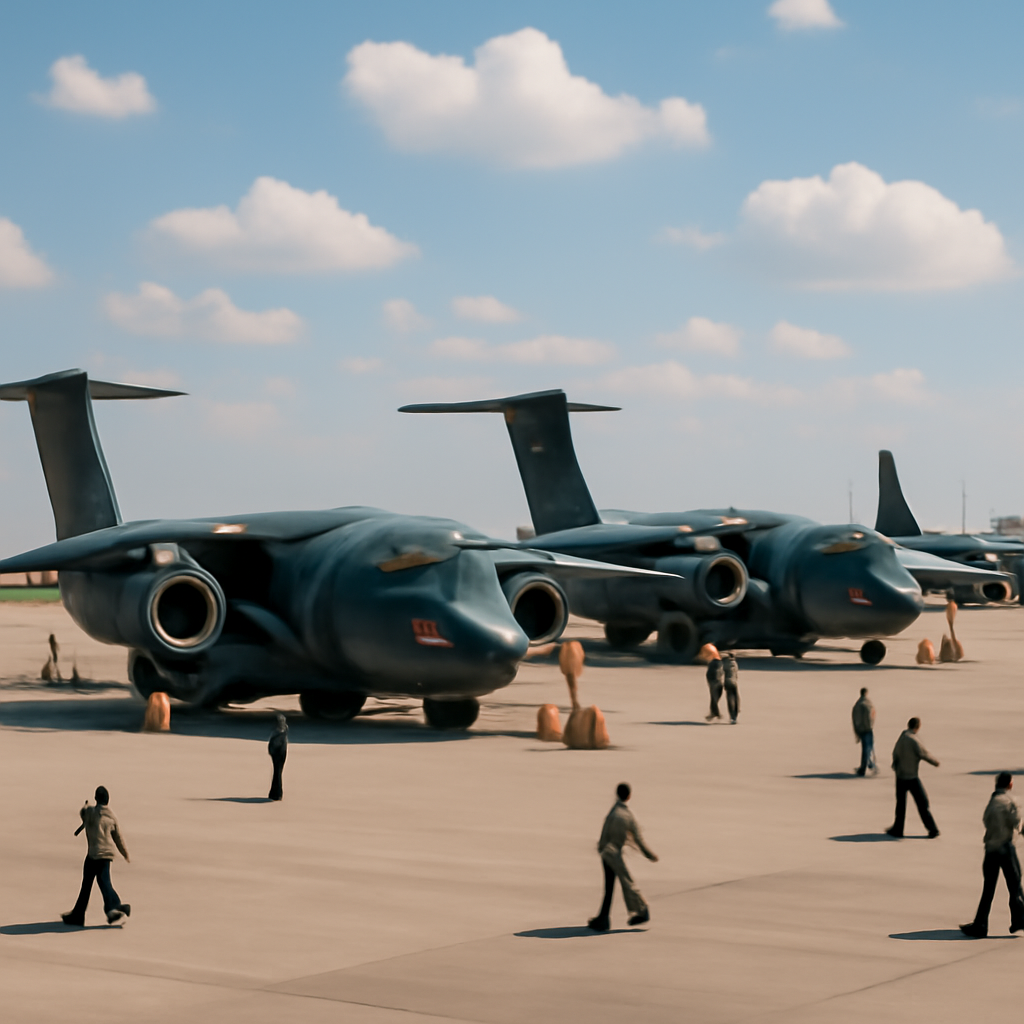
On 23 July 2026 Greece’s Government Council for Foreign Affairs and Defence approved the acquisition of three Embraer C-390 Millennium transport aircraft — with an option for three more — in an intergovernmental arrangement with Portugal, a program valued at USD $685 million and scheduled for delivery between 2027 and 2030.
How the C-390’s expansion is creating a secondary market
Embraer’s C-390 Millennium has now been ordered or formally selected by thirteen countries, and the manufacturer “has now established the aircraft across NATO and several important non‑NATO markets,” the reporting states. That growing orderbook is producing a predictable downstream effect: air forces that bring C-390s into service will phase out older tactical transports, creating a secondary market for retired airframes.
The source specifically links the C-390 build‑out to disposal of Lockheed Martin C-130H family aircraft: as C-390 deliveries arrive, some operators will "dispose of C-130H airframes." This is not hypothetical — the article cites prior disposal pathways that ended with sales to other nations, demonstrating how retired H‑series Hercules can move between operators.
Which operators still fly the standard C-130H, and how many airframes are involved
Of the thirteen C-390 customers, six still operate the standard, short‑body C-130H or KC‑130H. These are explicitly distinguished from the stretched C-130H‑30, the newer C-130J, and the former Royal Air Force C-130K (noted in the source as being operated by Austria).
- Sweden: five C-130Hs plus one KC-130H tanker.
- Greece: about ten C-130Hs, including aircraft that have spent extended periods in storage or under repair.
- United Arab Emirates: roughly eight C-130Hs, operated alongside civilian L-100-30 transports.
- South Korea: received twelve H‑family aircraft between 1987 and 1990 — eight standard C-130Hs and four C-130H‑30s.
- Portugal: two standard C-130Hs.
- Netherlands: two standard C-130Hs, converted from former United States Navy EC-130Qs.
Together, those six fleets hold roughly 36 airframes — a finite pool likely to generate surplus aircraft as C-390 deliveries proceed.

Audit-ready is a season. It shouldn't be.
Evidence in spreadsheets, controls drifting between audits, frameworks multiplying on flat headcount. Nubivance runs continuous compliance on Rapid7 Cyber GRC - SOC 2, HIPAA, ISO 27001, PCI, CMMC.
End the scrambleBelgium’s disposal route and the Pakistan Air Force
The article points to a concrete precedent for how retired H‑series airframes can find new owners: a Belgian fleet sale that "ended with the Pakistan Air Force (PAF)." That transaction is cited as an example showing how some surplus C-130Hs from C-390 customers may ultimately reach Pakistan.
The reporting does not detail the mechanics of that Belgian sale, but uses it to illustrate a pathway: government or military disposals can be packaged, sold, and transferred to third‑party air forces rather than scrapped or cannibalised for parts.
What this means for the Pakistan Air Force, Embraer, and current C-130H operators
- For the Pakistan Air Force: the Belgium example demonstrates an existing route by which retired C-130H airframes have reached the PAF. The growing number of C-390 customers retiring H‑series aircraft increases the pool of potential surplus airframes that could be acquired through similar disposal channels.
- For Embraer: establishing the C-390 across NATO and non‑NATO markets is simultaneously a sales success and a market-reshaper; its orderbook is creating a secondary market in used tactical transports that changes the lifecycle economics of legacy fleets.
- For current C-130H operators: countries listed as C-390 customers that still operate standard C-130Hs face an inventory decision as C-390 deliveries arrive — whether to store, sell, or otherwise dispose of older H‑series aircraft. The presence of stored or under‑repair examples in Greece suggests that not all airframes will be immediately available for transfer.
Final observation: a pipeline of availability tied to delivery schedules
Greece’s USD $685 million program and its 2027–2030 delivery window make the dynamic concrete: as C-390s enter service over the coming years, the roughly 36 C-130H airframes held by six C-390 customers form a measurable, if uneven, supply of retirements and potential sales. The Belgium‑to‑PAF example shows a path from disposal to acquisition; whether other surplus H‑series airframes follow that route — and which nations become buyers — will depend on the timing and condition of each retired airframe as C-390 fleets expand.