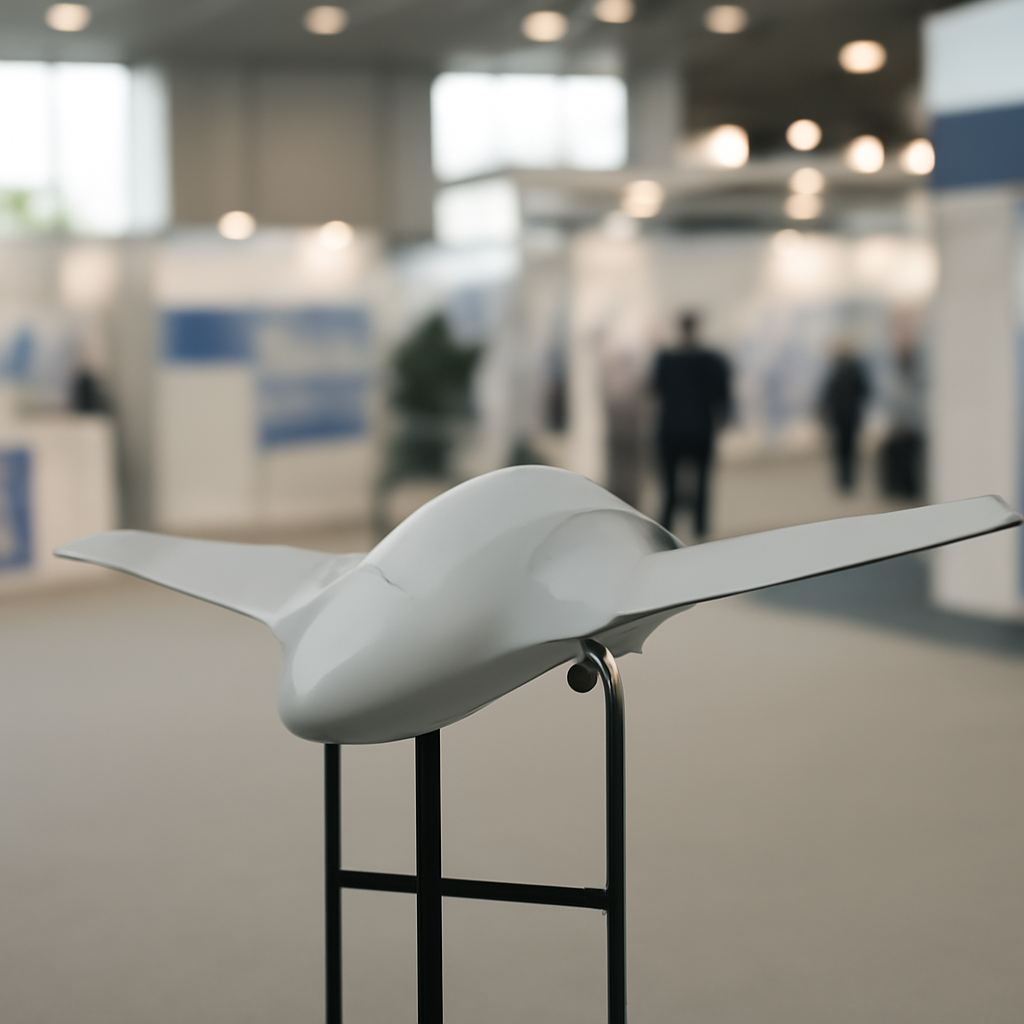
“The D-248 reaches 2,200 km to 3,000 km and the S-369 covers 1,500 km to 2,000 km.” Those numbers, revealed by Heavy Industries Taxila (HIT) at the 2026 Indus Robotics and Autonomous Systems Expo, mark a concrete expansion of Pakistan’s loitering-munition envelope and a notable change in the country’s strike architecture.
D-248: specifications and the Shahed-136 resemblance
HIT describes the D-248 as a tailless delta configuration with a maximum take-off weight (MTOW) of 240 kg, a wingspan of 3.3 m, and a payload of 30–50 kg. Performance figures shown at the expo list a maximum speed of 225 kph, cruise speed of 185 kph, endurance of 12–14 hours, and a flight ceiling up to 4,500 m. The D-248’s design closely matches the broad layout of Iran’s Shahed-136; the source reports that this resemblance suggests use of a 500–550cc piston engine and, plausibly, a GNSS/GPS-aided inertial navigation system (INS) for guidance.
S-369: an ‘arrow-delta wing’ and extended reach
The S-369 is described by HIT as an “arrow-delta wing” loitering munition that carries an MTOW of 215–225 kg, a 4 m wingspan, and a 30–50 kg payload capacity. Published performance figures show a maximum speed of 220 kph, cruise speed of 160–180 kph, and a flight ceiling up to 4,500 m. With ranges reported at 1,500–2,000 km, the S-369 and the D-248 together now stand as Pakistan’s longest-range loitering munitions.

Audit-ready is a season. It shouldn't be.
Evidence in spreadsheets, controls drifting between audits, frameworks multiplying on flat headcount. Nubivance runs continuous compliance on Rapid7 Cyber GRC - SOC 2, HIPAA, ISO 27001, PCI, CMMC.
End the scrambleSatellite ISR: the targeting backbone named
The author links these new munitions to an expanded space-based intelligence, surveillance, and reconnaissance (ISR) infrastructure — specifically the PRSC EO1/2/3, S1, and HS1 satellites, and a planned interferometric synthetic aperture radar (InSAR) constellation. That satellite layer, the source says, “will equip Pakistan to identify and track its targets of interest throughout its adversaries’ territories,” and over time will build a near-real-time picture of movements and defensive measures that can feed targeting for loitering munitions.
Production and industrial strategy: HIT, SOEs, and private suppliers
Because HIT is a state-owned enterprise that reports directly to the Pakistan Army, the D-248 and S-369 signal a deliberate move toward a scalable strike capability. The piece outlines parallel activity across public and private suppliers: private firm Alsons Group revealed piston engines in June 2026 ranging from 120cc to 280cc and supplies fuzes; SOEs such as the National Engineering & Scientific Commission (NESCOM) are producing new-generation fuzes; and the National Aerospace and Scientific Technology Park (NASTP) is developing the Lahab-series turbojet engines. The argument advanced in the source is that SOEs are well placed to own hyperscale upstream inputs — fiberoptic cabling, electric motors, plastic moulds, engine components and fuels — while the private sector focuses on drone design and downstream production to meet mass-demand.
What this means for technologists, policymakers, and the Pakistan Army
- Technologists and security teams: expect greater demand for piston- and turbojet-engine components, guidance packages (GNSS/GPS + INS), and rapid-production inputs such as fiberoptic cabling and plastic moulds as munition output scales.
- Policymakers and regulators: the source highlights a governance challenge — Pakistan presently “lacks a cohesive mechanism to cleanly manage parallel public- and private sector defence production.” Decisions about whether SOEs retain prime production roles or pivot to upstream inputs will shape capacity to sustain mass-salvo operations and to develop exportable supply chains.
- The Pakistan Army: fielding the D-248 and S-369 alongside existing systems such as the Sysverve Mudamir-LR (range ~600 km) expands the loitering-munition mix. The source also records parallel investments in counter-UAS — sensor-integrated interceptors, anti-air guns (AAG), EW emitters/jammers, and a tested Lance IR infrared-guided SAM — indicating plans to pair offensive scale with layered defensive measures.
The analysis in the source flags two additional operational points. First, HIT could plausibly produce a turbojet-powered D-248 subvariant: several Pakistani SOEs already produce jet-powered loitering munitions (Delta Baaz, KaGeM V3, Sarfarosh), and a jet variant would trade range for speed and survivability — a dynamic compared to the Russian Geran-3 (cited as up to 1,000 km and a cruising speed of 300–370 kph). Second, the author identifies a potential capability gap in electronic attack (EA)/electronic countermeasures (ECM) drones: larger target-drone airframes (for example, reworked HADAF-series vehicles) or enlarged designs like Turkey’s Super Şimşek could be adapted to jam radars or spoof guidance, protecting slower piston-powered munitions and higher-value missiles.
HIT’s public unveiling of the D-248 and S-369 therefore does more than add two airframes to a catalog; it lays out the technical parameters of a possible, scalable strike regime — one that depends on satellite ISR, mass production of propulsion and guidance inputs, and an industrial structure that balances SOE capacity with private-sector agility. Whether Pakistan prioritizes SOEs as hyperscale suppliers while outsourcing drone productization to private firms will determine how rapidly and at what cost that strike capability can be expanded.