The U.S. Air Force plans to keep flying the F-117 Nighthawk through at least 2034, nearly three decades after the type first entered service and almost two decades after its official 2008 retirement. That extension has a small but strikingly literal consequence: the service must buy fresh explosive charges to make one of the jet’s most obscure emergency systems work.
The Air Force’s CAD/PAD contract for the F-117
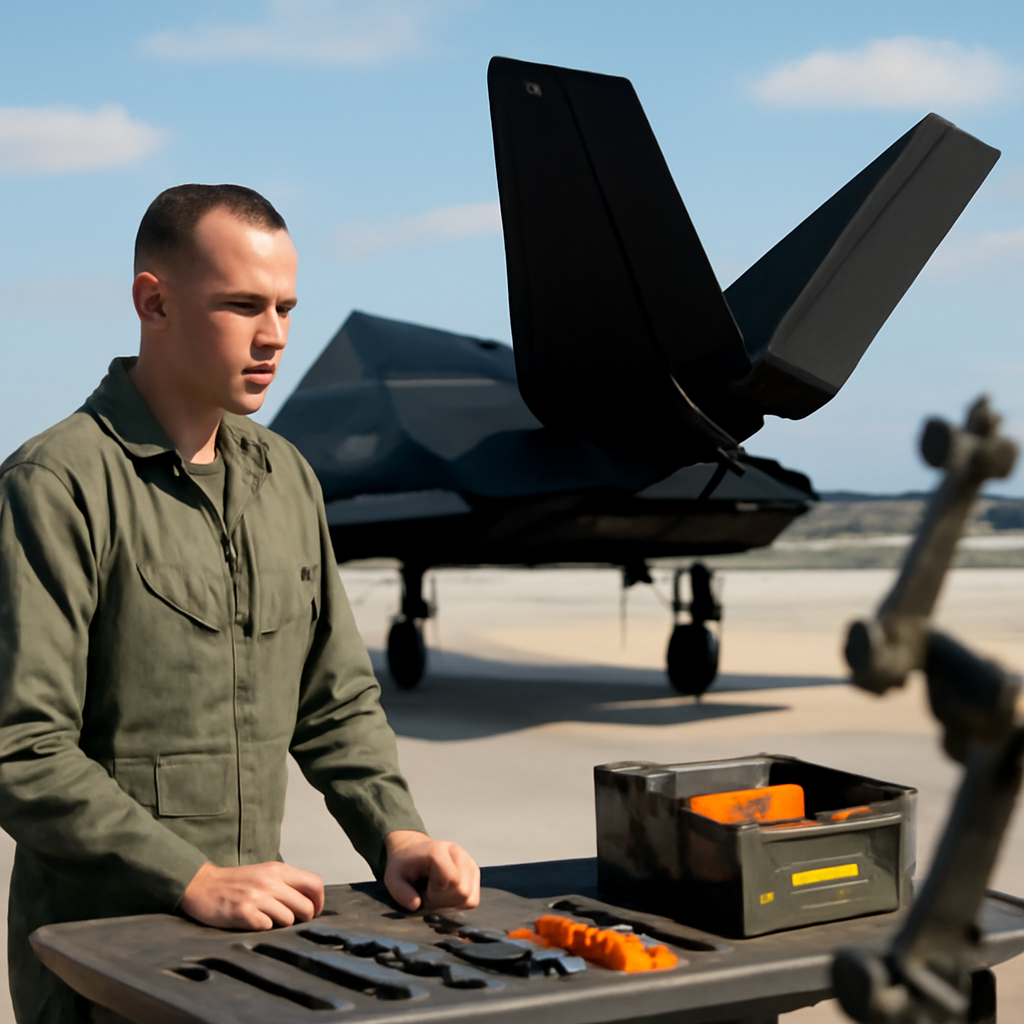
This spring the Air Force released additional details about a planned sole-source contract to procure “CAD/PAD” devices for the remaining F-117s. CAD/PAD is the military shorthand for cartridge-actuated devices and propellant-actuated devices — pyrotechnic and explosive components used across aircraft systems that have limited shelf lives and must be replaced for safety and reliability reasons. The Air Force’s order explicitly includes charges used to clear the F-117 canopy for ejection, and separate items described as the “Tail Hook Panel Pyrotechnic Assembly” and the “Tail Hook Panel Initiator.” The latter are small shaped explosive charges and electrically-initiated detonators used to open the tailhook bay, not part of the ejection system.
How the F-117’s tailhook works
Unlike carrier-based fighters, many land-based combat jets carry tailhooks only for emergency use with runway-installed arresting gear. On conventional jets the hook can be mounted externally or semi-externally; on stealthy designs a protruding hook would grow the aircraft’s radar cross section. The F-117’s solution was to fully encase an emergency tailhook behind a flush-mounted panel. When the hook must deploy, explosive charges blast the panel away so it drops down and the hook can extend. The system then must be reset on the ground. The Air Force’s contracting notice makes clear that the explosive elements that free that panel are separate from the pyrotechnics that allow the canopy to jettison for ejection.

The cyber insurance questionnaire just landed. Now what?
SOC 2, HIPAA, insurance renewals - someone has to own security strategy. Nubivance provides fractional CISO leadership without the full-time salary.
Get a security leadThe F-117’s continuing role at Tonopah Test Range Airport
Although retired from frontline service in 2008, a pocket fleet of F-117s has continued to operate from Tonopah Test Range Airport in Nevada. The service has said it will use the jets for research and development, test and evaluation, and especially training. In those roles the Nighthawk’s radar, infrared, and other signature profiles remain useful: the jets have been flown as ‘red air’ aggressors and as surrogates for stealthy cruise missiles during large-scale exercises. As a test platform the F-117 also serves as a well-studied control variable, since its baseline signatures are documented and familiar to range and lab personnel.
Logistics ripples: KC-46 certification and a boutique maintenance effort
Keeping a boutique fleet of stealth jets operational creates knock-on logistics tasks. One visible consequence has been the certification of the KC-46 Pegasus tanker to refuel F-117s in flight; the first KC-46 was delivered to the Air Force in 2019. The CAD/PAD contracting notice offers a glimpse into the maintenance work that sustains the remaining Nighthawks: a specialized shop must preserve fragile stealth skins and subsystems and must manage limited-life explosive devices that keep emergency systems safe and reliable.
What this means for the Air Force, test and training units, and maintenance crews
- The Air Force: will continue to plan and procure limited, safety-critical parts (including pyrotechnic charges) to keep the Nighthawk fleet available for R&D, testing, and training through at least 2034.
- Test and training units: will retain access to an aircraft with distinctive, well-understood radar and infrared signatures useful as red-air opponents and as surrogates for stealthy cruise-missile threats.
- Maintenance crews and logistic planners: must manage CAD/PAD shelf lives, perform ground resets after any tailhook deployment, and sustain stealth skins and unique subsystems that other retired types typically do not require.
The F-117’s survival in a limited but active role underscores how a handful of small components — shaped charges and initiators that open a flush panel — can determine whether a jet remains a usable tool. With replacement explosives already scoped for purchase and operations slated through at least 2034, the Nighthawk’s operational afterlife will depend as much on careful logistics and maintenance as on anything the aircraft itself does in the air.