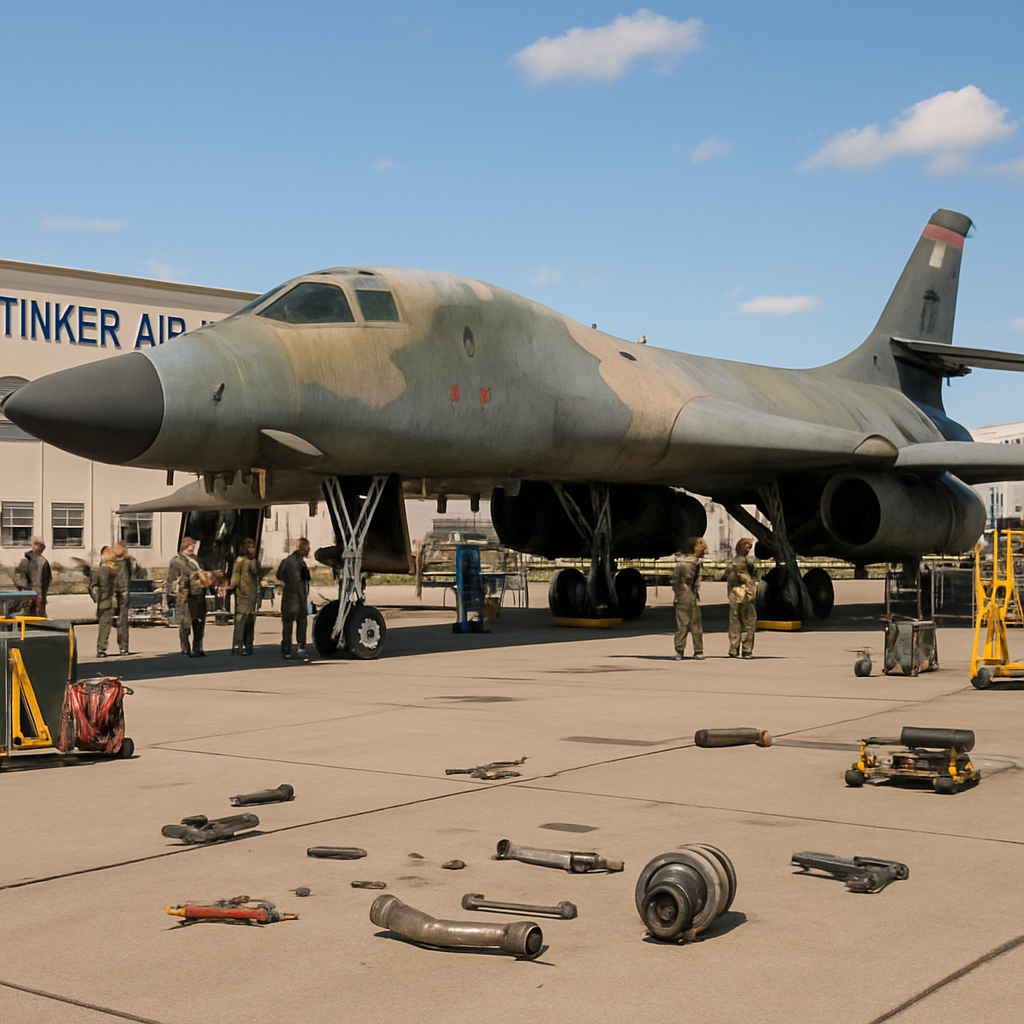
More than 500 components were replaced on B-1B serial 86-0115 during its regeneration at Tinker Air Force Base, a depot effort that took nearly two years and returned a jet once parked in the Arizona “boneyard” to full operational status.
567th Aircraft Maintenance Squadron and the Oklahoma City Air Logistics Complex
The depot work was led by the Oklahoma City Air Logistics Complex and involved more than 200 airmen and civilians from the 567th Aircraft Maintenance Squadron working extended shifts. Technicians replaced in excess of 500 components as part of system overhauls and structural repairs, completed functional check flights in a stripped, bare-metal configuration over Oklahoma, and then repainted the aircraft prior to transfer. The bomber departed Tinker Air Force Base on April 22, 2026, following declaration of full mission capability after system validation flights.
309th AMARG Type 2000 storage at Davis‑Monthan: the boneyard-to-fleet pipeline
Serial 86-0115 was returned to combat-capable status after spending time in Type 2000 storage at the 309th Aerospace Maintenance and Regeneration Group (AMARG) at Davis‑Monthan Air Force Base, Arizona. The jet originally arrived at the boneyard in 2021 as one of 17 B-1Bs retired that year when the fleet was consolidated from 62 to 45 aircraft. Type 2000 storage, the service says, preserves aircraft in a reclaimable state to make it easier to return them to service to fill potential combat losses or accidents; 86-0115 was one of four B-1Bs placed into that reclaimable storage.

This site is the portfolio.
OSINTSights runs on Cloudflare Workers, D1, R2, and Vectorize, with an AI pipeline on Hetzner ARM. Nubivance designed, built, and operates it. We do the same for clients.
See what we buildDyess Air Force Base, the 7th Bomb Wing, and the reborn "Apocalypse II"
After leaving Tinker, the regenerated B-1B rejoined the 7th Bomb Wing at Dyess Air Force Base, Texas, carrying a new name and nose art: Apocalypse II. The jet serves as the wing’s flagship and bears markings of the 9th and 28th Bomb Squadrons. The nose art honors the World War II crew of the B-24J Liberator Apocalypse and was described as the final step in regenerating tail number 86-0115 for its return to the operational bomber fleet.
Meeting the Congress-mandated 45-aircraft requirement and a repair trade-off
The arrival of 86-0115 brought the Air Force back in line with legal requirements set by Congress for the service to maintain a fleet of 45 B-1Bs. The Air Force told TWZ that 86-0115 was regenerated to replace aircraft 86-0126, which was undergoing heavy-structures repair development with Boeing at Palmdale, California. “Analysis determined regenerating an aircraft in AMARG storage could be accomplished faster, at lower cost and risk, than continuing the Boeing repair project,” the Air Force said, framing the regeneration as a programmatic decision based on time, cost and risk.
Fiscal Year 2027 modernization funding and evolving weapons roles
Fiscal Year 2027 budget documents show the Air Force intends to invest $342 million to upgrade its remaining 44 B-1Bs between 2027 and 2031. “This request provides the necessary funding to modernize the platform, ensuring its lethality and relevance through 2037,” the document states. The Air Force has also publicly shown a B-1B carrying an AGM-183 Air-launched Rapid Response Weapon (ARRW) in imagery released this year and is pursuing development of an improved ARRW and a separate air-launched ballistic missile (ALBM), with the B-1B likely to be closely involved in those efforts.
What this means for the 567th Aircraft Maintenance Squadron, Boeing at Palmdale, and the 7th Bomb Wing
- 567th Aircraft Maintenance Squadron: The squadron demonstrated its ability to execute an intensive depot regeneration and will face continued heavy maintenance tempo as the service modernizes the legacy fleet and pursues further regenerations when needed.
- Boeing at Palmdale: The decision to regenerate 86-0115 instead of completing a long-term heavy structures repair on 86-0126 illustrates a procurement trade-off; Boeing’s Palmdale repair development remains a comparative pathway that the service weighed against AMARG regeneration.
- 7th Bomb Wing at Dyess: Reacquiring Apocalypse II increases available aircraft for operations that the source describes as heavily tasking the bomber fleet, including support for Operation Epic Fury, and restores a flagship aircraft to wing markings and squadron identity.
The return of 86-0115 — formerly Rage and now Apocalypse II — illustrates how depot-level regeneration and Type 2000 storage are being used as active management tools to keep a legacy bomber flying into a service life now projected through at least 2037. The Air Force’s FY2027 modernization request and the documented choice to favor AMARG regeneration over a Boeing heavy-structures repair on a companion jet make clear the immediate priorities: restore availability quickly, control cost and reduce risk. The practical question the record leaves on the table is operational and programmatic: which combination of regeneration and industrial repairs will the service favor when the next heavy-structures challenge arises?
https://www.twz.com/air/b-1b-apocalypse-ii-out-of-the-boneyard-and-back-in-service