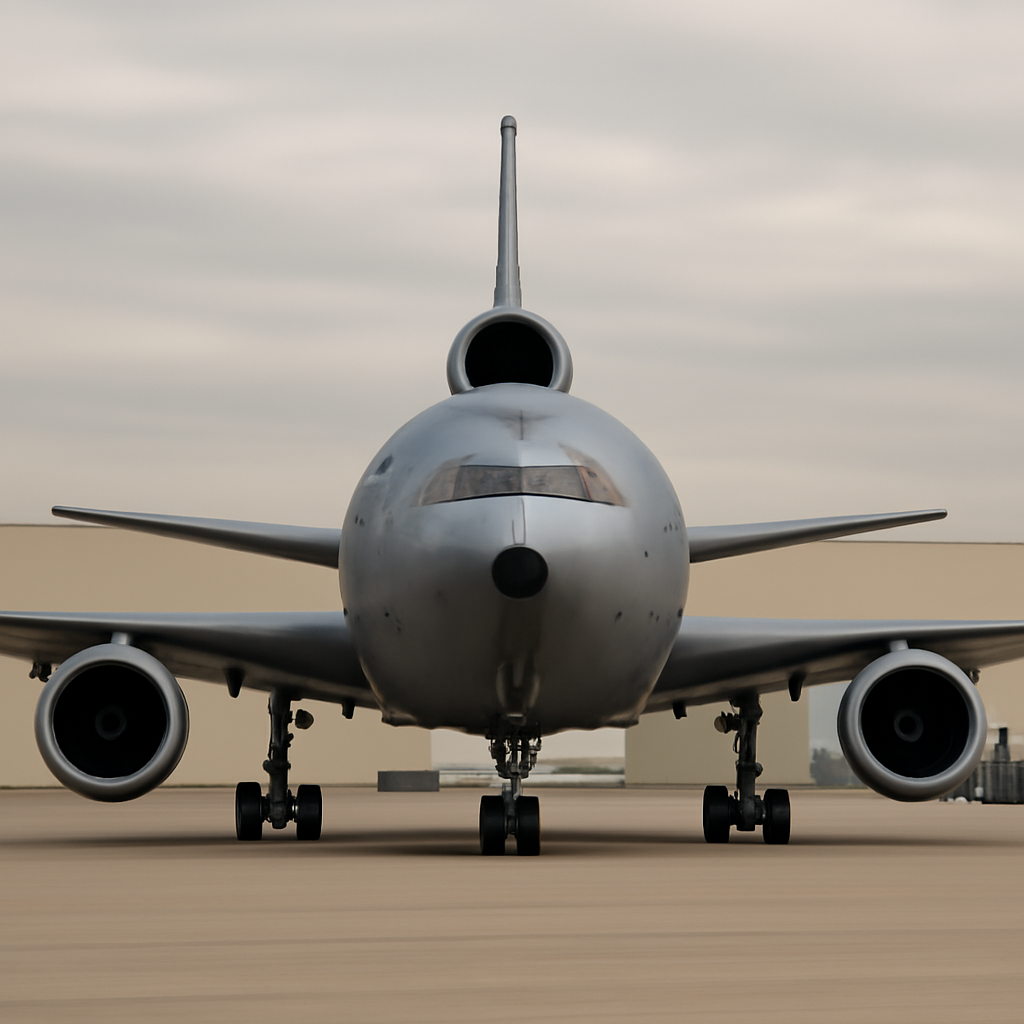
"solely for information and planning purposes," the Air Force Life Cycle Management Center (AFLCMC) wrote in a contracting notice that opened the door to the possible regeneration and transfer of up to four retired KC-10 Extender aerial refueling tankers to a partner nation in North Africa.
AFLCMC’s request: what industry would be asked to do
The AFLCMC notice seeks industry sources able to perform a range of tasks to return as many as four KC-10 Extender aircraft to service. Specifically, the agency asked for capability to execute regeneration, a one-time flight clearance, depot-level return to service, worldwide ferry delivery, in-country Contractor Logistics Support (CLS), and operational/maintenance training for up to four KC-10 aircraft. The notice framed those requirements as preparatory and did not present a transfer as finalized.
Who could receive the KC-10s: Egypt and Morocco are the likeliest candidates
While the notice did not name the recipient country, the source identifies Egypt and Morocco as the most likely North African candidates based on current and planned inventories and their status as major U.S. allies. The Egyptian Air Force currently operates no dedicated aerial refueling tankers and is in the process of acquiring two C-130J-30 Hercules aircraft for use as both airlifters and tankers via the probe-and-drogue method. Egypt already flies C-130s, but none are explicitly configured for aerial refueling duties, and its fleet includes U.S.-made F-16 Vipers that can only be refueled in mid-air via boom.
Morocco likewise operates F-16s and is in the process of acquiring additional aircraft; the first new-production Block 72 F-16D for the Moroccan Air Force flew for the first time earlier this week, according to the reporting. Morocco does possess an organic aerial refueling capability today, in the form of C-130s equipped for probe-and-drogue refueling.

The cyber insurance questionnaire just landed. Now what?
SOC 2, HIPAA, insurance renewals - someone has to own security strategy. Nubivance provides fractional CISO leadership without the full-time salary.
Get a security leadCondition of the KC-10 fleet and recent disposition actions
McDonnell Douglas delivered 60 KC-10s to the U.S. Air Force between 1979 and 1987; the type was derived from the three-engine DC-10 airliner, the last of which was produced in 1989. One KC-10 was lost in an accident in 1987. Of the remaining 59, ten were put up for auction last year in a non-flyable state; each of those aircraft had a single engine removed from under a wing and had booms stripped for spares. Private aerial refueling contractor Omega Air appears to have won those auctions and already operates two ex-Dutch KDC-10 tankers and a DC-10 converted into a probe-and-drogue-only tanker, along with several Boeing 707-based tankers.
The condition of the remaining 49 Extenders is unclear. Congress included a provision in the National Defense Authorization Act (NDAA) for Fiscal Year 2026 that required the Air Force to preserve remaining retired KC-10s “in the same storage condition” they were in as of September 30, 2025. That bill, signed into law in December 2025, also made clear the Air Force could still “dispose” of the aircraft in accordance with existing property management statutes.
Boom vs. probe-and-drogue: operational implications for recipients
The KC-10 was designed to refuel receivers using either the flying boom or the probe-and-drogue method. International tankers more commonly use probe-and-drogue, but the KC-10’s boom capability would allow it to refuel aircraft that cannot accept probe-and-drogue refueling — a notable factor given Egypt’s fleet of F-16 Vipers. The Extender also served in a substantial cargo role while in U.S. service, and regeneration could restore that dual tanker/cargo capability, though the reporting notes cargo conversion is possible but appears less likely.
Operational trade-offs matter: the KC-10 can carry more fuel than the KC-46s that replaced it in U.S. service, but regenerating larger, older military aircraft is costly, complex, and time-consuming, even when they have been stored in a maintained state.
What the AFLCMC, Egypt and Morocco, and private contractors will watch
- AFLCMC: will evaluate industry responses to the contracting notice and manage any logistics tied to Excess Defense Articles (EDA) transfer rules, including the requirement that the foreign nation pay for delivery and refurbishment if applicable.
- Egypt and Morocco (potential recipients): will assess whether KC-10s, if offered via EDA, fit their refueling concepts—especially the operational value of boom-equipped tankers for aircraft that cannot accept probe-and-drogue—and whether the cost of regeneration and sustainment is acceptable.
- Private contractors (including firms like Omega Air and other potential industry sources): will weigh the technical and financial feasibility of regeneration, ferry delivery, in-country Contractor Logistics Support, and training, and whether acquiring KC-10s via EDA offers a lower-cost path to large-tanker capability than new-production alternatives.
The AFLCMC notice does not close the book; it signals a real possibility that “one of America’s partners in North Africa could breathe new life into four of these retired tankers.” For now, the path from Davis-Monthan’s boneyard back to active service will hinge on technical work, budget choices by a foreign buyer, and decisions by U.S. agencies administering the EDA process. TWZ reached out to the U.S. Air Force and the U.S. State Department for more information; the State Department directed inquiries to the Pentagon.