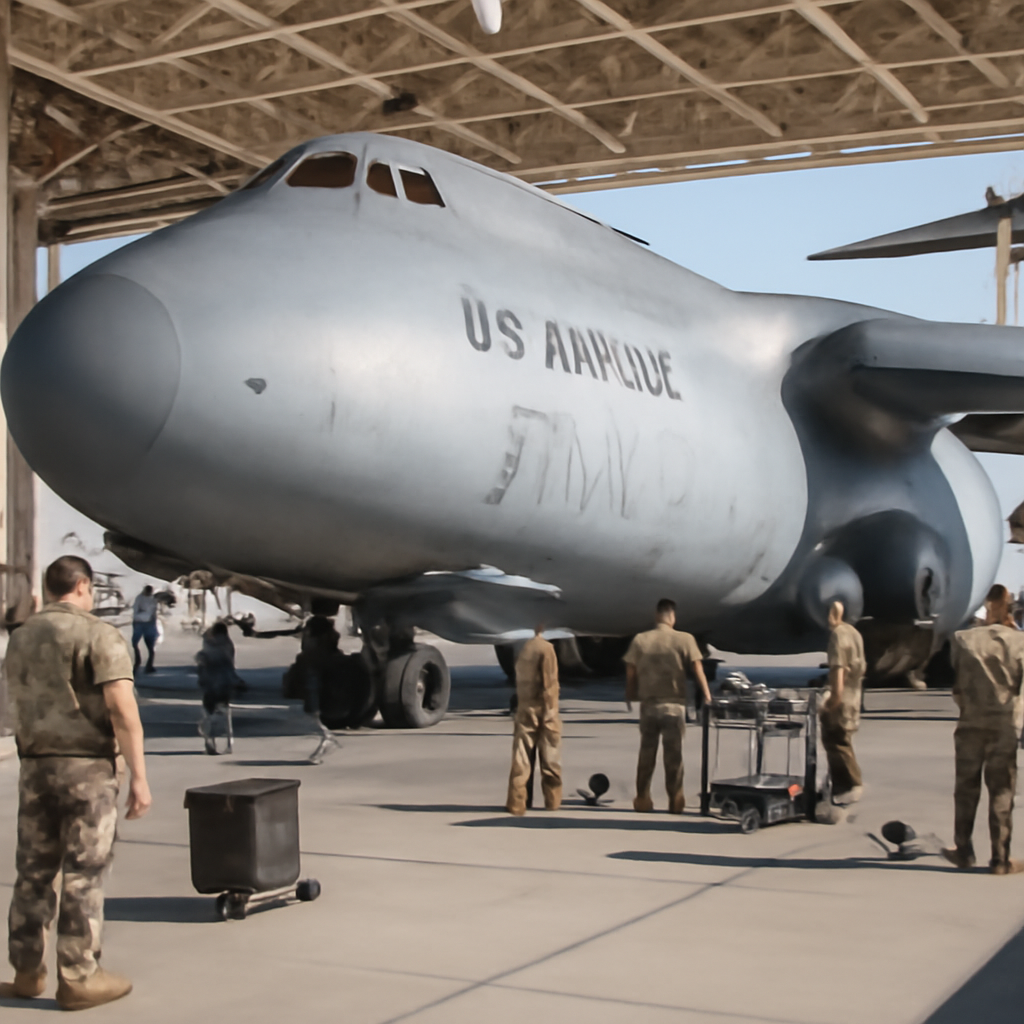
“At a hearing before the House Appropriations Committee in April, Air Force Chief of Staff Gen. Kenneth S. Wilsbach told members of Congress that the C-5’s mission capable rate had fallen to 37 percent.”
Mission-capable rate: a steep fall to 37 percent
The Air Force disclosed in April that the C-5 fleet’s mission capable rate has slumped to 37 percent, a decline that was emphasized during testimony before the House Appropriations Committee by Gen. Kenneth S. Wilsbach. That figure follows an earlier public reference—retired Gen. Michael “Mini” Minihan cited U.S. Transportation Command testimony indicating a mission reliability rate of 46 percent—underscoring a trajectory of falling readiness for the Galaxy fleet.
Fleet composition and age: 52 C-5Ms and service life to 2050
The service currently fields 52 C-5M Galaxies, all upgraded from older B and C variants, the last of which were built in 1989. Under the Air Force’s Fiscal Year 2027 budget documents, the service does not expect the last C-5M to be replaced by a Next-Generation Airlift (NGAL) platform until Fiscal Year 2050—meaning the youngest C-5Ms would be about 61 years old at retirement. By contrast, the Air Force also operates 222 C-17As (the last acquired in 2013) and plans for the C-17 fleet to remain viable through 2075. Neither the C-5 nor the C-17 remains in production today.

This site is the portfolio.
OSINTSights runs on Cloudflare Workers, D1, R2, and Vectorize, with an AI pipeline on Hetzner ARM. Nubivance designed, built, and operates it. We do the same for clients.
See what we buildNGAL timeline, budget requests, and transition plans
The Air Force’s Fiscal Year 2027 budget request contains the latest schedule for recapitalization. The service is requesting $8.9 million in the C-5 Modernization Efforts line for NGAL Analysis of Alternatives (AoA) and concept development in FY27, on top of $200,000 already included for NGAL in this portion of the budget for FY27. The budget documents state that “NGAL is projected to fully replace the C-5M fleet tentatively in FY 2050 and maintain the Strat Air program floor of 223 C-17 aircraft and 52 C-5 aircraft per the FY 2013 National Defense Authorization Act (NDAA).”
The Airlift Recapitalization Strategy (November 18, 2025) laid out an accelerated pathway: with an accelerated NGAL AoA in FY27 and uninterrupted funding, “the first NGAL aircraft could be produced as early as FY38,” and the program “is estimated [that] the NGAL program will reach Initial Operational Capability (IOC) in FY41.” The strategy states the recapitalization approach as one-for-one: “One NGAL aircraft will replace one C-5M aircraft until the entire C-5M fleet is retired. Then, the C-17A fleet will be replaced by NGAL at a one-for-one swap.”
Operational demand, unique capabilities, and growing threats
The C-5M remains the largest airlifter in U.S. military service and provides unique capabilities: it accommodates larger payload mass and volume than the C-17A, can load from both nose and tail simultaneously, and moves outsized and unusual payloads, including satellites and other space-related items. The fleet has been in high demand recently, with support documented for ongoing operations against Iran and during the buildup to that conflict, as well as in other Middle East contingencies.
At the same time, the Air Force notes an expanding threat ecosystem: it expects anti-air missiles with ranges of up to 1,000 miles by 2050, which would elevate risk to supporting assets such as airlifters and aerial refueling tankers during high-end fights. That threat projection is part of the context the service cites when weighing sustainment of older airframes against development of next-generation systems.
Industry concepts and competing approaches: Windrunner, BWBs, and tanker linkage
Industry proposals are already part of the conversation. Radia is pitching an aircraft called Windrunner—described as bigger than the C-17 and the C-5 and designed for operational flexibility—though the company’s project began focused on carrying oversized wind-turbine components and the Windrunner’s projected range is shorter than either the Galaxy or Globemaster III. Lockheed Martin and Boeing have also publicly shown various concepts for advanced transports and tankers, including stealthy types and blended wing body (BWB) designs. The Air Force has previously explored BWB concepts and now has a blended wing body demonstrator in development.
The Air Force’s FY27 budget also shifts the future-aerial-refueling work from the Next Generation Air-refueling System (NGAS) to a new effort dubbed Advanced Tanker Systems. “We are shifting to what’s called Advanced Tanker Systems,” Air Force Maj. Gen. Frank Verdugo said during a budget rollout briefing, adding the shift is meant “to offer more options than just NGAS, and to make sure that our future advanced tanker systems are more resilient and can operate in contested environments.” The linkage between future tankers and NGAL remains to be defined in coming budget and acquisition steps, even as the Air Force plans more KC-46 purchases and expects older KC-135s to remain in service for years to come.
What this means for Air Mobility Command, TRANSCOM, and Congress
- Air Mobility Command (AMC): AMC leadership is actively engaged in defining NGAL requirements. Lt. Gen. Rebecca Sonkiss said the service has “invested a lot of money to keep [the C-5] on board” and emphasized the need to “move forward from having to pour that much money into something old to the pathway to a modernized fleet.”
- U.S. Transportation Command (TRANSCOM): TRANSCOM’s operational posture—previously cited in testimony about the fleet’s reliability—will continue to hinge on C-5 availability for outsized cargo and strategic lift during current operations and contingencies across the Middle East.
- Congress: Budget requests and testimony have put Congress squarely in the path of decisions on sustainment funding, NGAL AoA funding, and timelines for replacement; the FY27 request and the November 2025 strategy both underscore that sustained, consistent funding is a prerequisite for accelerated timelines.
The record the Air Force has placed in its FY27 request and the November 2025 recapitalization strategy sets a clear, if tension-filled, path: the C-5M is slated to remain a central capacity-holder into 2050 even as its readiness has fallen and planners pursue NGAL AoA work now. The coming months—marked by FY27 funding decisions, the AoA in FY27, and further concept development—will determine whether the service can reconcile extending an aging, hard-to-maintain fleet with the ambition of fielding a single next-generation airlifter to replace both the Galaxy and the Globemaster III.