Ukrainian Precision Defies Russian Air Dominance Amid Shifting Battle Lines
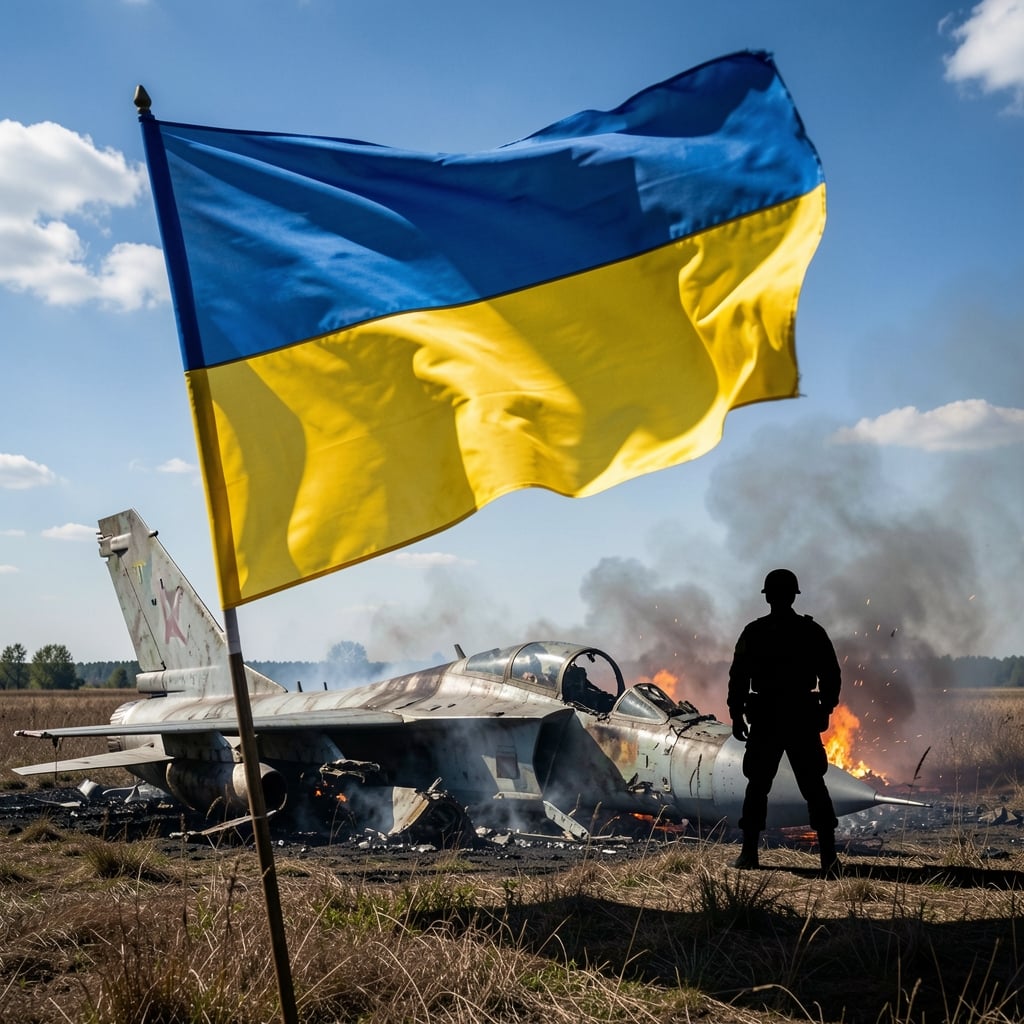
In the early hours of Saturday, June 7, a notable incident in the ongoing conflict between Ukrainian and Russian forces unfolded near the Kursk direction. Ukrainian Air Force units successfully shot down a Russian Su-35 multirole fighter jet—a development confirmed by an official military report from Kyiv. As the image from Defence Blog vividly depicts the intensity of conflict, the event underscores the escalating technological and tactical complexities on the modern battlefield.
This incident, taking place at a strategically significant juncture, highlights the evolving capability and resolve of Ukrainian forces in countering one of Russia’s most advanced aerial platforms. Military analysts point to this as more than an isolated military victory; it is emblematic of a broader strategic recalibration in a conflict defined by rapid shifts in technology, tactics, and international support.
In an official announcement, the Ukrainian Air Force succinctly stated, “A Su-35 multirole fighter was downed as part of an air operation in the Kursk direction,” signaling not only the operational success but also the improved coordination and capability of air defense units. The news, initially detailed on Defence Blog, has since drawn attention from military strategists and government officials alike.
Historically, the airspace over Eastern Europe has served as a contested zone. Since the conflict intensified following the events of 2014 and subsequent escalations, each successful defense or counteroffensive by Ukrainian forces has been closely analyzed for its tactical and political implications. Russian air superiority had long been regarded as a strategic asset, and the deployment of the Su-35, renowned for its agility and advanced avionics, underscored this assumption. However, recent events indicate that technological edge alone no longer guarantees unchallenged dominance.
In the context of contemporary warfare, the successful shoot-down near Kursk illustrates Ukraine’s increasing commitment to robust air defense. Over recent months, Ukrainian forces have received heightened levels of training and advanced systems from Western allies, aimed at narrowing the technological gap with their adversary. A synergy of intelligence, precision targeting, and upgraded counter-air measures have contributed to shifting the balance, one engagement at a time.
The implications of this downing extend beyond the immediate tactical victory. As Washington, Brussels, and Kyiv underscore the importance of defending sovereign airspace, such actions represent a broader commitment to deterrence. International relations experts note that every instance where Ukrainian forces repudiate Russian air intrusion not only bolsters national morale but also sends a potent message to allies and adversaries alike regarding the evolving nature of modern warfare.
Why does a single fighter jet matter? Simply put, the downing of a Su-35—a platform celebrated for its versatility and advanced combat capabilities—represents a challenge to Russia’s longstanding assumption of air control. In geopolitical terms, this engagement reinforces the narrative that even historically dominant forces can be vulnerable on the modern battlefield when facing a well-armed and strategically adept opponent.
Several recent analyses from defense experts, including those from the International Institute for Strategic Studies (IISS) and the RAND Corporation, support the view that Ukrainian air defense improvements have significantly altered tactical calculations. The incident near Kursk is emblematic of a shift that sees old paradigms of air superiority being put to the test in a theater where technology, intelligence, and rapid response play crucial roles.
Military officials from both sides have expressed measured reflections on the engagement. While Kyiv emphasizes the success and precision of its air operations, Moscow maintains a reserved stance, often framing losses as isolated incidents in the broader context of ongoing operations. This divergence in narratives adds another layer to an already complex strategic dialogue, inviting scrutiny from international observers who advocate for a cautious assessment of facts.
Experts such as retired Air Force General John Bogdan, a consultant with decades of experience in Eastern European military affairs, have noted that “the shoot-down signals an important shift in how air power is contested in modern conflict zones.” His comments, published in several military journals, underscore the tactical risk that such advanced aircraft face when confronted with determined adversaries employing innovative countermeasures.
Another perspective comes from analysts within NATO’s Cooperative Cyber Defence Centre of Excellence, who emphasize that the incident may have broader implications for regional deterrence. “It’s a reminder that technological investments must be complemented by tactical adaptability,” remarked a senior official at the center, stressing that the battle space is as much about information and rapid decision-making as it is about hardware.
Looking ahead, the international community will be watching closely to see how Russia adjusts its aerial strategies. Strategic recalibrations might include alterations in mission planning, enhanced electronic countermeasure deployments, or even shifts in the operational use of high-performance platforms like the Su-35. On the Ukrainian side, the successful engagement provides validation for recent investments in air defense and may well justify further international support in the form of advanced detection and neutralization systems.
Additionally, policy shifts could arise as nations reexamine the importance of maintaining a robust, agile air defense in an era where conventional wisdom on air superiority is continually challenged. The incident near Kursk is not just a military event—it is a signal to policymakers that modern conflict is multifaceted and requires a blend of technology, training, and tactical ingenuity.
Ultimately, the downing of the Su-35 serves as a stark reminder of the human cost behind every strategic maneuver. Each fighter jet, no matter how technologically advanced, carries the lives of its crew and the weight of national pride. When such a platform is brought down, it is not merely a tactical achievement but a somber moment reflecting the harsh realities of war. For Ukrainian pilots and ground controllers, the success also serves as a testament to dedication, sacrifice, and the constant quest to secure sovereignty in the face of overwhelming odds.
In summary, this engagement between Ukrainian air defenses and a Russian Su-35 fighter jet encapsulates the evolving dynamics of modern warfare. It challenges outdated notions of unassailable air superiority and underscores the importance of innovation and international cooperation. As both sides adjust their strategies and tactics, the international community must keep a keen eye on how such developments influence both the immediate conflict and the broader geopolitical landscape.
The unfolding narrative poses enduring questions: In an age where technology continually reshapes the battlefield, how will advances in air defense redefine power dynamics in conflicts around the globe? And what does this mean for the future of aerial combat and international security?



