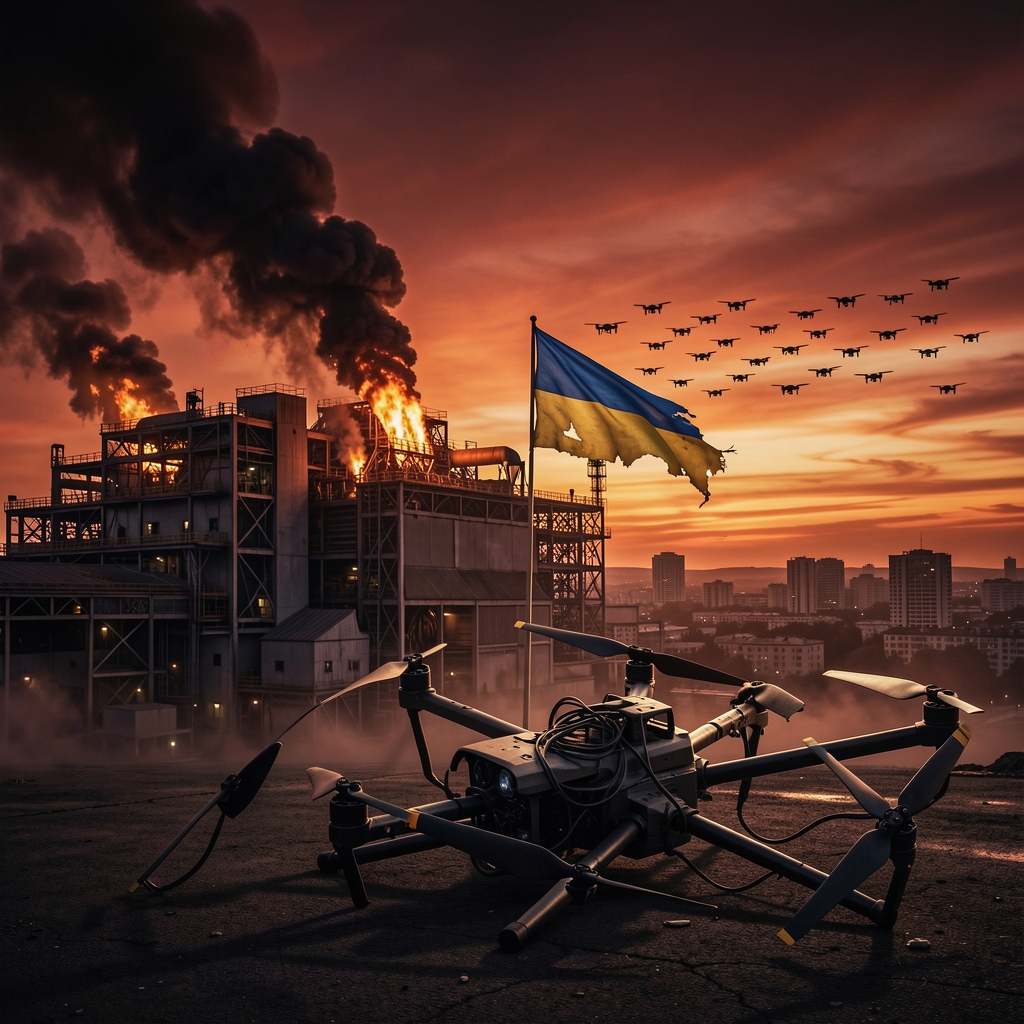
Ukrainian Drone Strike Disrupts Russian Advanced UAV Production Near Moscow
A surge of tension in Eastern Europe took a dramatic turn as Ukrainian drones reportedly struck the Kronstadt plant in Dubna, a city near Moscow. The targeted facility, a cornerstone of Russia’s modern UAV production network, is known for manufacturing advanced reconnaissance and strike drones—including the Orion and Inokhodets systems—as well as the newly developed “Banderol” cruise missile. This worrisome development raises critical questions about the evolving nature of warfare and the vulnerabilities in a nation that has long relied on prowess in high-tech military technology.
Reports emerging from Defence Blog detail the attack with striking precision. Witnesses and open-source intelligence have indicated that the Ukrainian strategy was designed to disrupt the enemy’s production of essential drone systems at a facility that plays a pivotal role in bolstering Russia’s aerial surveillance and strike capabilities. In an era where unmanned aerial vehicles have redefined the battlefield, this incident is more than a tactical loss—it marks a symbolic impasse in the ongoing technological struggle between two nations locked in protracted conflict.
The historical context of this confrontation is embedded in years of escalating drone warfare and the rapid evolution of UAV technology. Russia, committed to modernizing its military, has invested substantially in drone production facilities across its territory. The Kronstadt plant, located in Dubna near Moscow, has become representative of this strategy. Not only does it produce long-range reconnaissance drones capable of gathering critical battlefield data, but its production lines also supply advanced strike drones, which are fundamental to modern combat scenarios that have increasingly blurred the lines between conventional and cyber warfare.
In contrast, Ukraine has steadily advanced its drone technology and operational capabilities, evolving from defensive measures to proactive counter-strike strategies. The deployment of drones in such a strategic offensive role reflects Ukraine’s growing emphasis on asymmetric warfare, underlining a determination to challenge traditional power dynamics. Analysts note that Ukraine’s approach of using relatively low-cost, nimble drones to target enriched technological nodes in enemy infrastructure symbolizes a sophisticated adaptation to a conflict that defies conventional warfare paradigms.
What is happening now is a clear indication of shifting operational tactics. Early reports confirm that the Ukrainian assault hit a critical node within the Russian industrial complex. The Kronstadt plant, renowned for its production of the Orion and Inokhodets drones as well as the “Banderol” cruise missile—the latter representing a significant leap in Russia’s offensive reach—has endured substantial operational setbacks. While neither side has yet provided exhaustive technical details or casualty counts, official statements from both Ukrainian sources and independent military analysts have confirmed that the impact was significant enough to momentarily disrupt production at a key facility.
Why it matters cannot be understated. The targeting of a major production plant is a strategic gambit designed to induce both immediate operational paralysis and long-term logistical delays. The incident illustrates a larger trend in modern warfare where manufacturing capabilities become as much a target as frontline units. In this case, the potential repercussions are manifold:
- Operational Impact: Interrupting the supply of advanced UAVs and missile systems may temporarily handicap Russian battlefield capabilities.
- Psychological Warfare: A successful strike against the heart of Russia’s technological production infrastructure could serve as a morale booster for Ukrainian forces and their international supporters, while simultaneously shaking confidence within Russian command structures.
- Economic Ramifications: Such attacks can strain resources by necessitating costly shifts in production lines, supply chain overhauls, and heightened security measures, further complicating Russia’s military logistics.
- Technological Vulnerabilities: The breach of a fortified production facility brings to light vulnerabilities in even the most secure and advanced industrial sites, encouraging adversaries to seek similar targets elsewhere.
Experts in military technology and strategic studies have provided measured interpretations of this development. Eugene Rumer, a defense analyst at a noted think tank in Moscow, commented in a recent analysis that such incidents “point to an evolution in the warfare playbook—where digital precision and tactical agility can undermine traditional military manufacturing hubs.” Similarly, analysts at the RAND Corporation have underscored that the successful execution of such a high-value target strike could herald a broader shift in how nations prioritize and defend critical military-industrial assets.
While the Ukrainian strike is a tactical maneuver, its implications could resonate well beyond the immediate sphere of conflict. Historically, warfare has evolved through the targeting of critical infrastructure—a lesson well-learned from previous conflicts where industrial capacity determined the war’s tempo. The damage to the Kronstadt plant not only disrupts production lines but also has the potential to delay the deployment of advanced UAV systems, thereby altering strategic operational timelines for Russian forces.
Looking ahead, several scenarios could unfold from this escalatory act. Russian military leadership may be compelled to enhance the security of similar industrial facilities, prompting a chain reaction of increased military spending and a possible realignment of strategic priorities. The Kremlin is likely to scrutinize the vulnerabilities exposed by the strike, which could lead to both immediate retaliatory measures and long-term revisions in production and defense strategies.
For Ukraine, the audacious operation reinforces its tactical credibility and underscores its commitment to leveraging unconventional methods to offset conventional military disadvantages. This event may also have broader diplomatic and geopolitical ramifications, affecting everything from international arms trade policies to regional alliances. Observers at the European Council on Foreign Relations have noted that events such as these have the potential to influence public debates on military intervention and defense spending across the continent.
Yet, amid the strategic calculations and high-stakes maneuvers, the human element remains at the forefront. Behind each data point and production target are individuals—plant workers, drone operators, and the soldiers on the front lines—whose lives are deeply entwined with the outcomes of these tactical decisions. The strike, like many modern conflicts, not only redefines political and military narratives but also disrupts local economies and family lives, adding a poignant layer of complexity often lost in statistical summaries.
In revisiting historical precedents, one recalls how critical industrial failures in previous conflicts have reshaped battlefront strategies. The echoes of past industrial sabotage underscore that a well-calculated attack on the heart of enemy manufacturing can serve to tilt the broader scales of war. As this incident unfolds, policy makers, military strategists, and global observers will be closely tracking its implications—not only for the conflict between Ukraine and Russia but also for the future of warfare in an increasingly technologically driven era.
In summing up, the Ukrainian drone strike on the Kronstadt plant near Moscow represents a significant moment in an already turbulent conflict. With production lines now disrupted and vulnerabilities exposed, the strategic calculus for both combatants may now shift. As history has repeatedly demonstrated, the modern battlefield is defined by its convergence of technological innovation and the tenacity of human resolve. The events unfolding today invite all stakeholders to ponder: In a world where infrastructure can be so ruthlessly dismantled, what safeguards must we implement not only to protect nations but also to safeguard the human stories interwoven with these epic encounters?



