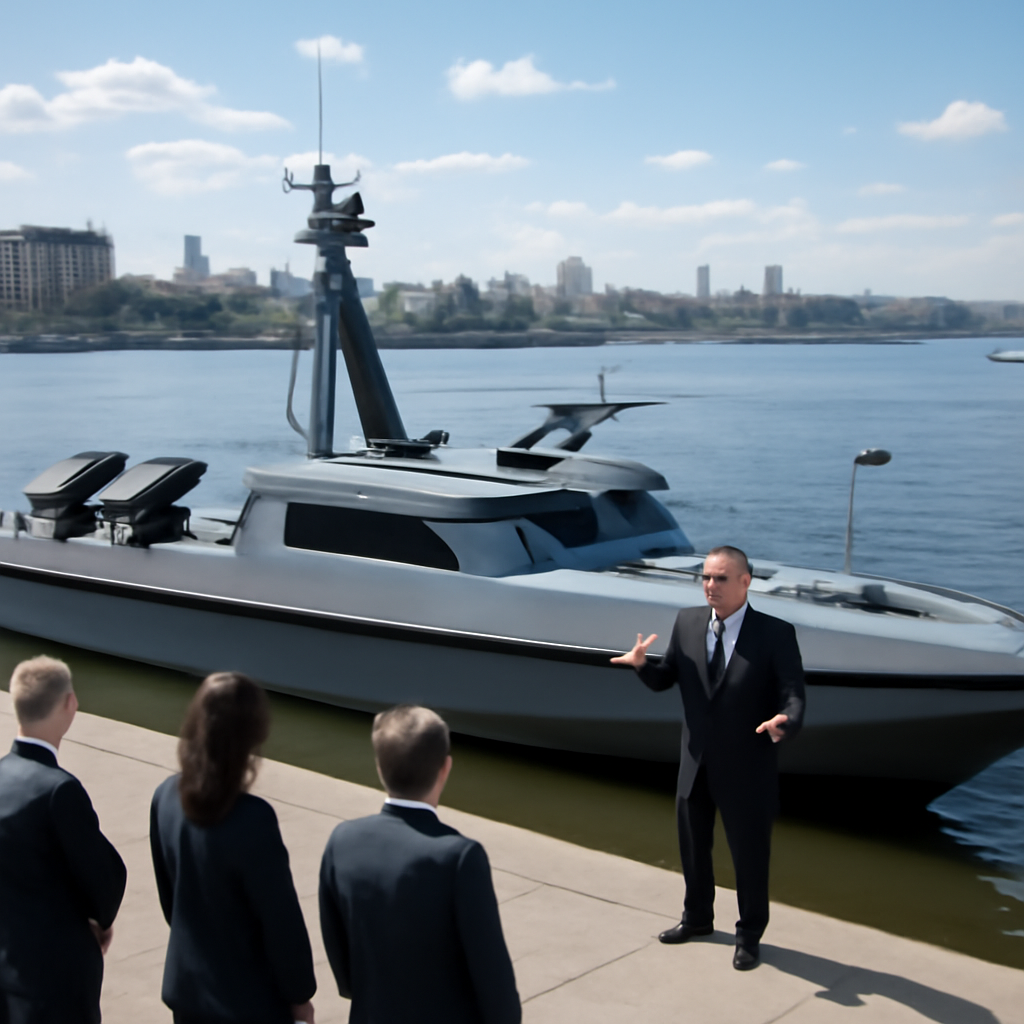
“We are proud to present the MV11 on Ukraine’s Independence Day. This is not just the largest naval drone – it is a platform that delivers multi-domain capability: a single carrier that transports and launches other unmanned systems far from shore, enabling operations across all domains,” Oleg Roginsky, CEO of UFORCE, said in a statement.
UFORCE, the Magura family, and the MV11 debut in Kyiv
The MV11, the largest member yet of Ukraine’s combat‑proven Magura family of uncrewed surface vessels (USV), made its public debut at Ukraine’s Independence Day parade in Kyiv, held along a section of the Dnipro River. UFORCE — founded in Ukraine with its main headquarters in London — showcased the MV11 alongside other uncrewed air, ground, and maritime systems. UFORCE described the platform in a press release as able to support multi‑domain missions and said it could be used for surveillance, reconnaissance, amphibious support, or cargo transport.
MV11 technical profile and sensors shown so far
The MV11 is designed for open‑ocean operations lasting up to a week and can carry payloads weighing up to 4,850 pounds (2,200 kilograms). Images and footage released by UFORCE show the USV with a rear mast carrying a camera turret, navigation radar, and two horn‑like antennas; a fixed forward camera sits atop the bow. The main deck also displays what appear to be a pair of rectangular satellite communications (SATCOM) terminals. How the MV11 spots and tracks aerial targets has not been fully disclosed, but the visible camera, radar and antennas offer plausible means for navigation, situational awareness, and passive signal detection.

This site is the portfolio.
OSINTSights runs on Cloudflare Workers, D1, R2, and Vectorize, with an AI pipeline on Hetzner ARM. Nubivance designed, built, and operates it. We do the same for clients.
See what we buildSting interceptors and the MV11’s counter‑drone fit
The configuration shown at the parade carried 18 small, vertically launched Sting interceptors, each loaded in box‑like launchers that can be used on other platforms, including trucks or ground emplacements. Wild Hornets, the Ukrainian developer, says Sting is an electrically powered quad‑rotor interceptor with a small explosive warhead, heavy use of 3D‑printed components, and a reported unit cost of about $2,100. A Sting weighs roughly nine pounds, can reach altitudes up to nearly 23,000 feet (7,000 meters), and has a maximum range of around 23 miles (37 kilometers), though flying time is typically shorter and depends on battery capacity, weather, payload and operator flight style.
Sting is manually operated by a human controller via a wireless link and can be recovered for reuse if it fails to intercept a target. Wild Hornets has previously stated that its interceptors can be remotely operated from locations up to 2,000 kilometers from the launch point using a laptop‑installed user interface. How the Sting control chain is implemented specifically when the MV11 is the launch platform remains unclear; TWZ has reached out for more information.
What appeared on the Dnipro: kamikaze USVs, repurposed missiles, and armed UGVs
The maritime portion of the parade included additional Magura family vessels and other USVs: kamikaze types, boats armed with repurposed air‑to‑air missiles, a drone boat with a launcher for FPV‑type aerial kamikaze drones, and a vessel with an array of small domed antennas that UFORCE suggested could be tied to electronic warfare or communications roles. The event also displayed aerial kamikaze drones and uncrewed ground vehicles (UGVs) armed with anti‑tank guided missiles, automatic grenade launchers, and machine guns — a reminder that Ukraine is demonstrating uncrewed systems across sea, air and land domains.
How this matters for Ukrainian forces, Gulf Arab States, and naval planners
- Ukrainian forces: An MV11 armed with Stings could serve as a forward‑deployed counter‑drone node in the Black Sea and along waterways, thinning out waves of incoming one‑way attack drones and easing pressure on strained air‑defense units.
- Gulf Arab States: The source notes that Gulf Arab States sought Ukrainian assistance following Iranian drone attacks this year; an MV11 carrying Stings could offer a lower‑cost, sea‑based option to intercept Shahed‑type and similar one‑way drones when linked to even a basic early‑warning network.
- Naval planners and logistics teams: With a 4,850‑pound payload, the MV11 can be repurposed beyond counter‑drone work — to launch groups of one‑way attack drones, mount direct attack weapons, or carry sensors, electronic warfare, or communications packages, as well as to support amphibious operations or cargo transport.
Ukraine has previously employed USVs armed with traditional anti‑air missiles and has claimed those systems were used to down Russian fixed‑wing jets and helicopters. Separately, video released in July shows a smaller USV transporting and deploying an armed UGV into a Russian‑occupied area on the Kinburn Spit, presented as the world’s first known combat mission of its kind — a proof‑of‑concept that larger platforms like the MV11 could extend.
The MV11’s public debut underlines how quickly Ukrainian uncrewed capabilities are evolving at sea as well as on land and in the air. Now that the platform has been shown openly — configured as a floating counter‑drone battery in the footage and marketing materials — it could soon be employed in operational roles ranging from intercepting one‑way drones to delivering sensors, electronic warfare, or cargo farther from shore.
Original reporting: https://www.twz.com/sea/ukraines-newest-usv-is-a-super-sized-mothership-packed-with-anti-drone-interceptors