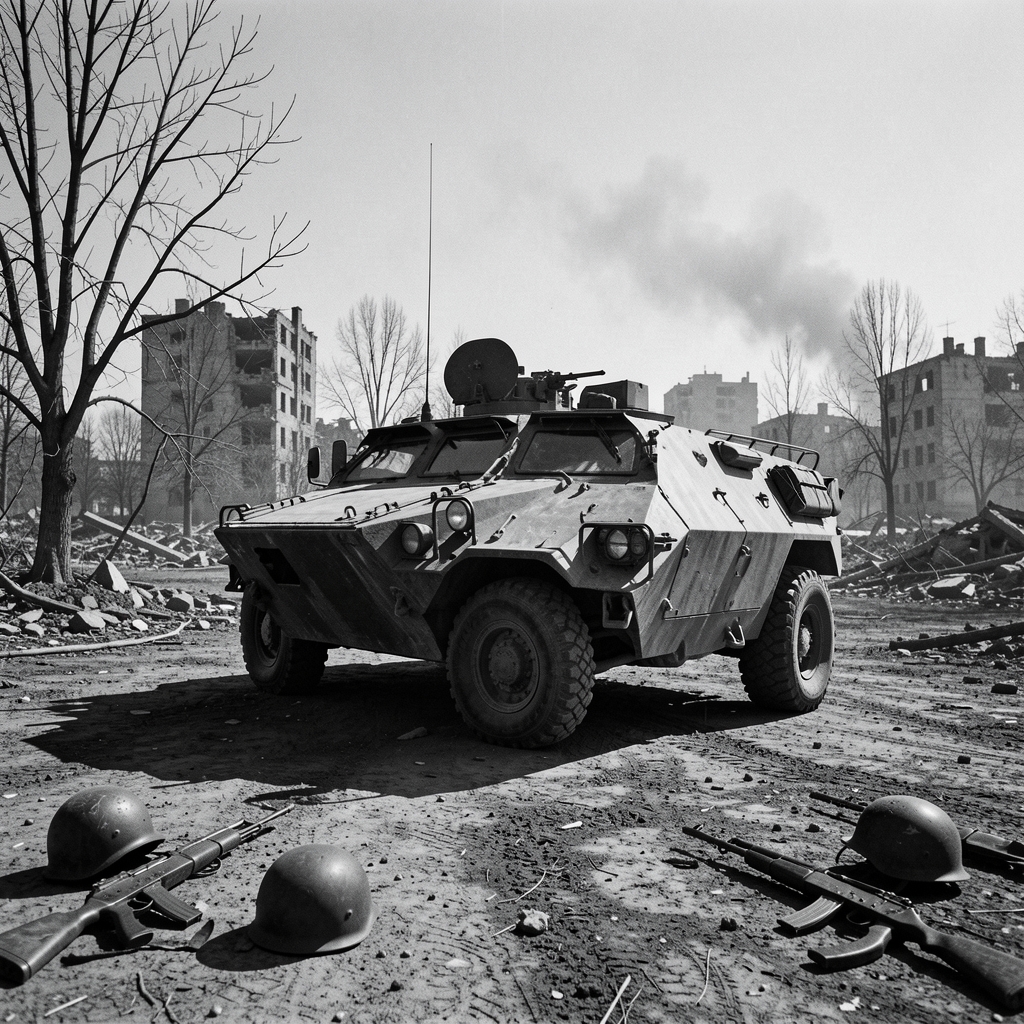
Can a nation rebuild its armored ranks from scratch in the middle of an extended conflict? Ukraine has begun pressing that question in concrete form: a new armored personnel carrier, explicitly described as M113-inspired, is now in testing as the country seeks to replace and replenish vehicles lost or worn down over years of war.
Background: a gap left by eroded fleets
Years of fighting have taken a visible toll on Ukraine's mechanized forces, the reporting notes. Donated vehicles and the country's original fleets have been eroded by sustained operations, creating an acute need for fresh armored personnel carriers (APCs). In response, Ukraine is working to provide its own APC solution rather than relying solely on external supplies.
The M113-inspired APC now in testing
According to the reporting, a domestically produced APC modeled on the M113 design has entered a testing phase. The description—M113-inspired—signals a lineage of design choices that informed the vehicle now undergoing evaluation. Beyond that characterization, the available source material does not provide technical specifications, test locations, production timetables, or performance results.

Audit-ready is a season. It shouldn't be.
Evidence in spreadsheets, controls drifting between audits, frameworks multiplying on flat headcount. Nubivance runs continuous compliance on Rapid7 Cyber GRC - SOC 2, HIPAA, ISO 27001, PCI, CMMC.
End the scrambleWhy this matters: operational and strategic implications
- Logistics and sustainment: Developing an indigenous APC capability aims to reduce dependence on external donations and to replenish units that have been depleted over time. Domestic production could introduce more predictable supply lines for spare parts, maintenance and future replenishment.
- Adaptation and urgency: Putting a vehicle into testing under wartime conditions suggests an imperative to adapt quickly. Testing is a necessary step toward fielding, but it also reflects pressure to shorten development cycles and to prioritize solutions that can be produced and supported in the near term.
- Design trade-offs: An M113-inspired approach implies reliance on a proven, familiar architecture. Such familiarity can simplify training and integration for crews and maintainers, but it may also carry limitations inherent in older platform concepts. The source does not specify how these trade-offs are being addressed.
- Signal to partners and adversaries: The move to test a domestic APC sends a clear signal that the country is seeking greater self-sufficiency in ground combat vehicles. That signal has diplomatic and military resonance: for partners, it is an indicator of intent to shoulder more of the production burden; for adversaries, it is a marker of resilient adaptation.
Perspectives and outstanding questions
- Technologists and engineers will be focused on whether the tested vehicle meets modern survivability, mobility and payload expectations while remaining producible at scale. The reporting does not provide test outcomes or technical details, leaving core evaluation criteria open.
- Policymakers face choices about resources and industrial policy: whether to accelerate domestic production capacity, to seek additional external assistance, or to prioritize other systems. The source material only states that Ukraine is pursuing its own APC solution and does not describe policy decisions or funding pathways.
- End users—soldiers and unit commanders—will judge the vehicle by its reliability, maintainability and protection under combat conditions. The vehicle's entry into testing is a first step toward such user assessments; no operational use or user feedback is reported.
- Adversaries will observe whether this effort yields a reliable, scalable production line or remains an incremental, limited response to attrition. The reporting does not offer information on production ambitions or timelines that would clarify that assessment.
The testing of an M113-inspired APC is a clear, pragmatic response to a stark problem: donated and original armored vehicle fleets have been eroded by prolonged conflict, and substituting domestic production is one way to restore capability. Yet testing is only the start—questions about performance, production capacity, sustainment and strategic impact remain unanswered by the available reporting. Will the effort mature into a mass-producible solution that can materially change battlefield mobility and protection, or will it provide a stopgap that eases pressure only marginally? The answer will depend on results that, for now, are still to come.
Read the original report: https://www.twz.com/land/ukraines-m113-inspired-armored-personnel-carrier-in-testing