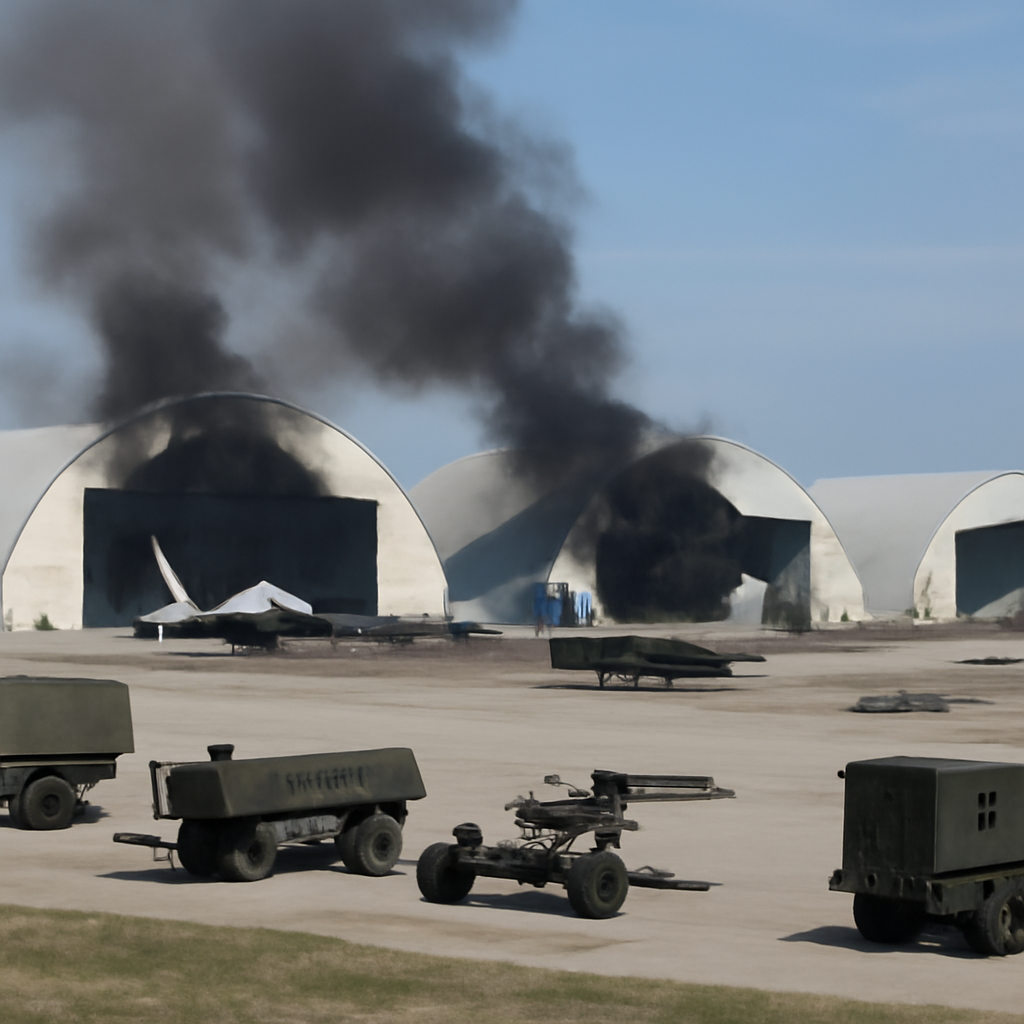
“At the ‘Saki’ airfield, seven hangars storing aviation equipment were hit, in which Su-30SM, Su-30, and Su-24 fighter jets and frontline bombers were located,” SBU added.
SBU’s claim: multiple hangars and jets struck at Saki Air Base
The Ukrainian Security Service (SBU) said it launched a drone strike on Russia’s Saki Air Base in Crimea on Friday and claimed damage to aviation assets. The SBU stated that “seven hangars storing aviation equipment were hit” and that “according to preliminary information, at least seven aircraft were destroyed or damaged.” The SBU also said it had no visual evidence from either the Friday strike or a separate strike on Wednesday to back its claim.
Saki Air Base is identified in reporting as home to the Russian Navy’s 43rd Independent Naval Attack Aviation Regiment, which “flies mostly Su-30SM Flankers.” The SBU’s statement framed the series of strikes as part of Ukrainian President Volodymyr Zelensky’s campaign “to inflict so much pain on Russia that Vladimir Putin moves to end the war,” according to the source material.
Vantor satellite imagery: hardened aircraft shelters show structural damage
Private imagery provider Vantor supplied overhead satellite photographs of Saki that show clear structural damage to hardened aircraft shelters. In the first image, analysts noted damage to four hardened aircraft shelters; in an updated set of images Vantor provided later, a “very cursory analysis” identified six out of seven hardened shelters as damaged, with doors blown off of four of them.
From the overhead perspective visible in those images it is not possible to determine whether aircraft were present inside the shelters at the time of the strikes or to assess any damage to aircraft. The reporting also notes that imagery from Planet Labs dated June 27 does not appear to show the same damage to the shelters, suggesting the harm visible in the Vantor photos occurred after that date.

Audit-ready is a season. It shouldn't be.
Evidence in spreadsheets, controls drifting between audits, frameworks multiplying on flat headcount. Nubivance runs continuous compliance on Rapid7 Cyber GRC - SOC 2, HIPAA, ISO 27001, PCI, CMMC.
End the scrambleOperational backdrop: Ukraine’s pressure campaign and Crimea’s fuel crisis
The strike on Saki comes amid months of Ukrainian attacks on Crimea’s infrastructure, including “bridges connecting the peninsula with the mainland and on its fuel infrastructure,” the source reports. Those strikes have coincided with local attempts to ration gasoline in Crimea, described as making “life miserable at the height of the traditional summer vacation season.”
The reporting links the fuel situation to social tensions: residents of Russia’s nearby Krasnodar region were said to be complaining that “non-Russians” from Crimea had occupied their gas stations, and local refusals at stations were documented in an embedded social post cited by the source.
Wargames, raids, and the character of modern amphibious scenarios
A Russian reserve colonel and military expert, Viktor Murakhovsky, said he took part in an operational command-staff exercise called “Crimean Alert” that simulated a Ukrainian landing on Crimea and measures to repel it. Murakhovsky described the exercise as dedicated to a landing by the Ukrainian Armed Forces and credited organizers for a high-level execution.
Independent reporting by The Insider interpreted the exercise’s map and scenario as simulating not a classic large-scale World War II–style landing but a modern maritime operation that “likely envisioned … the mass use of drones, long-range precision-guided weapons, reconnaissance systems, and possibly small, high-speed boats.” That assessment noted blue arrows drawn from the direction of Odesa and the northwestern Black Sea toward Crimea, with defensive positions marked around Sevastopol and along Crimea’s northern and eastern edges.
The account also recalled a past Ukrainian raid: in October 2023 the Ukrainian Defense Intelligence Directorate (GUR) sent a small raiding party by Sea-Doo GTX 300 personal watercraft to a point north of Tarkhankut Bay, equipped with grenade launchers, machine guns, MANPADS, and other assault gear. Those incursions were described as not intended to create a sustained presence but to signal that Crimea remained within reach.
What this means for the 43rd Regiment, Russian planners, and local residents
- Russian Navy’s 43rd Independent Naval Attack Aviation Regiment: The SBU’s claims and Vantor imagery together indicate that shelters used to protect Su-30SM, Su-30, and Su-24 aircraft at Saki were struck or damaged, raising immediate questions about the availability and readiness of those aircraft should losses be confirmed.
- Russian military planners and analysts: The reported exercise “Crimean Alert” and The Insider’s reading of its scenario suggest Russian planners are treating the possibility of modern, drone- and small-boat–heavy amphibious or maritime operations as a planning priority.
- Residents of Crimea and Krasnodar Krai: Continuing strikes on infrastructure and attempts at gasoline rationing have produced social friction between populations in Crimea and neighboring Krasnodar, with reports of local protests and complaints about fuel access.
The verified Vantor images corroborate that hardened shelters at Saki sustained structural damage and that at least some shelter doors were blown off; they do not, by themselves, prove the SBU’s claim of seven aircraft destroyed or damaged. Planet Labs imagery from June 27 lacks the same damage, indicating the harm is recent, and independent analysis of the evolving strike campaign, Russian countermeasures and exercises, and social strain over fuel will hinge on further imagery, on-the-ground reporting, and official confirmations.