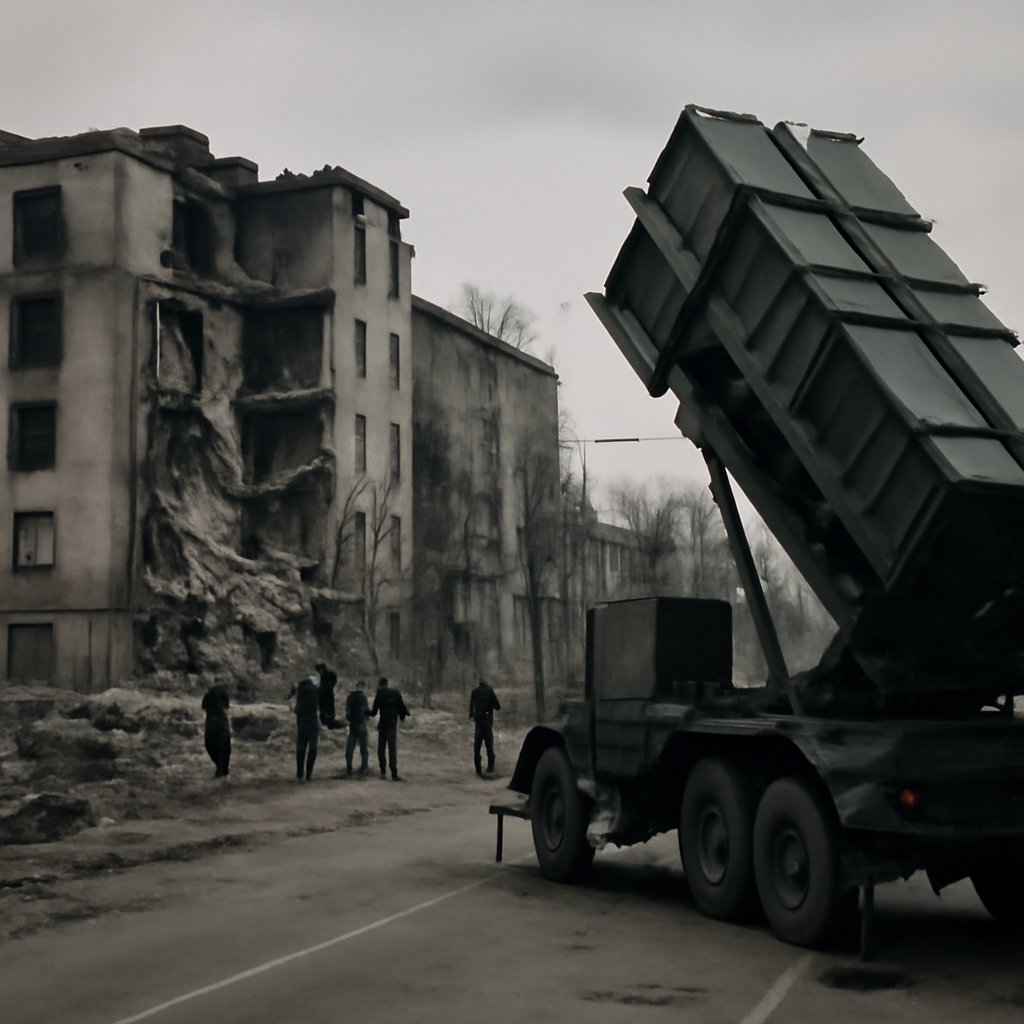
Ukrainian officials say that shortfall left the capital exposed during an overnight Russian barrage that, according to Kyiv, included ballistic and hypersonic missiles and killed at least 20 people while wounding scores more. Ukrainian authorities and the Air Force report that none of the Iskander ballistic missiles or Zircon hypersonic cruise missiles in the attack were shot down.
What Kyiv says happened overnight
The Ukrainian Air Force reported that Russia fired 23 Iskander ballistic missiles and six Zircon hypersonic cruise missiles in the attack; all evaded Ukraine’s air defenses, Air Force spokesman Yuriy Ignat told national television. Ukrainian authorities also reported the wider scope of the strike: 68 rockets and 351 strike drones, a toll that Ukrainian social media and official briefings used to describe widespread damage across more than 10 locations in Kyiv, including residential buildings. Kyiv said it shot down large numbers of lower-speed threats — 326 of 351 drones, 31 of 33 Kh-101 cruise missiles and all six Kalibr cruise missiles in the same barrage — but that ballistic and hypersonic weapons got through.
How Ukraine and its air defenses describe the problem
Ukrainian officials framed the failure to stop ballistic and hypersonic strikes as a munitions shortage, not a lack of Patriot launchers. Ignat put it bluntly on national television: “In order to shoot down ballistic missiles, you need to have something to shoot them down with.” He added that Patriot systems themselves are sufficient, but that Ukraine faces a “serious shortage of interceptor missiles.” President Volodymyr Zelensky echoed that criticism on X, urging America and European partners to deliver interceptors and calling on allies at the NATO summit in Ankara to make “strong decisions to support our defense of the sky.”

This site is the portfolio.
OSINTSights runs on Cloudflare Workers, D1, R2, and Vectorize, with an AI pipeline on Hetzner ARM. Nubivance designed, built, and operates it. We do the same for clients.
See what we buildAllied stocks, production and policy constraints
Reports cited in the coverage point to wider, global constraints on Patriot PAC-3 MSE interceptors. A Center for Strategic and International Studies (CSIS) assessment cited by the piece put current PAC-3 MSE production at roughly 650 interceptors per year, with about half the output staying with the United States and the remainder going to allies. A January contract obligates Lockheed to boost annual Patriot production to 2,000 interceptors. The U.S. Pentagon has said it is working to increase output, and U.S. deliveries to Ukraine are “actively” ongoing, NATO Secretary General Mark Rutte said in Ankara — but he also warned that “there is a limit to the amount of interceptors that are in NATO territory.”
Concrete national responses: Germany and Poland
Germany has pledged targeted financial support for munitions procurement. German Defense Minister Boris Pistorius announced that Germany would provide $200 million under the Prioritized Ukraine Requirements List (PURL) to buy U.S.-made air defense munitions and join the JUMPSTART mechanism, which focuses specifically on procuring Patriot interceptor missiles. TWZ’s reporting translated that $200 million into roughly 40–50 PAC-3 MSE interceptors and noted an additional $400 million Germany will allocate for air defense and missiles under PURL.
Meanwhile, Polish deputy marshal Krzysztof Bosak claimed on X that Poland transferred Patriot interceptors to Ukraine in March without notifying the Sejm, saying the missiles “had been purchased by Poland from the USA” and were the “only missiles that Poland possessed/possesses, capable of countering Russian Iskander missiles” deployed nearby. That claim is part of the public debate over allied inventories and their distribution.
Ukraine’s domestic effort: Fire Point and the FP-7.x interceptor
Ukraine is also developing indigenous options. Fire Point, the Ukrainian company behind several drones and the FP-5 Flamingo cruise missile, is working on an “anti-ballistic shield” built around an FP-7.x interceptor missile. The company demonstrated tests in February and company officials described the missile as “aerodynamically ready” but not yet combat-capable without full integration. Chief designer Denys Shtilerman said the system depends on radars, command centers, a secure data link, and a European-developed seeker head; those elements are still being combined with partners to produce a functioning missile defense network.
What this means for Ukraine, NATO, and defense producers
- For Ukraine: The gap between available interceptors and the pace of ballistic and hypersonic strikes translates into immediate civilian risk in Kyiv, according to presidential and military statements; Kyiv is pushing for faster, fuller deliveries from allies while also investing in domestic interceptors.
- For NATO policymakers: Allies face a choice between reallocating scarce interceptor munitions and accelerating production. NATO’s public framing — that deliveries are underway but limited by inventories — underscores pressure on procurement schedules and allied budgeting commitments ahead of the Ankara summit.
- For defense contractors: The CSIS and TWZ reporting point to production targets and price pressures — a baseline output of about 650 PAC-3 interceptors per year, a Lockheed commitment to 2,000 annually under a January contract, and discussion of developing new, roughly $1 million-per-interceptor designs to expand supply rapidly.
The facts laid out by Ukrainian officials leave a simple, difficult question for the Ankara summit: will pledged funds, the shipments already under way and stepped-up industrial output be enough — and fast enough — to change the calculus that left Kyiv unable to stop the ballistic and hypersonic elements of this latest strike? The answers will determine whether future barrages can be kept from translating directly into civilian casualties.
Source: TWZ — Out Of Patriot Interceptors, Ukraine Can’t Down Any Ballistic Missiles Striking Kyiv