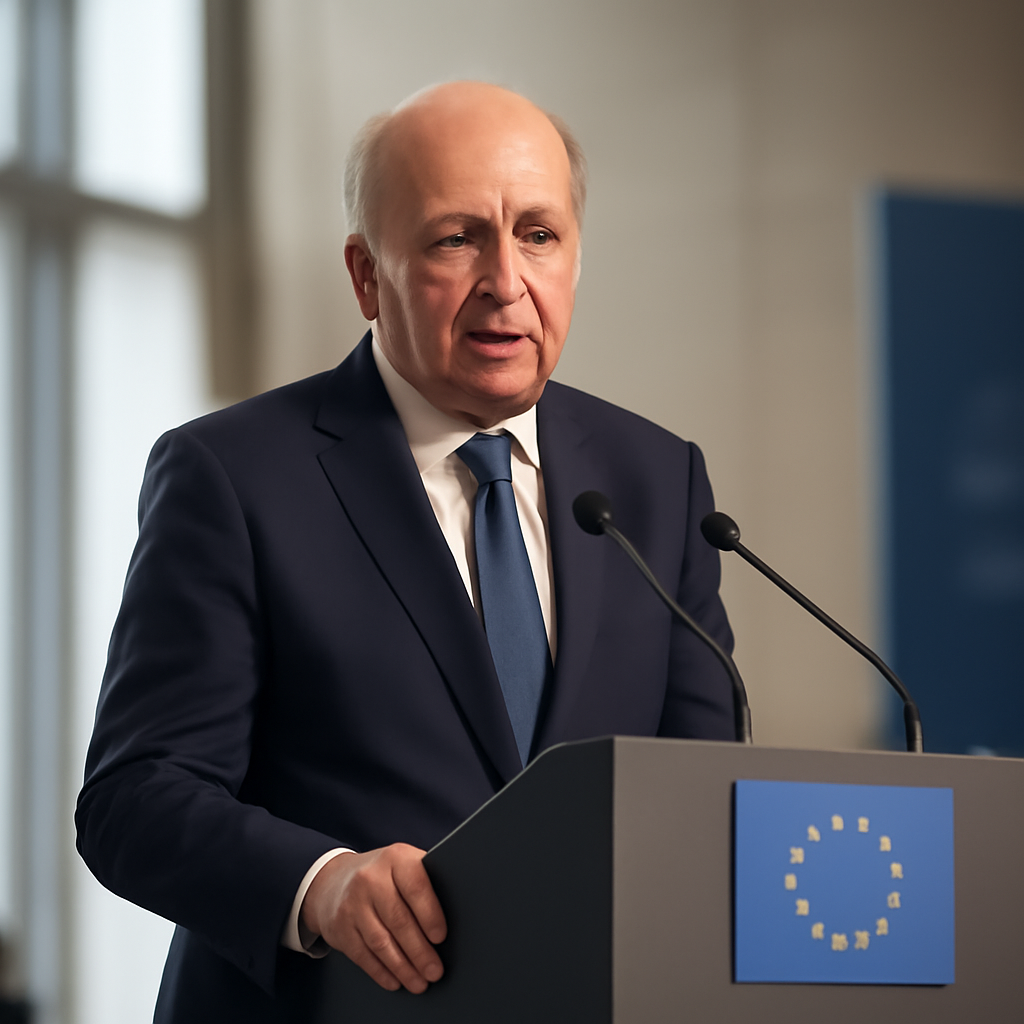
"There is no Golden Dome."
Those words, spoken by Space Force Gen. Michael Guetlein at the Space and Missile Defense Symposium in Huntsville last week, put the program’s fate in stark monetary terms: without congressional funding sorted, the homeland missile-defense project codenamed Golden Dome cannot proceed. The blunt assessment has resonated in Capitol Hill discussions, where lawmakers and program advocates are wrestling with competing budget priorities and the mechanics of reconciliation funding.
The funding math: $17.5 billion sought, $400 million in the baseline
The White House is seeking $17.5 billion next year for Golden Dome, but only about $400 million of that figure is in the baseline budget; the remainder has been packaged into reconciliation measures controlled by Congress. Rep. Jeff Crank, R-Colo., told Defense One that “I think we largely funded Golden Dome through reconciliation, and that only works if the money is there that we gave them through reconciliation.”
Congress is currently processing a third reconciliation package, a $90 billion measure that has been significantly scaled down from the Pentagon’s initial $350 billion request and “primarily focuses on funding operations and replenishing munitions from the Iran war,” the reporting says. Crank warned that if reconciliation funds are redirected, Golden Dome could lose the financing it depends on.

Your town's IT department is one person. Maybe.
Ransomware crews target small municipalities because nobody's watching. Nubivance gives Maine and New Hampshire towns a security program sized to a town budget.
Protect the town officeCongressional politics and the Golden Dome Caucus
Rep. Jeff Crank co-chairs the House’s Golden Dome Caucus alongside Rep. Dale Strong, R-Ala. According to LegiStorm, the caucus presently has no Democrats. Crank said he has been attempting to persuade members across the aisle to support additional funding, targeting lawmakers whose districts host military facilities or contractors with ties to ballistic missile defense work: “So, we’re working on that. It’s a tough slog.”
Crank framed the choice as a classic appropriations trade-off: “there’s also only so much money, right? And if you allocate it to certain things at the department, it can’t be used for other things.” He added a specific concern about the Iran war: “I am concerned that if Congress doesn't appropriate money for some of the operations in Iran that are going on, that they're going to have to take it from somewhere. I wouldn't want that to be Golden Dome...”
Operational trade-offs: Iran war funding and replenishment needs
The reporting links the scaled reconciliation package to pressure coming from operations tied to the Iran war. The $90 billion reconciliation package emphasizes funding operations and replenishing depleted munitions, a shift from the Pentagon’s earlier $350 billion ask. Crank’s concern, echoed by program leadership, is straightforward: when reconciliation must cover urgent operational and munitions needs, long‑term modernization projects that rely on that vehicle can be at risk.
AEI analyst Todd Harrison framed the dilemma in budget-choice terms: “Spending more to reduce risks to the homeland increases risks elsewhere—through higher borrowing and taxes that impose economic risks, or through cuts to other defense and non-defense funding that carry security and political risks of their own.” Harrison concluded that Golden Dome’s ultimate scope “will not be determined by fiscal constraints or technical capabilities, but by political choices.”
Program risks, technical hurdles, and planning for contingencies
Beyond funding, the program faces technical challenges—reporting cites space-based interceptors as a notable hurdle—and program leadership has been explicit about contingency planning. Guetlein told reporters there is ongoing Defense Department discussion “about how to go forward,” and that officials are planning for contingencies. Rep. Crank said he “trust[s] Gen. Guetlein implicitly to do everything he can to do this, and I know they'll be compliant with the law in doing so,” while still acknowledging fiscal limits.
What this means for policymakers, Space Force program managers, and the Colorado Springs community
- Policymakers and appropriators: They must weigh reconciliation priorities against baseline budget choices. If reconciliation funds are needed for operations in Iran and munitions replenishment, lawmakers face the decision Crank described—whether to reallocate money away from Golden Dome or accept other trade-offs.
- Space Force program managers and acquisition teams: With technical challenges such as space-based interceptors and Guetlein’s public warning, program managers will need both clear funding lines and contingency options to sustain development if reconciliation funding proves unreliable.
- Colorado Springs and local economic actors: Crank represents a district that includes Peterson and Schriever Space Force Bases and Cheyenne Mountain Space Force Station. He highlighted ongoing Space Force investments in the region—an Infrastructure Portfolio Acquisition Executive office moving from Space Systems Command in California to Colorado Springs (an office said to control $4 billion in contracts), expected by the end of this year, and the construction of a new Space Force Operations Facility at Schriever announced by Air Force Secretary Troy Meink in May—which he said “will be far in excess of what we would lose” after U.S. Space Command’s headquarters moved out last year.
The program’s fate now hinges on political choices as much as technical feasibility. Guetlein’s stark summary—“there is no Golden Dome”—and Rep. Crank’s warning about competing demands for reconciliation funds frame a clear near-term test: whether Congress will sustain the specific reconciliation pathway that undergirds the bulk of the $17.5 billion request, or reallocate those resources to pressing operational needs.