“This deal strengthens our ability to protect freedom of navigation, which is critical to our security and our economy …[We are] using the biggest sustained increase in defense spending since the Cold War to put the latest modern technology in the hands of our sailors,” — British Defense Secretary Wes Streeting
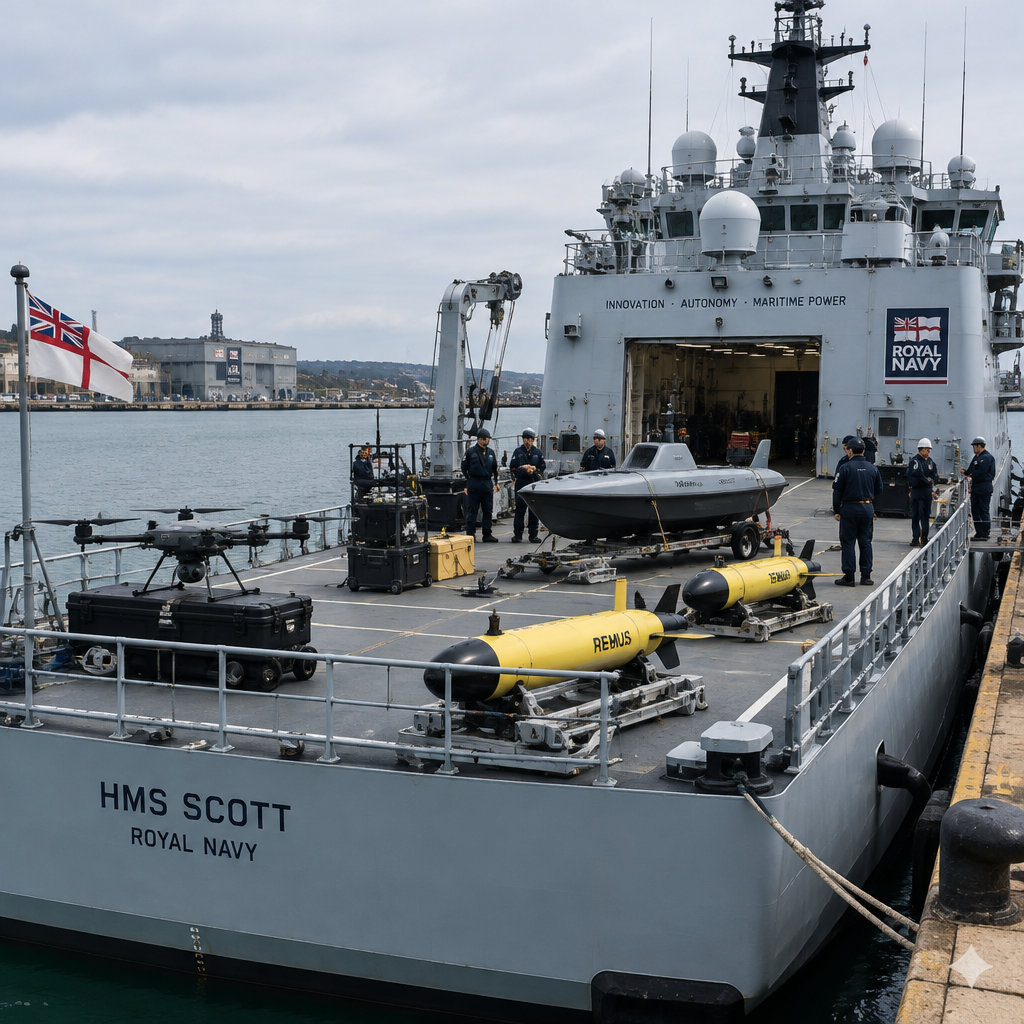
The United Kingdom this week moved from declaration to delivery planning on a capability meant to keep ships clear of mines while keeping personnel at a greater distance from danger. Under an agreement with Norway, London committed to buy three offshore support vessels configured as unmanned mine-hunting “motherships,” with an option to buy three more.
The Lunna House Agreement and the P1118 Standardized Vessel Program
The procurement follows the UK-Norway Lunna House Agreement signed last December and formalizes British participation in Norway’s P1118 Standardized Vessel Program. The British decision, announced on Thursday at the Atlantic Future Forum in Oslo, joins London to Norway’s effort to develop offshore support vessels that act as motherships for autonomous mine countermeasure systems.
British Defense Secretary Wes Streeting and his Norwegian counterpart, Tore O. Sandvik, signed off on the move in Oslo. The British Ministry of Defense characterized the vessels as being built on the same family as Norway’s naval version of the P1118 design.

Audit-ready is a season. It shouldn't be.
Evidence in spreadsheets, controls drifting between audits, frameworks multiplying on flat headcount. Nubivance runs continuous compliance on Rapid7 Cyber GRC - SOC 2, HIPAA, ISO 27001, PCI, CMMC.
End the scrambleThree motherships: cost, timeline, and procurement particulars
London has allocated £90 million (reported as $119.1 million) for the initial purchase of three motherships. The British MoD said the first ship is expected to arrive in 2031. The procurement includes an option for London to order three additional vessels, doubling the initial purchase if exercised.
The formal announcement in Oslo converted the UK’s previous intention into an actionable program entry: a planned purchase tied to an established Norwegian design and a timetable that sets initial delivery near the end of the decade.
Design and intended capability: unmanned mine countermeasures and force protection
The motherships are explicitly configured to deploy unmanned mine-hunting assets — autonomous systems that search for, classify and enable the neutralization of naval mines. The British MoD said those vessels would help keep sailors “further from danger,” reflecting a doctrinal move to exploit unmanned systems for hazardous tasks.
Beyond the immediate mine-countermeasure role, the ministry linked the ships to broader operational effects: supporting “anti-submarine warfare capabilities on NATO’s northern flank.” The vessels are thus presented as a dual contributor to explosive hazard reduction and regional maritime security postures in northern NATO waters.
Why mines are central now: the Strait of Hormuz and the Iran war
The announcement framed the procurement against a recent increase in the threat from naval mines. The British MoD said that the threat has “surged since the start of the Iran war in February, when Tehran launched mine-laying operations to restrict navigation of the waterway.”
The ministry called those mine-laying operations “illegal” and said they caused “major disruption to the global trade in energy.” British officials tied the new mine-hunting capability directly to preserving freedom of navigation and protecting economic and security interests affected by disruptions in key maritime chokepoints.
What this means for British sailors, NATO’s northern flank, and global energy traders
- British sailors: The MoD emphasizes that the motherships and their unmanned systems will keep sailors “further from danger,” shifting hazardous mine-clearance tasks away from crewed platforms and toward standoff autonomous assets.
- NATO’s northern flank: The MoD explicitly links the vessels to supporting anti-submarine warfare capabilities in the north, signaling an intent to integrate mine-countermeasure motherships into regional deterrence and maritime domain awareness efforts.
- Global energy traders and commercial shipping: The ministry framed the procurement as a response to mine-laying that has “caused major disruption to the global trade in energy,” positioning the capability as a tool to reduce commercial interruptions tied to maritime insecurity.
The UK’s entry into Norway’s P1118 program formalizes a shared approach to unmanned mine-countermeasure motherships and commits a defined budget and timeline to the effort. With the first vessel due in 2031 and an option for three more ships, the program ties technological choices, alliance cooperation, and regional security concerns together — while explicitly citing recent mine-laying in the Strait of Hormuz as the immediate driver.
Original reporting: https://breakingdefense.com/2026/11/uk-to-buy-three-new-mine-hunting-drone-motherships-under-norway-agreement/