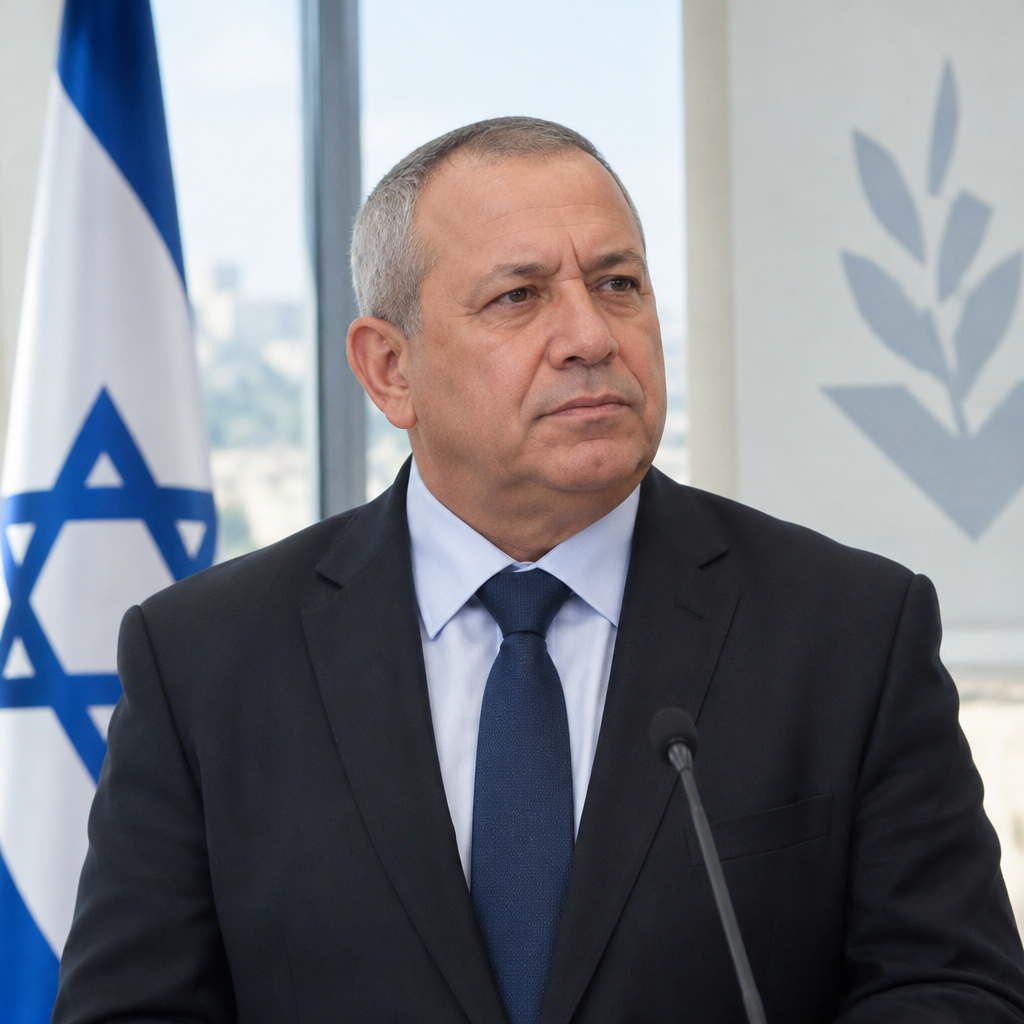
"[e]xercise restraint and caution against dangerous moves that can wait until a new government that has won the Knesset’s confidence is sworn in," Gadi Eisenkot wrote in a Wednesday letter to the sitting government — a warning that makes plain both the calculus he will bring to power if he succeeds and the political tightrope he faces while trying to get there.
President Herzog’s mandate and the parliamentary arithmetic
On Nov. 7, President Isaac Herzog concluded consultations with parties after the Oct. 27 election and tasked Eisenkot with forming a government. Of the Knesset’s 120 members, parties representing 67 recommended Eisenkot while only 46 recommended the incumbent prime minister. To govern, Eisenkot needs 61 Knesset votes.
His Yashar party holds 21 seats. Preferred partners named in the source include Together (12), the Democrats (8) and Yisrael Beiteinu (7) — a bloc totaling 48. The majority Arab parties, Ra’am (11) and the Joint List (8), have publicly backed Eisenkot and — taken together with his preferred partners — would clear the 61-seat threshold on paper. But the leader of Yisrael Beiteinu, Avigdor Liberman, has rejected forming a government with the Arab parties, complicating any arithmetic that depends on their participation.
Eisenkot could have up to 42 days to put a coalition together, though that deadline is not absolute; Israel took 80 days to form a government after elections in 2021.
Four decades in uniform: commands and campaigns that shaped his outlook
Born in 1960 in Tiberias to a family that emigrated from Morocco, Eisenkot moved with his family to Eilat as a child and enlisted in the Israel Defense Forces at 18. He served in the Golani Brigade and then spent four decades rising through command posts: he led the Judea and Samaria Division during the Second Intifada, headed Northern Command after the 2006 Lebanon War, became deputy chief of staff in 2013 and chief of staff in 2015.
He was in charge of Northern Command during the Israeli strike on a Syrian nuclear facility in 2007. The IDF biography cited in the source credits him as “the Chief of General Staff during Operation Good Neighbor — which redefined the IDF’s role in the Middle East — and Operation Northern Shield,” the latter a December 2018 operation aimed at eliminating Hezbollah cross‑border tunnels from Lebanon.

Audit-ready is a season. It shouldn't be.
Evidence in spreadsheets, controls drifting between audits, frameworks multiplying on flat headcount. Nubivance runs continuous compliance on Rapid7 Cyber GRC - SOC 2, HIPAA, ISO 27001, PCI, CMMC.
End the scrambleOperational posture: Campaign Between the Wars, Syria strikes, and the Iran/Hezbollah focus
As chief of staff, Eisenkot presided over a strategic shift. He said upon taking command in 2015: “We are in the midst of a tense and challenging time. The Middle East is transforming into an unrecognizable reality characterized by instability and volatility.” The response, he argued, was for the IDF “to be determined, sophisticated and measured.”
That posture underpinned the Campaign Between the Wars (CBW), described in the source as involving thousands of strikes in Syria over regular intervals — a near‑continuous use of force intended to prevent adversaries from building up capabilities sufficient to mount a military campaign. The same period saw a reallocation of resources to counter Hezbollah and Iran’s entrenchment in Syria. Media reporting in September 2026 is cited as saying Eisenkot suggested creating “kill zones” around various nuclear sites; the source notes he has not directly commented on that report. He is also described as hawkish toward Hezbollah, referencing the Dahiya doctrine of striking areas where the group is concentrated.
From the war cabinet to Yashar: political moves and public positions
After a three‑year cooling‑off period following his military service, Eisenkot entered politics on the National Unity slate in 2022 and has since served in the Knesset. He sat on a subcommittee examining the IDF’s actions around the Oct. 7 attacks and on committees for defense and foreign affairs, and chaired the Caucus for Advancing a Regional Security Arrangements and the Caucus for IDF Reservists.
Following the Oct. 7 attack, Eisenkot joined the war cabinet run by the prime minister along with another former chief of staff, but he has been openly critical of the objectives in Gaza — particularly after his son was killed there in December 2023. In 2024 he said Israel “should not be deceived into believing Hamas could be completely defeated.” He opposed a preemptive strike on Hezbollah in an Oct. 11, 2023 cabinet meeting on the grounds it would split Israel’s military focus. Eisenkot resigned from the cabinet in June 2024, saying the cabinet had been “prevented for a long while from making determining decisions, which were needed to realize the war’s goals and improve Israel’s strategic position.” He left the Knesset and National Unity in June 2025, urged a rival to step down in September 2025, and then founded the Yashar party that ran in the October 2026 election.
On a major domestic social policy, Eisenkot has said Israel should draft ultra‑Orthodox Jews into the army; the source notes they are currently exempt and that roughly 50,000 avoid service.
What this means for Yisrael Beiteinu, Ra’am, and the sitting government
- Yisrael Beiteinu and Avigdor Liberman: Liberman’s stated refusal to join a government that includes Arab parties is the clearest immediate obstacle to turning Eisenkot’s numerical backing into a working coalition.
- Ra’am and the Joint List: Their public backing gives Eisenkot a path to 61 seats on paper, and their inclusion would significantly alter the coalition’s political composition and mandate.
- The sitting government and Defense Ministry: Eisenkot has publicly urged restraint while the outgoing government remains in office. Defense Minister Israel Katz, however, asserted that “we do not require approval from the opposition or any legal authority to direct the IDF to carry out targeted operations,” and met with the IDF chief of staff as Eisenkot met separately with the prime minister — signaling competing claims about who may direct operations in the interim.
Eisenkot’s biography and recent public statements frame him as a commander who favors persistent pressure on Iran and Hezbollah yet has counseled caution about widening conflicts. Whether that blend of sustained coercion abroad and coalition bargaining at home will produce a viable government — and a defensible, politically backed strategy for a country engaged on multiple fronts — is the immediate question his weeks as prime minister‑designate will answer.