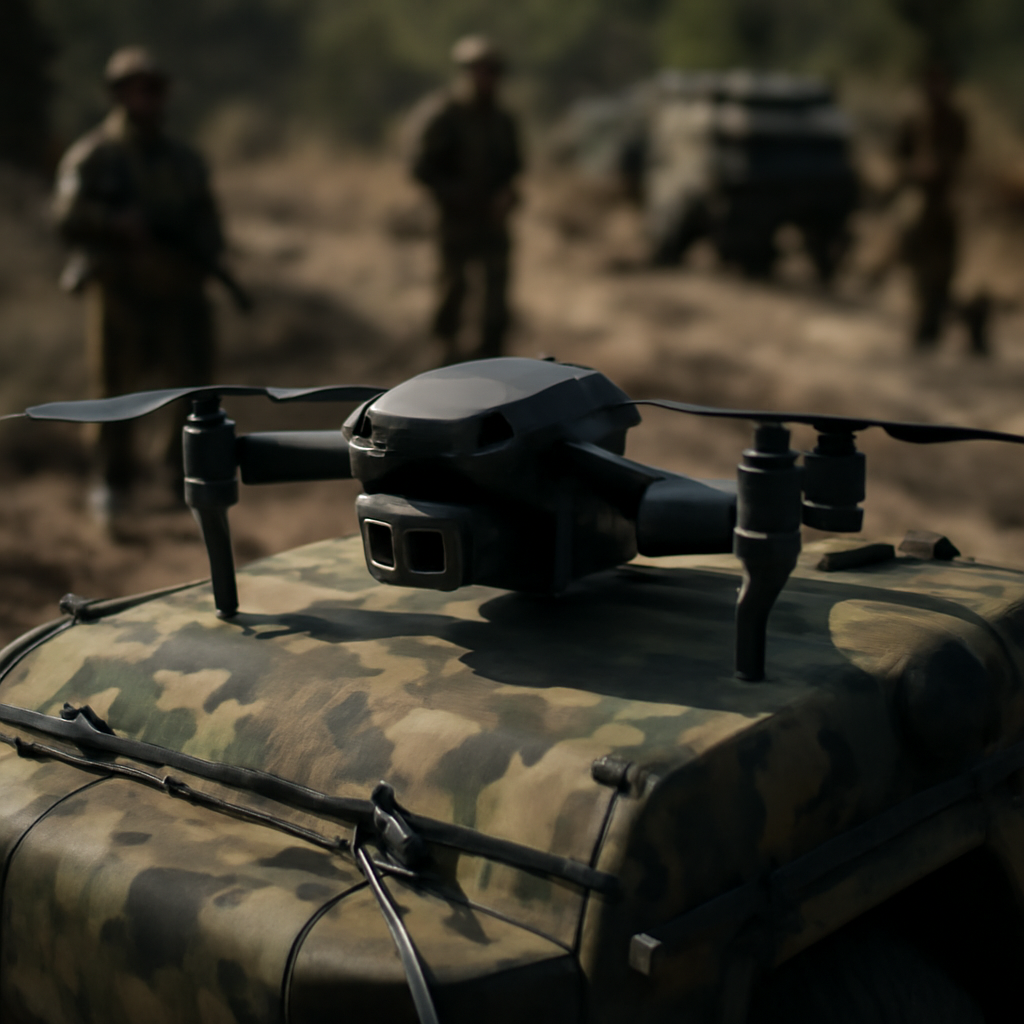
"Drones are rapidly reshaping warfare, with cheap systems destroying high-value targets and innovation cycles measured in weeks, not years," the government said, as it unveiled a sweeping Defense Investment Plan that places autonomous systems at the center of the United Kingdom's military posture.
Budgetary scale: £5 billion for drones inside a £298 billion defence package
The Defense Investment Plan commits more than £5 billion (about $6.6 billion) over four years specifically for drones and related capabilities, embedded within a larger £298 billion ($395 billion) defence spending envelope for the same period. That overall sum includes an additional £15 billion ($20 billion) on top of last year’s Spending Review. The plan also sets aside £11 billion ($14.5 billion) to expand U.K. munitions stockpiles and more than £63 billion ($83 billion) for the nuclear deterrent, covering Dreadnought ballistic missile submarines, SSN‑AUKUS attack submarines, and a new warhead, alongside procurement of 12 F-35A jets.
The Royal Navy: a “Hybrid Navy” and the sacrifice of the Type 83 destroyer
The Royal Navy will pursue a so-called Hybrid Navy built around four new classes of uncrewed vessels intended to operate alongside crewed warships. The announced Types are:
- Type 91 — an uncrewed missile platform serving as a floating magazine with modular air-defence, long-range land-attack, and anti-ship capabilities;
- Type 92 — an uncrewed "sense platform" optimised for anti-submarine warfare (ASW) to extend sensor reach into the North Atlantic in support of frigates hunting Russian submarines;
- Type 93 — an extra-large uncrewed underwater vessel carrying sensors and weapons to augment crewed hunter-killer submarines;
- Type 94 — an uncrewed sense platform optimised for air-defence missions, using its sensors for fleet and homeland protection.
At least six crewed Common Combat Vessels are planned to tie Types 91 and 94 together as part of a networked Maritime Air Defense system; these vessels, arriving in the 2030s, will act as the "brains" that eventually take over air-defence tasks now handled by Type 45 destroyers. The Maritime Air Defense architecture and Common Combat Vessels supersede earlier plans for a Type 83 destroyer, a shift that the government presents as part of a move toward a "high-low" equipment mix exploiting autonomy and digital integration.

Audit-ready is a season. It shouldn't be.
Evidence in spreadsheets, controls drifting between audits, frameworks multiplying on flat headcount. Nubivance runs continuous compliance on Rapid7 Cyber GRC - SOC 2, HIPAA, ISO 27001, PCI, CMMC.
End the scrambleBritish Army: expendable and teamed uncrewed systems
The British Army will invest in inexpensive expendable autonomous systems and loitering munitions, plus rapid production of uncrewed ground vehicles via a new UGV programme. Specific near-term boosts include roughly $66 million for the Rapstone programme to buy more first-person view (FPV) and interceptor drones over the next 12 months.
Three named projects outline the Army’s drone posture: Project Nyx will deliver up to 24 autonomous armed drones to operate in crewed-uncrewed teams with upgraded Apache attack helicopters, planned to be operational by 2030 for reconnaissance, precision strike, and electronic warfare. Project Corvus will replace the Watchkeeper surveillance system with up to 24 new ISTAR drones. The moves underscore a pivot to lower-cost, higher-volume uncrewed effectors.
Royal Air Force: next-generation fighters and electronic-warfare drones
The RAF secures about $10.6 billion for the Global Combat Air Program (GCAP) over four years, advancing development of a next-generation stealth fighter in partnership with Japan and Italy. The Defense Investment Plan also introduces a "new, national Collaborative Combat Air program" to develop autonomous fighter jets intended to fly alongside crewed jets, with a demonstrator expected by at least 2030.
Separately, the Storm Shroud uncrewed electronic-warfare system — already trialled and equipped with the Leonardo BriteStorm stand-in jammer — is scheduled to enter service this year. As part of nuclear deterrence allocations, the RAF will receive 12 F-35A aircraft that will be armed with U.S.-owned B61-12 tactical nuclear bombs to participate in NATO’s nuclear mission.
What this means for technologists, policymakers, and procurement leaders
Technologists and security teams will be tasked with rapid development and integration across air, surface, and subsurface domains: designing modular armaments and sensors for Type 91–94 vessels, building datalinks and control stations for carrier-based and teamed drones, and maturing the Storm Shroud electronic-warfare package. Policymakers must reconcile the plan’s rapid-fielding priority with developmental risk — the MoD itself notes many systems “don’t currently exist in physical form” — while managing tensions over funding priorities exposed by the recent resignation of John Healey as defence secretary and the Defence Secretary’s refocusing effort to get kit to personnel faster. Procurement leaders will need to scale munitions production (including six new energetics factories by 2030), replace systems transferred to Ukraine, and oversee phasing out older assets, such as Storm Shadow missiles and more than 30 Wildcat and the oldest Chinook Mk 6A helicopters.
The United Kingdom has bet heavily that autonomy and swarming, expendable systems will reshape how its services fight. The plan ties large financial commitments to concepts — hybrid carrier air wings, crewed-uncrewed naval formations, and loyal-wingman fighters — many of which must still clear substantial technical and integration hurdles before they can become the force-multipliers the government describes.
Source: TWZ — UK Sacrifices Its Future Destroyer As Part Of Massive Bet On Drones Across Its Forces