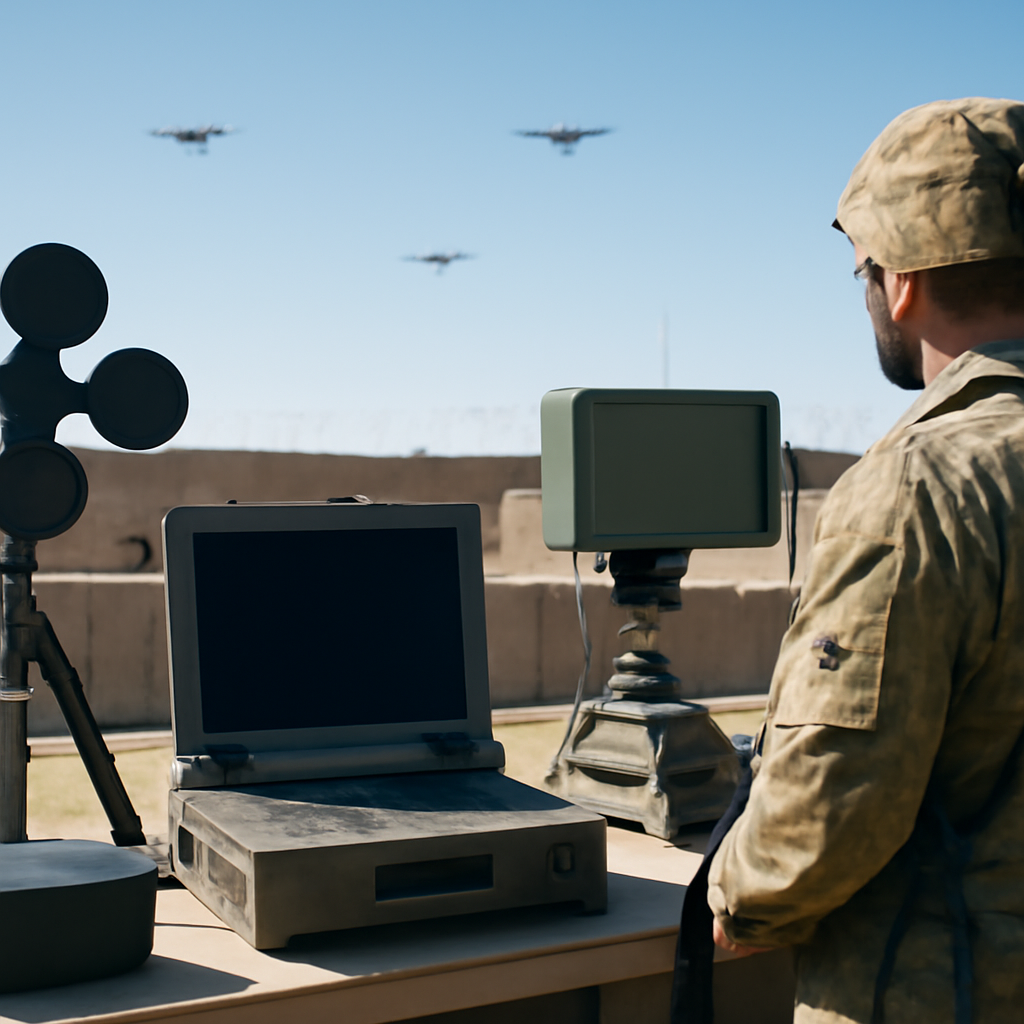
"The UAE Defense Ministry says its air defenses “have engaged a total of 551 ballistic missiles, 29 cruise missiles, and 2,265 UAVs” fired by Iran."
Images show metal caging around oil tanks near Dubai International Airport
An image posted on X by Israel’s i24 News and shared by other outlets appears to show large metal "cope cages" being built around oil tanks near Dubai International Airport. In the far-right section of the photograph, what the posts identify as a more complete metal enclosure is visible around a group of fuel tanks; in the foreground, construction looks to be underway on caging for additional tanks. The story’s reporting notes this is the first sighting of such structures in the UAE and across the Gulf, and that it is unclear when construction began or how many barriers the UAE is building or plans to build. The author says they have reached out to the UAE Embassy in Washington for more details.
What the structures are intended to stop — and what they are not
The reported purpose of these metal frames is defensive: to mitigate damage from incoming one-way attack munitions by creating a physical barrier between the point of weapon impact and the target. The article cites the Shahed-136 as an example of the kind of weapon these measures are meant to blunt — an item the piece explicitly connects to the Iranian campaign that has struck the Emirates.
At the same time, the reporting is explicit about limits. The caging depicted is not designed to stop Iranian ballistic missiles, and even cruise missiles “could be a challenge.” The structures are described as useful primarily against one-way attack munitions and as able to protect from near-field small suicide drone attacks — although the piece notes small suicide drones “have not been a major issue in the UAE during this conflict.”

Audit-ready is a season. It shouldn't be.
Evidence in spreadsheets, controls drifting between audits, frameworks multiplying on flat headcount. Nubivance runs continuous compliance on Rapid7 Cyber GRC - SOC 2, HIPAA, ISO 27001, PCI, CMMC.
End the scramblePrecedent: Russia’s use of nets and cages on oil infrastructure
The UAE’s apparent turn to metal caging follows precedents observed in Russia, where oil storage facilities have been covered with nets and cages in attempts to blunt repeated Ukrainian drone attacks. The report includes multiple visual examples drawn from open posts and satellite imagery: a fuel tank covered with nets cited in an August 24, 2024 post; Google Earth satellite imagery dated September 17, 2025 showing anti-drone nets at the "Nurlino" production and dispatch station; and other imagery and video posted in September 2025 showing protective coverings on a Russian oil refinery.
Damage already inflicted on UAE energy sites: Fujairah and Habshan
The article links the UAE’s defensive move to a pattern of strikes that have damaged major energy infrastructure. It cites two high-profile cases: oil storage facilities at the Port of Fujairah and the Habshan natural gas processing facility. The reporting references video and social posts of fires and damage in industrial areas following drone attacks on March 1 and March 3, 2026, including a post that said Iranian attack drones struck oil storage infrastructure worth around $50 billion in Fujairah.
On recovery timelines, the piece quotes Bloomberg News noting Habshan “will only return to full capacity next year, highlighting the long recovery times for some of the region’s most critical infrastructure that was damaged in the Iran war,” and references a Financial Times post saying the Habshan Gas Facility “Will Not Be Restored To Its Complete Operational Capacity Before 2027 Because of Iranian Strikes.”
U.S. Department of Defense guidance and a new task force
The report places the UAE measures in a broader context of changing U.S. thinking on physical defenses for infrastructure. It states the Pentagon issued new guidance calling for increased use of netting, cables, and other passive physical defenses to protect critical infrastructure against drone attacks. The article includes a cited video of War Secretary Pete Hegseth introducing the Pentagon’s new approach, with his tweet: “Hostile drones are growing by the day. That’s why I’ve directed @SecArmy to establish the Joint Interagency Task Force 401 to secure our skies.” The tweet is dated August 28, 2025.
What this means for the UAE Defense Ministry, the U.S. Department of Defense, and energy operators
- UAE Defense Ministry: After repeated strikes, the ministry’s statistics — and reported construction of metal caging — indicate a shift toward hardening critical energy sites to reduce the damage from one-way attack munitions and certain drones.
- U.S. Department of Defense: With Pentagon guidance encouraging netting and cables and creation of Joint Interagency Task Force 401, the U.S. appears to be formalizing an approach that includes passive physical defenses alongside other measures.
- Energy operators in the UAE: Operators face long repair timelines and the prospect of further hardening; the reporting links Fujairah damage valuations and Habshan’s delayed recovery to sustained operational and economic impacts.
Whether the new structures the UAE is building to defend its energy infrastructure actually work will only be known should Iran launch a new round of attacks that target these sites. Clearly, the world will be watching and taking notes.