“As Turkey, we are located in a geography of high strategic importance, located in the heart of three continents, where global arm wrestling is never lacking … the first condition for survival in such a geography is deterrence,” President Recep Tayyip Erdogan said, framing the motivation that Ankara’s leaders have repeatedly offered for longer-range missiles.
The Yildirimhan revealed: what Turkey showed in Istanbul
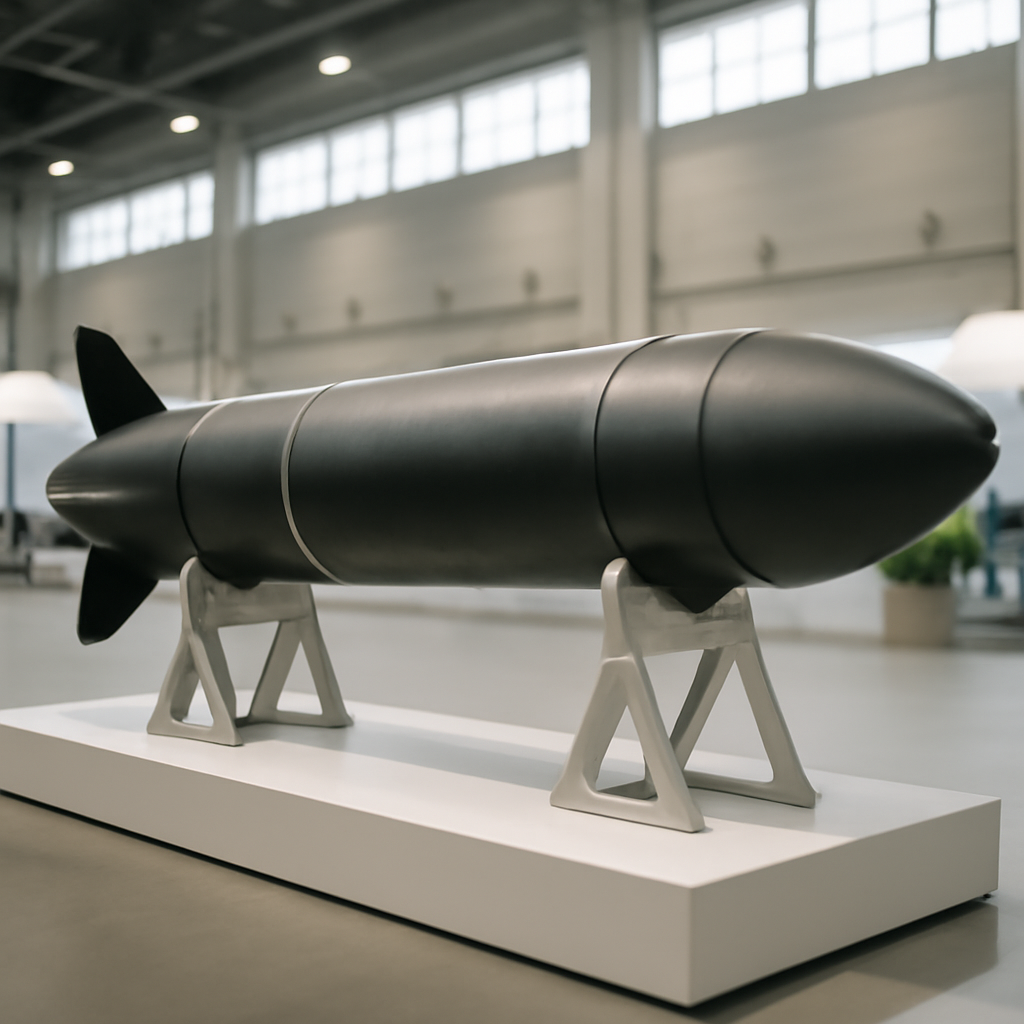
At the SAHA 2026 International Defense and Aerospace Exhibition in Istanbul on May 5, 2026, Turkey displayed a full-size model of a previously unannounced intercontinental ballistic missile (ICBM) called Yildirimhan (Turkish for “lightning”). The program, presented by Minister of Defense Yasar Guler, is said to have been in development for around a decade and was featured as the centerpiece of the Turkish National Ministry stand.
The model’s published specifications are striking on paper: a 6,000‑kilometer (3,728‑mile) range — marginally inside the ICBM class (missiles over 5,500 kilometers) — a single stage powered by four rocket engines, and a conventionally armed, very large warhead capacity of 3,000 kilograms (about 6,600 pounds). The design is road‑mobile and liquid‑fueled, using nitrogen tetroxide and hydrazine, which would require fueling before launch.
Technical choices and operational consequences
A single‑stage, four‑engine, liquid‑propellant design is notable in two respects. First, single‑stage long‑range missiles are relatively unusual; Turkey’s defense sector has not previously fielded weapons with this reach. Second, the liquid propellants named — nitrogen tetroxide and hydrazine — mean the system would need pre‑launch fueling, reducing launch responsiveness and increasing vulnerability to preemptive strikes compared with solid‑fuel alternatives. Turkish media reports claim production of fuel and warhead development are already underway, but the ministry has not released service entry timelines.

Audit-ready is a season. It shouldn't be.
Evidence in spreadsheets, controls drifting between audits, frameworks multiplying on flat headcount. Nubivance runs continuous compliance on Rapid7 Cyber GRC - SOC 2, HIPAA, ISO 27001, PCI, CMMC.
End the scrambleWhere Yildirimhan sits relative to Tayfun/Bora and Cenk
Yildirimhan follows a string of domestic advances. Turkey already fields the locally developed Tayfun (previously Bora‑2) short‑range ballistic missile (SRBM), the only conventional ground‑launched NATO missile in Europe with a range beyond 300 kilometers (186 miles). In 2025 Roketsan unveiled the Tayfun Block IV — a heavier member of the Bora/Tayfun family — and Turkish sources reported a test firing in the fourth quarter of 2025. Roketsan said, “The Tayfun Block IV achieves long ranges, setting another record for the Turkish defense industry,” and added it “will be capable of destroying numerous strategic targets, such as air defense systems, command and control centers, military hangars, and critical military facilities.”
Separately, Turkey has pursued a medium‑range ballistic missile, Cenk, with a stated range of 2,000 kilometers. Observers inside Turkey have speculated Cenk could be a further development of the Bora/Tayfun family or an all‑new design; either way, such a weapon would already place most regional adversaries within reach. By contrast, an ICBM like Yildirimhan extends potential strike reach far beyond the region — Turkish commentators even suggested the weapon would allow Ankara to hold targets as far away as Beijing at risk.
Testing constraints and the Somalia spaceport proposal
Turkey faces practical limits for testing a 6,000‑kilometer missile. The country’s primary missile test range is on the Black Sea, whose east‑to‑west span is under 1,000 kilometers. That forces longer‑range tests to be flown on steep parabolic trajectories, an approach North Korea has used. Turkish officials and commentators have discussed a possible spaceport partnership with Somalia, which could allow launches far out into the Indian Ocean and provide a testing and space‑launch trajectory not available from domestic ranges.
MTCR, ITAR, exports, and strategic implications
Turkey’s growing missile portfolio has benefited from access to markets not constrained by U.S. International Traffic in Arms Regulations (ITAR). That has been a commercial advantage for Turkish exports. At the same time, Turkey is a member of the Missile Technology Control Regime (MTCR), which restricts exports of systems able to deliver more than 1,100 pounds (≈500 kilograms) to ranges over 190 miles (≈300 kilometers). Under MTCR rules the Yildirimhan would be non‑exportable unless Ankara altered its commitments. The article’s analysis judges the most likely purpose for Yildirimhan is to extend Turkey’s own conventional deep‑strike deterrent rather than to become an export product.
The combination of a very large conventional warhead, extended range into the ICBM band, and potential for multiple or larger warheads, decoys, or countermeasures introduces new technical and strategic challenges. The piece notes there are no indications Turkey is pursuing nuclear warheads; Ankara has relied on NATO collective defense and U.S. nuclear guarantees since the Cold War. Nevertheless, the development of long‑range ballistic capability can be a technological stepping stone toward a different posture if political priorities change — a point made with reference to South Korea’s prior case.
What this means for policymakers, Turkish defense technologists, and regional militaries
- Policymakers and regulators: MTCR export controls and domestic fuel‑production timelines will be immediate issues to track; reported progress on fuel production and warhead work will inform debates about deployment windows and export policy.
- Turkish defense technologists and procurement leaders: managing liquid‑fuel handling, road‑mobile launcher survivability, and developing larger warheads and countermeasures are near‑term technical priorities if the Yildirimhan program advances to testing and fielding.
- Regional militaries (including Greece and forces facing Kurdish militants): existing shorter‑range systems like Tayfun Block IV and prospective MRBMs already affect regional threat calculations; an operational 6,000‑kilometer conventional ICBM would reshape deterrence considerations well beyond the eastern Mediterranean.
Yildirimhan is both a technical departure for Turkey’s defense industry and an explicit statement of strategic ambition. The model displayed at SAHA 2026 showcased reach, payload, and mobility claims, but left open the decisive questions of testing pathways, timelines for service, and how Ankara will reconcile export controls with any ambitions to sell beyond its borders. The Somalia spaceport discussion, fuel‑production reports, and the decade‑long development claim are the concrete threads to follow as this program moves from model to potential reality.