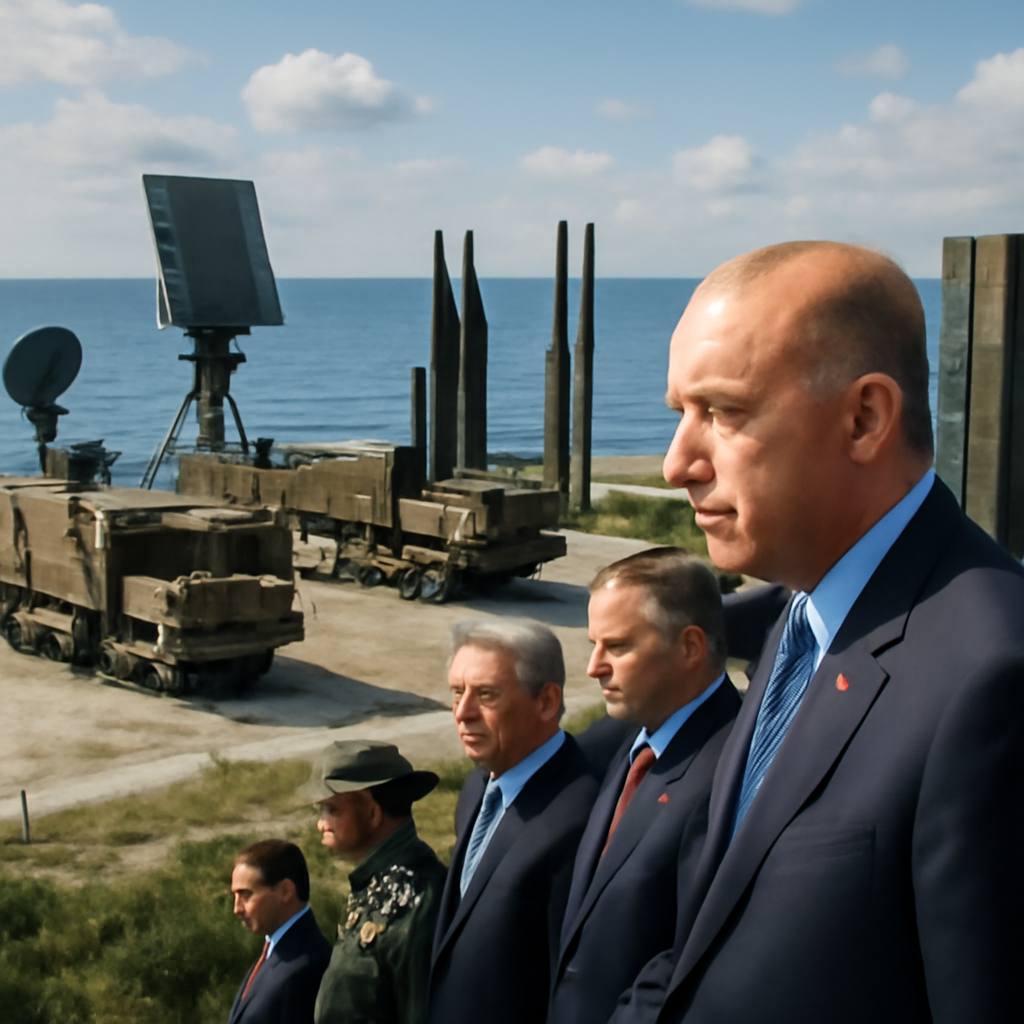
A bright banner reading "Çelik Kubbe" loomed over a narrow Aegean shoreline as President Recep Tayyip Erdoğan and defence delegations from 50 countries watched Türkiye’s multi-layered air and missile defence architecture deployed together in the field for the first time on 20–21 May 2026.
Distinguished Observer Day: an integrated display before international eyes
The Doğanbey live-fire area in Seferihisar, İzmir, hosted the public demonstration during EFES 2026’s Distinguished Observer Day. President Erdoğan attended in person and observed the deployment alongside defence ministers and military chiefs from the 50 participating countries. The event presented all four primary effectors of the Steel Dome architecture together on a thin coastal strip overlooking the Aegean Sea, with additional systems integrated into the daytime demonstration.
The Steel Dome’s layered weapons: Siper, Hisar-O, Hisar-A, and Sungur
Aselsan’s Steel Dome integrates distinct interceptors across engagement ranges. The configuration shown at EFES 2026 brought together the long‑range Siper interceptor, the medium‑range Hisar‑O, the short‑range Hisar‑A, and the very‑short‑range Sungur man‑portable air defence system. The stated design intent is to match different weapon ranges to different phases of a threat’s flight profile — from cruise and tactical ballistic missiles down to small commercial‑grade drones — so that detection, tracking and interception can occur at multiple engagement points rather than relying on a single layer.

This site is the portfolio.
OSINTSights runs on Cloudflare Workers, D1, R2, and Vectorize, with an AI pipeline on Hetzner ARM. Nubivance designed, built, and operates it. We do the same for clients.
See what we buildGun, directed‑energy and electronic warfare layers integrated beneath and alongside missiles
The live demonstration also highlighted non‑missile elements that broaden the architecture’s toolkit. MKE’s TOLGA short‑range air defence gun system was integrated during the daytime phase, adding a gun‑based close‑in layer beneath the missile effectors. Aselsan’s Gürz hybrid air defence system was noted to combine missile, gun, and laser technologies on a single platform, while the Korkut self‑propelled anti‑aircraft gun uses ATOM programmable airburst ammunition for short‑range defeat of drones and cruise missiles. Electronic‑attack and non‑kinetic systems were also displayed: KORAL for radar electronic attack, PUHU for communications electronic warfare, and the EJDERHA high‑power microwave weapon for non‑kinetic disruption of incoming threats ahead of engagement layers.
Operational testing claims: Siper Block I service and AI in command-and-control
The long‑range Siper Block I formally entered operational service in January 2026 after acceptance testing, according to the Secretariat of Defence Industries (SSB). The SSB said a Siper‑1 battery was tested in a scenario reflecting "real‑world airspace congestion," where the system had to identify and intercept a hostile target while friendly airborne elements operated in the same engagement area. SSB head Haluk Görgün described the test as "confirmation of the system’s ability to discriminate between friendly and hostile tracks under operationally demanding conditions," a capability the SSB flagged as among the most difficult requirements for any integrated air and missile defence architecture.
Chief of the General Staff General Selçuk Bayraktaroğlu confirmed in his post‑exercise summary that "AI‑assisted programs were used effectively in command‑and‑control processes during EFES 2026," indicating the Steel Dome’s C2 layer was exercised with automated decision support rather than relying solely on human operators for threat evaluation and weapon assignment.
What this means for Aselsan and the Turkish Armed Forces, foreign militaries, and procurement leaders
- Aselsan and Turkish defence institutions: The deployment put 47 major Steel Dome components — reportedly delivered to the Turkish Armed Forces in August 2025 and valued at about $460 million in Aselsan disclosures — into a coordinated field display, signaling integration progress beyond prior static exhibitions at IDEF 2025 and DIMDEX 2026 in Doha.
- Foreign defence ministers and military chiefs attending EFES 2026: The international audience saw the system operating as a system‑of‑systems in a field environment for the first time, a demonstration intended to illustrate interoperability across layers and a common operational picture supporting engagement decisions.
- Procurement leaders and military planners in potential partner states: The demonstration combined missile, gun, electronic‑attack and directed‑energy elements with AI‑assisted C2 — an operational model that procurement officials will evaluate for capability, integration complexity, and the distinction between demonstration and verified live‑fire performance.
One central factual difference remains visible in the public record: while all four missile layers and supplementary systems were positioned together and demonstrated coordinated tracking, cueing and command‑and‑control, available reporting has not confirmed whether any Steel Dome layer conducted live intercepts during EFES 2026. Deploying an integrated architecture to a field site and proving coordinated communication under a common operational picture is an important milestone; demonstrating representative live‑fire engagements against aerial threats under contested electromagnetic conditions would be a distinct, consequential next step.