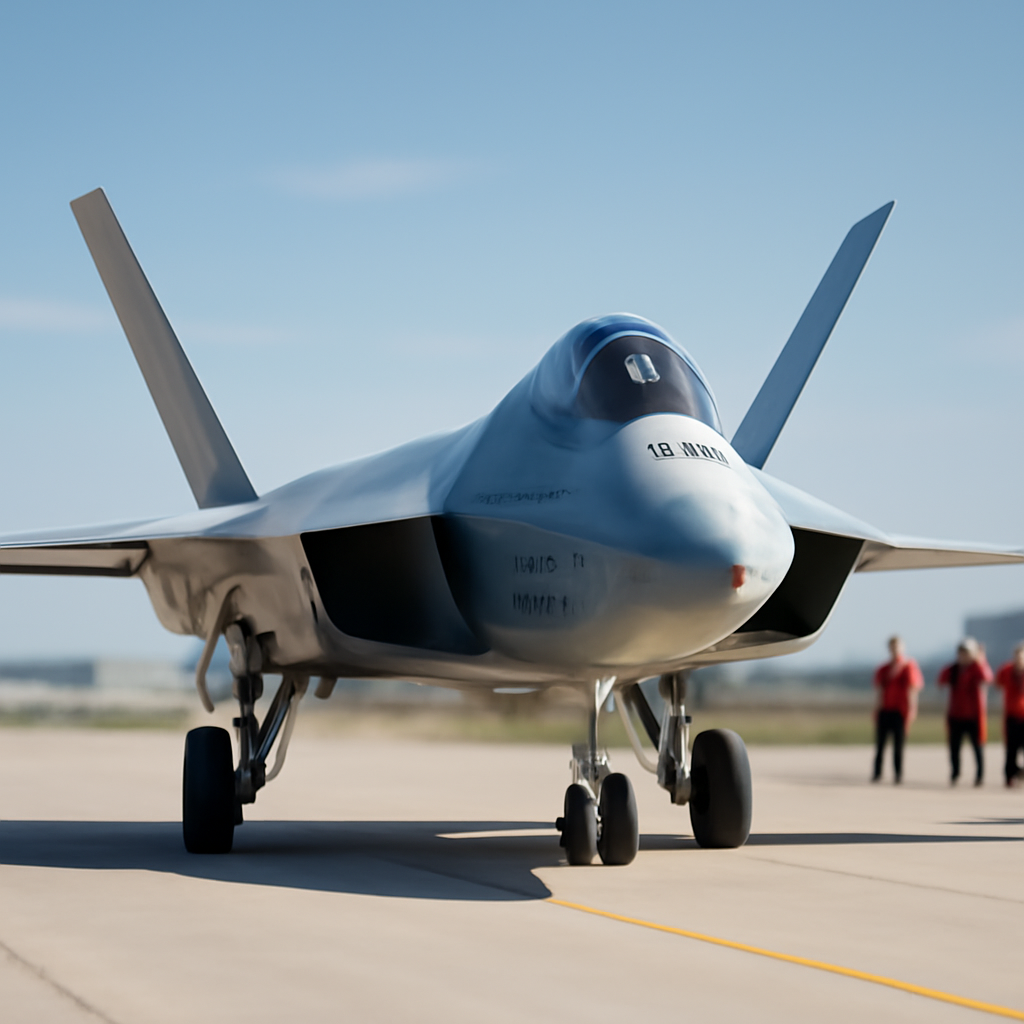
The Kaan program was launched in 2010 as the Milli Muharip Uçak (MMU), now branded TF Kaan — a date that anchors a development effort still moving from demonstrator to production-representative hardware.
P1 prototype: powered taxi tests and visible design changes
Turkish Aerospace (TUSAS) released new footage on July 31, 2026 showing the second airworthy prototype, designated P1, conducting powered taxi tests. The video shows P1 accelerating under its own power at increasing speeds, a final phase of ground testing that verifies engine operation, braking, steering, flight-control systems and other critical functions before clearance for flight.
Compared with the original P0 demonstrator, P1 displays several visible refinements: revised control surfaces, subtle changes around the engine intakes and cockpit areas, a cleaner external finish, wider-set and more robust-looking main landing-gear units, and a larger sensor aperture above the nose. The P1 retains the forward sensor installations observed earlier — including what appears to be multi-purpose electro-optical and infrared search-and-track (IRST) sensors — features that had been removed from the faceted enclosures on P0 for that prototype’s first flight.
Under the airframe, non-stealthy exhaust nozzles remain in place for the twin GE Aerospace F110 turbofans that power the prototypes.
From P0 demonstrator to a developmental test fleet: P1, P2 and the schedule
P1 follows the P0 demonstrator that conducted Kaan’s first flight in February 2024 and logged a second flight on May 6, 2024 that lasted 14 minutes, reached 10,000 feet and attained 230 knots, according to the Presidency of Defence Industries (SSB) and Anadolu imagery.
TUSAS has indicated P1’s maiden flight is expected “within the next couple of months.” A third prototype, P2, is reported to be under assembly, with the company aiming to have both P1 and P2 flying before the end of this year. That would allow parallel flight-test activity across multiple aircraft — a common way to accelerate data collection and maturation of systems ahead of series production.
The program reportedly plans three pre-production prototypes followed by 250 series-production aircraft. Initial deliveries to the Turkish Air Force continue to be targeted for 2028, a schedule the reporting characterizes as “ambitious.” A contract was reportedly signed for 20 examples of the initial Block 10 versions of the Kaan.

This site is the portfolio.
OSINTSights runs on Cloudflare Workers, D1, R2, and Vectorize, with an AI pipeline on Hetzner ARM. Nubivance designed, built, and operates it. We do the same for clients.
See what we buildPowerplant decisions: F110 engines, U.S. export controls, and the TF35000 timeline
Turkey intends to equip later-production Kaans with an indigenous TF35000 engine, but prototypes and the first production aircraft will use U.S.-built GE F110 turbofans. While F110s are assembled under license in Turkey, they remain subject to U.S. export restrictions — a major schedule risk for the program until the domestic engine arrives.
That uncertainty eased after the Trump administration reportedly approved the sale of dozens of F110 engines to Turkey in a deal estimated at more than $700 million. The arrangement is intended to ensure propulsion for the prototype fleet and early production aircraft while TF35000 development continues; the domestic engine is expected only in later production blocks, making continued access to the F110 critical to the current timeline.
Sensors, avionics and the program’s performance aspirations
P1 is widely expected to carry substantially more representative avionics, flight-control software and mission systems than P0, which was largely a proof-of-concept. The program’s stated objective is to deliver a reduced-radar-signature fighter with high performance, advanced avionics and modern mission systems.
The reporting places that aim in comparative terms: achieving the same degree of sensor integration, data fusion, networking and low-observable performance as a fifth‑generation fighter such as the F‑35 represents “a much higher bar.” Even so, the article notes, a meaningful frontal reduction in radar signature combined with modern sensors and weapons would still represent a significant capability step over much of Turkey’s existing fighter fleet.
What this means for Turkish Aerospace, the Turkish Air Force, and export customers
- Turkish Aerospace (TUSAS): Taxi testing of a more production-representative P1 marks the program’s transition from technology demonstrator to a developmental test fleet. If P1 and P2 fly on schedule, TUSAS will be able to collect parallel flight-test data — an essential requirement for meeting the currently targeted delivery timeline.
- Turkish Air Force: The force’s initial deliveries are still targeted for 2028. The reporting describes that timeline as ambitious, meaning the Air Force will be watching the P1 maiden flight and P2’s entry into testing closely to assess whether those delivery targets remain feasible.
- Export customers and partners: Any early Kaan exports would be constrained by U.S. restrictions on the F110 engines used in prototypes and early production. Until the TF35000 becomes available in later blocks, access to U.S.-origin engines will shape export prospects.
The latest taxi-test footage signals that Turkey has moved into a phase of more mature prototypes and an expanding flight-test fleet. P1’s imminent maiden flight and P2’s assembly will be the near-term, observable milestones that determine whether Turkish Aerospace can maintain an accelerated path toward the program’s stated objective of handing fighters over to the Turkish Air Force in 2028.
Source: https://www.twz.com/air/turkeys-latest-kaan-fighter-prototype-begins-taxi-tests