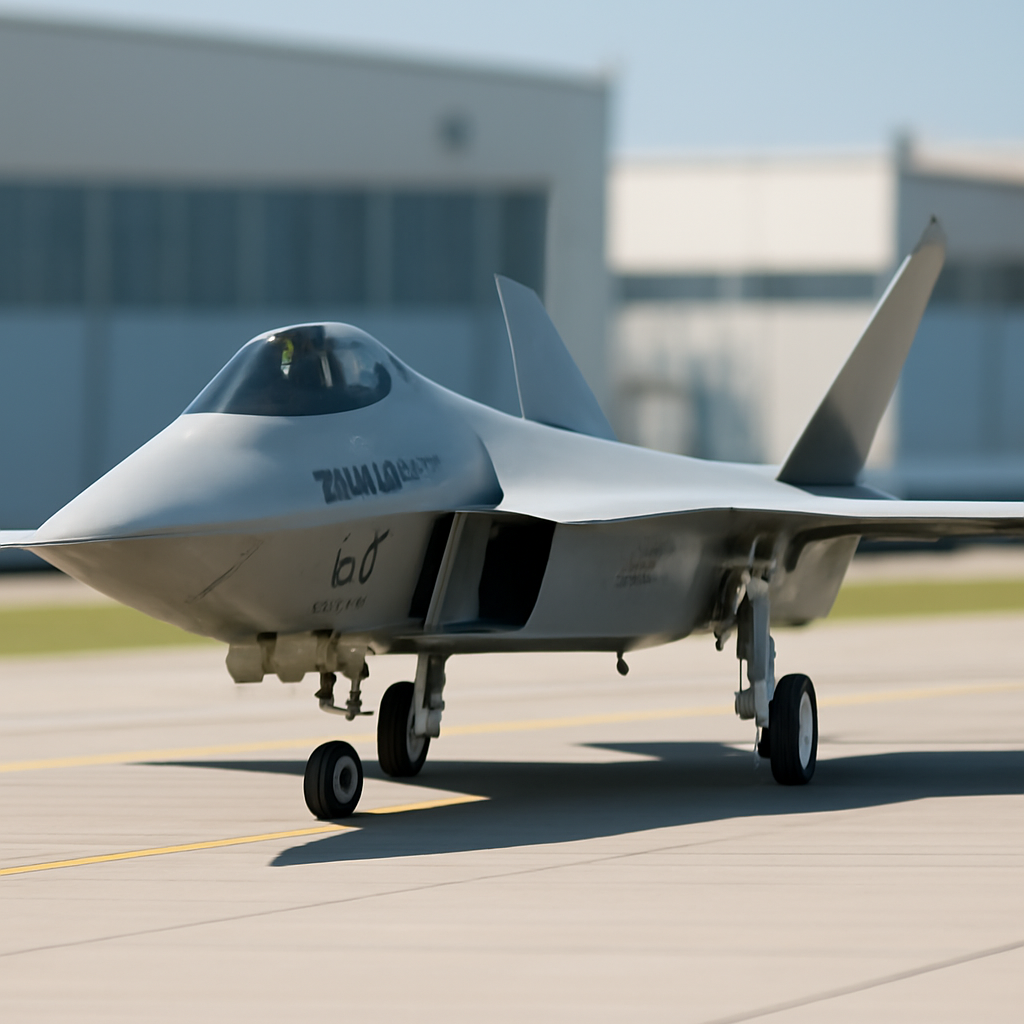
On 31 July 2026, Turkish Aerospace Industries (TAI/TUSAŞ) released footage showing KAAN P1 — the second prototype of Türkiye’s KAAN next‑generation fighter aircraft (NGFA) — completing its first taxi test at the company’s facility in Ankara.
KAAN P1’s taxi run: a concrete, visible step
The footage published by TAI/TUSAŞ documents a simple but significant milestone: KAAN P1 rolling under its own power along the tarmac at the Ankara facility. KAAN P1 follows KAAN P0, the demonstrator that first flew in February 2024, and is being readied to carry most of the flight‑test workload ahead of a production‑ready platform. According to TAI/TUSAŞ, P1 is expected to fly in the next several months, with P2 to follow shortly thereafter.
System architecture: P1 versus P0
TAI/TUSAŞ describes KAAN P1 as carrying a more advanced system architecture than P0. That architecture is composed of integrated mission‑system elements that more closely mirror the intended production configuration — in other words, P1 is not merely a flying demonstrator but a closer approximation of the aircraft TAI/TUSAŞ plans to produce and deliver.

Audit-ready is a season. It shouldn't be.
Evidence in spreadsheets, controls drifting between audits, frameworks multiplying on flat headcount. Nubivance runs continuous compliance on Rapid7 Cyber GRC - SOC 2, HIPAA, ISO 27001, PCI, CMMC.
End the scrambleProduction timeline and near‑term service entry
TAI/TUSAŞ is working toward delivery of the first batch of KAAN fighters to the Turkish Air Force (TuAF) in 2028. For the production‑ready platform, the company plans the first 40 KAAN airframes to be powered by the General Electric F110 turbofan engine; those aircraft are slated to join the TuAF. Beyond that initial tranche, TUSAŞ plans to field a KAAN Block‑30 variant powered by an indigenous TUSAŞ Engine Industries (TEI) TF‑35000 turbofan, with fielding of the TF‑35000‑equipped Block‑30 set to begin from 2033.
Engines and supply‑chain objectives
The KAAN effort is explicitly linked in TAI/TUSAŞ public materials to a broader objective: building the aircraft domestically and reducing foreign control over the supply chain that supports it. The program began, per the record, after Washington removed Türkiye from the F‑35 Lightning II program in 2019; Ankara’s response, as framed by the company, was to construct a homegrown path to a fifth‑generation, stealth‑capable fighter. The two‑step engine plan — initial reliance on the General Electric F110, followed by an indigenous TF‑35000 beginning in 2033 — is a clear example of that transitional approach.
What this means for TUSAŞ and TEI
- TUSAŞ: The P1 taxi test positions TUSAŞ to shift from demonstrator work to system integration and accelerated flight testing. With P1 slated to take on most flight‑test work, the company is advancing the hardware and software configurations that will define the production configuration and the aircraft to be delivered to TuAF in 2028.
- TEI: The engine replacement plan gives TEI a explicit long‑lead responsibility. The TF‑35000 is tied to the KAAN Block‑30 rollout beginning in 2033, making TEI’s development and production schedules central to TUSAŞ’s longer‑term export ambitions and to the program’s stated goal of reducing foreign supply‑chain dependence.
What this means for the Turkish Air Force and international customers (Indonesia, Pakistan, Azerbaijan, Qatar, Spain)
- Turkish Air Force (TuAF): The planned 2028 deliveries of the first 40 GE F110‑powered KAAN airframes would provide TuAF with early operational examples of the type while the indigenous engine transition continues. TuAF will therefore operate both a short‑term fleet powered by an established U.S. engine and, later, Block‑30 aircraft with a domestic turbofan.
- International buyers and prospects: The KAAN Block‑30 is described as TUSAŞ’s centrepiece for entering wider markets. Indonesia has 48 aircraft on order; active interest has been recorded from Pakistan, Azerbaijan, Qatar, and from NATO members including Spain. For these customers, the timeline implies they could receive F110‑powered aircraft earlier and potentially TF‑35000‑powered Block‑30s from the 2033 window if the indigenous engine programme stays on schedule.
KAAN P1’s taxi test is a visible, verifiable step in a multi‑phased strategy: advance system integration on a near‑production prototype, deliver an initial GE‑powered batch to TuAF in 2028, and replace that imported powerplant with an indigenous TF‑35000 by 2033 as part of a broader push to control the fighter’s supply chain and to compete for export orders. The immediate next markers will be P1’s first flight in the coming months and how rapidly P2 follows; the longer‑term hinge is whether TEI’s TF‑35000 meets the schedule that underpins the Block‑30 export pitch.