"By bringing autonomous launch, recovery, and recharging directly to the vehicle, we give operators persistent situational awareness, faster access to actionable intelligence, and greater protection in high-tempo missions," said JihFen Lei, president of Teledyne Defense and Aerospace Group and senior vice president of Teledyne Technologies, in the statement.
Black Recon capabilities
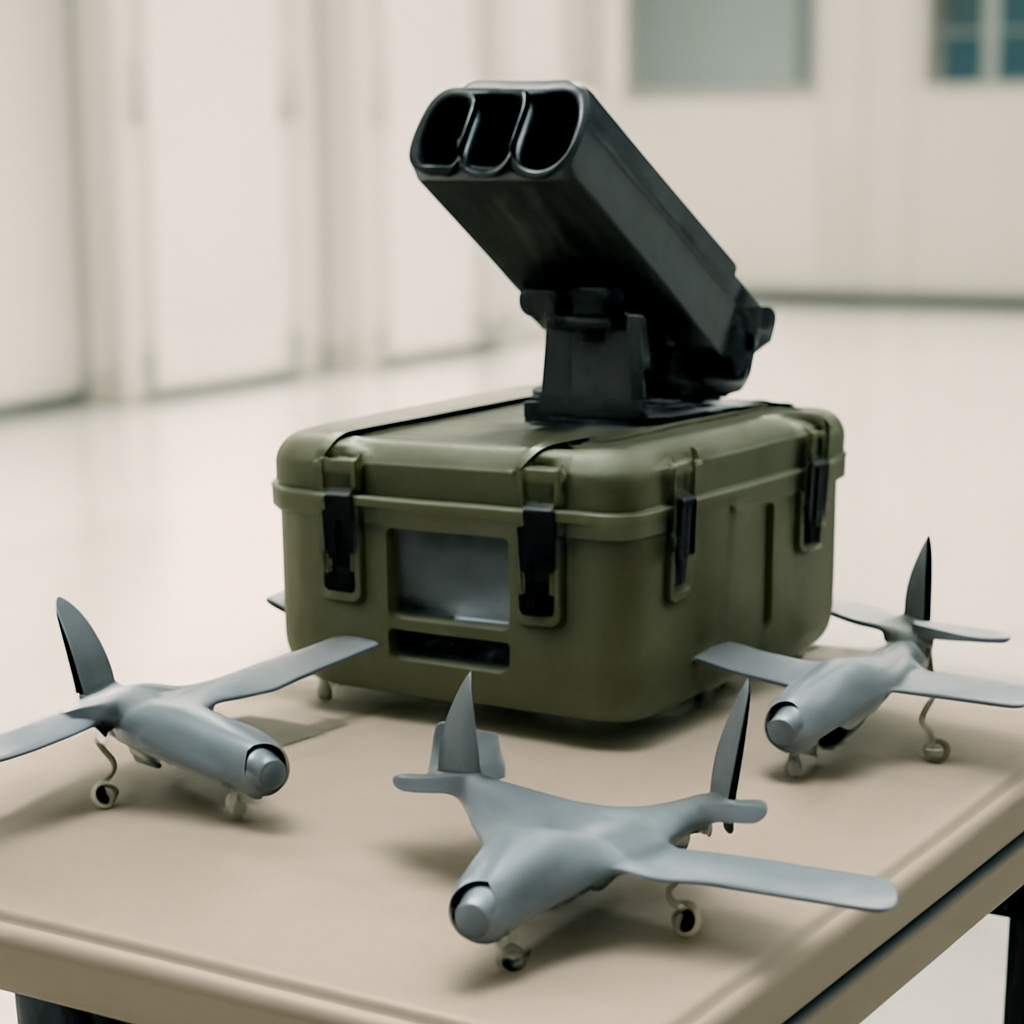
Teledyne FLIR Defense has introduced a compact "microdrone" system called Black Recon that is built to operate from manned ground vehicles. The system ships with three individual drones that, according to the company announcement, "launch autonomously, perform reconnaissance, surveillance, and acquisition (RSTA) missions, then return to the launcher for capture, docking, and recharging." Each airframe weighs less than 450 grams (0.99 lbs.), can remain aloft for up to an hour, and is capable of reaching a top speed of around 55 miles per hour. The company did not disclose pricing for the full system or for replacement drones.
Trials in Norway and Ford Raptor tests
Teledyne FLIR Defense reported that the Black Recon performed its first flights in Norway last winter. The system has also been tested aboard a Ford Raptor vehicle, the company spokesperson told Breaking Defense. The combination of vehicle-mounted launch, autonomous mission execution, and automatic recovery is central to the product pitch: by embedding launch and recharging at the vehicle, the company positions Black Recon as a tool to extend on-the-move situational awareness for crews without disembarking or dedicating personnel to drone operations.

Audit-ready is a season. It shouldn't be.
Evidence in spreadsheets, controls drifting between audits, frameworks multiplying on flat headcount. Nubivance runs continuous compliance on Rapid7 Cyber GRC - SOC 2, HIPAA, ISO 27001, PCI, CMMC.
End the scrambleDelivery timetable, customers, and planned payload modules
The company said deliveries of the Black Recon system should be available starting in 2027. Teledyne FLIR Defense confirmed it has signed contracts with two unnamed European customers. The spokesperson also told Breaking Defense that while the system has not yet been demonstrated for the US Army, the company expects to conduct trials with the Army later this year. Looking beyond the baseline RSTA role, the company pledged future modular additions to the system for both "lethality payloads and CBRN detection sensors."
What this means for vehicle crews, procurement leaders, and adversaries
- Vehicle crews: Crews receiving a launcher-equipped Black Recon would gain immediate, on-demand aerial reconnaissance without leaving the vehicle, according to the company’s description of autonomous launch, capture, docking, and recharging—capabilities intended to support persistent situational awareness in high-tempo missions.
- Procurement leaders: Procurement officers evaluating the system will note a 2027 delivery start date, existing contracts with two unnamed European customers, and planned demonstrations with the US Army later this year; pricing for the system and replacement drones has not been provided.
- Adversaries and threat planners: The company’s stated intent to add "lethality payloads and CBRN detection sensors" to the modular architecture suggests future capability expansion that could change how reconnaissance and certain types of sensing are performed from vehicle platforms.
Teledyne FLIR Defense frames Black Recon as a vehicle-centric microdrone package that moves launch, recovery, and power logistics into the vehicle itself. The public facts are straightforward: sub-450 gram drones, up to an hour of flight, roughly 55 mph top speed, autonomous operations tied to a three-drone launcher, first flights in Norway, tests aboard a Ford Raptor, two contracted European customers, planned US Army trials later this year, and deliveries beginning in 2027. The company’s explicit mention of future modules for lethality and CBRN sensing is the clearest signal that the platform is intended to evolve beyond basic RSTA roles.
For now, the Black Recon announcement supplies a concise technical and programmatic outline; the unanswered operational questions—how capture and docking perform in contested environments, how modular payloads will be certified or governed, and how pricing will influence adoption—remain to be resolved in the demonstrations and deliveries the company has scheduled. Those next steps, according to the company timeline, will begin with trials later this year and customer deliveries starting in 2027.
Source: Breaking Defense — Black Recon ‘microdrone’ system unveiled by Teledyne FLIR