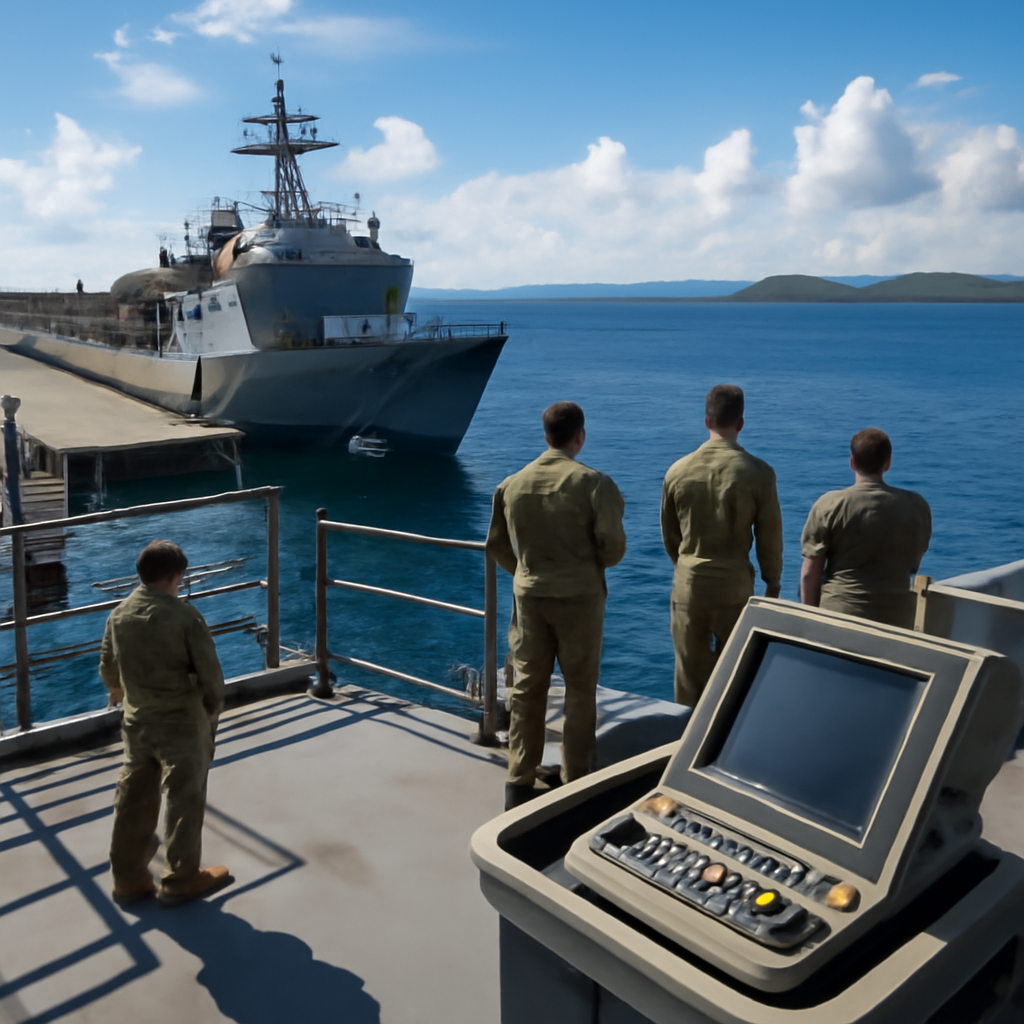
"The commands and people who’ve operated there talk about four tyrannies: distance, water, time, and scale," said Steve Boraz, Leidos’ vice president for maritime growth and strategy, and former assistant program manager for maritime domain awareness with U.S. Navy.
Four tyrannies and the practical problem they pose
The line is blunt because the problem is blunt: logistics in the Pacific are a question of thousands of miles. The source material frames the challenge as not merely geographic distance but the combination of long transit times, the maritime domain itself, compressed operational timelines, and the sheer scale of resources required. Those four constraints, Boraz said, "are not anything that you can necessarily overcome. You have to figure out ways to mitigate them."
Indo-Pacific Logistics and Sustainment Services (ILS2): an options architecture
The strategy under ILS2 for PACOM and SOCPAC is to give commanders more options when conventional logistics networks are disrupted. The program is not limited to moving supplies; it layers capabilities: prepositioned resources, regional commercial partnerships, resilient communications, autonomous vessels, and predictive analytics. Leidos frames this as enabling commanders to operate when "traditional logistics ships, infrastructure, and supply routes could themselves become targets."

Audit-ready is a season. It shouldn't be.
Evidence in spreadsheets, controls drifting between audits, frameworks multiplying on flat headcount. Nubivance runs continuous compliance on Rapid7 Cyber GRC - SOC 2, HIPAA, ISO 27001, PCI, CMMC.
End the scrambleAI, mesh networking, and logistics that work with degraded comms
Leidos argues that artificial intelligence is central to accelerating operational planning across a theater that changes quickly. Boraz said AI can create "speed to decision through COA generation and optimized routing," turning deliberations that can take hours or days into results reached "in minutes." The company pairs its decision-support AI with Rune Technologies’ TyrOS predictive logistics software to produce those outcomes.
Recognizing that continuity of communications cannot be assumed, Leidos designs tools to function in disconnected, denied, intermittent and low-bandwidth (DDIL) environments. The approach includes mesh networking and local data caching so that AI-enabled planning tools keep working when connectivity degrades, and then sync once links are reestablished.
Autonomous surface vessels: keeping sailors out of harm’s way
Autonomy is presented as a force multiplier and a risk reducer. Matt O’Brien, senior capture director, framed the primary benefit this way: using autonomous platforms "where you don’t have to put service members in harm’s way" while maintaining confidence in mission execution. Leidos both builds and operates autonomous vessels and can offer contractor-owned-and-operated, government-owned, or hybrid business models.
Leidos describes software that lets one operator manage a fleet of unmanned craft, assigning which vessel carries "beans," which carries "bullets," and which carries "bandages." Predictive logistics in that stack can flag "when the next bullets need to get there" and reroute vessels accordingly. The company has operational experience: Medium Displacement Autonomous Vessels Sea Hunter and Seahawk have logged years as experimental Navy platforms; this spring the Seahawk was handed off from the acquisition community to the fleet and folded into the Theodore Roosevelt Strike Group for the Composite Unit Training Exercise (COMPTUEX).
Autonomous ships converted or sustained by Leidos—Ranger and Mariner among them—participated in a trans-Pacific deployment called Integrated Battle Problem 23.2, sailing from California (San Diego and Port Hueneme) to Guam, Japan, and Australia and back while exercising autonomous operations. The platforms also appeared in Exercise Rim of the Pacific 2026 (RIMPAC).
Leidos also stresses speed to capability by converting existing commercial vessels into autonomous ships rather than waiting for newly built unmanned hulls. "The ability to take a traditional vessel and convert it to an autonomous one is one way to deliver those ships more quickly than if you were starting to build them from scratch," O’Brien said.
Indo-Pacific Logistics Alliance, prepositioning, and corporate track record
Leidos has assembled an Indo-Pacific Logistics Alliance of more than 70 companies to create capacity across the theater, and says the alliance already has 14,000 personnel prepositioned in the region, including foreign partners with access to local workers and trusted supply chains. The aim is to build "depth into the network before a contingency occurs" so a second or a third provider is available when primary supply chains are stressed.
The company points to long logistics contracts as evidence of relevant experience: a 13-year UK Ministry of Defence Logistics Commodities & Services Transformation (LCST) program, two decades of providing contract logistics support during the Afghanistan war until the drawdown, and leadership of the multi-billion-dollar Antarctic Support Contract for the National Science Foundation as part of the US Antarctic Program. Leidos frames that record as a discriminator for managing theater-scale logistics.
What this means for PACOM, SOCPAC, and commercial partners
- PACOM and SOCPAC: Gain layered options—prepositioning, AI-enabled courses of action, and autonomous delivery—to mitigate the four tyrannies when conventional routes are denied or degraded.
- Regional commercial partners and the Indo-Pacific Logistics Alliance: Are positioned to provide surge capacity, vessels, maintenance, and local supply chains; they also represent the means by which Leidos intends to field "non-standard logistics" such as chartering commercial vessels during disasters like typhoons.
- The naval fleet and operators: Receive autonomy-enabled platforms that Leidos says can be managed by a single operator and integrated into strike groups, as with Seahawk’s COMPTUEX handoff and participation in RIMPAC 2026.
The plan is straightforward: layer capacity, automate decision-making where possible, and accelerate delivery of unmanned platforms by converting existing hulls. Whether this mix of prepositioned depth, predictive AI, resilient networking, and converted autonomous vessels will be sufficient to mitigate distance, water, time, and scale remains the immediate operational question. For now, Leidos’ record and the elements it has assembled are meant to give commanders more options when the map widens and the clock runs short.