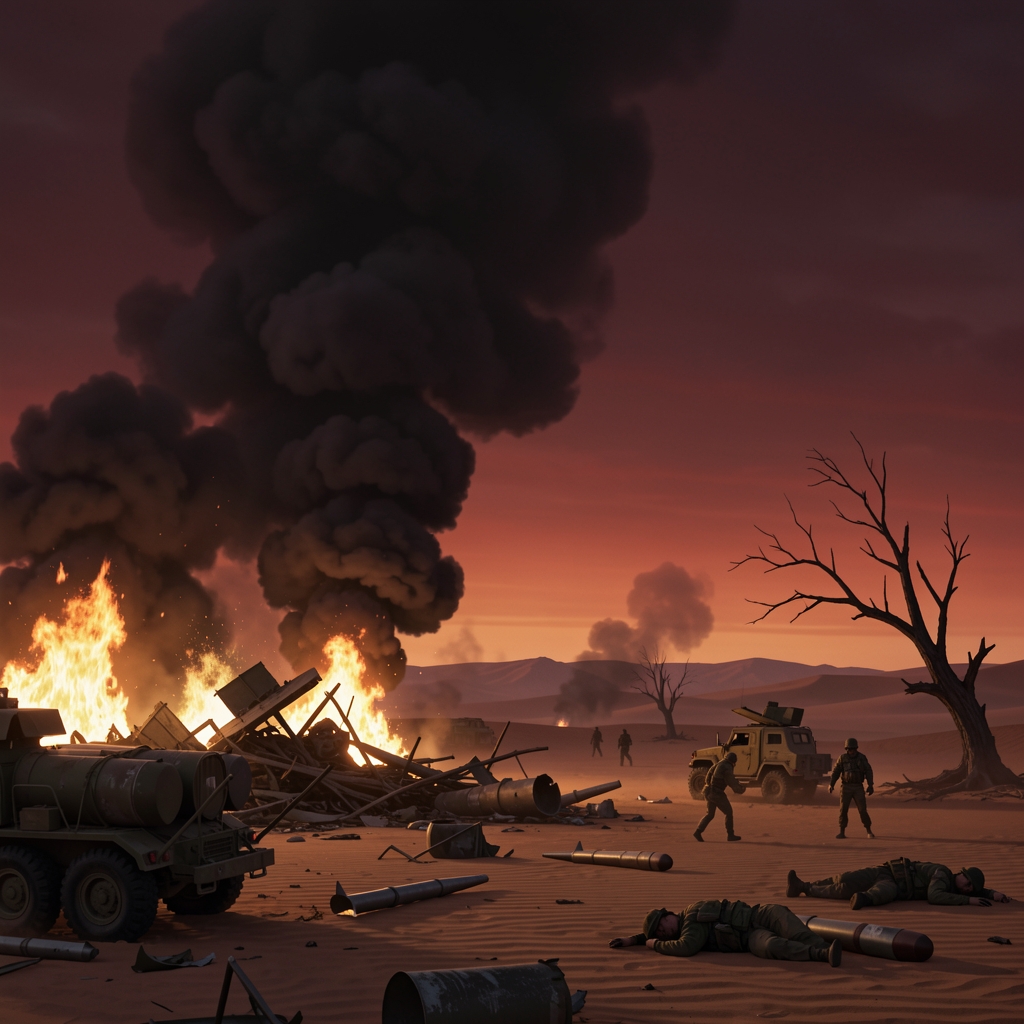
Fatal Misstep: Iranian Missile Convoy’s Desperate Dash Ends in Destruction
The early morning calm over Tehran was shattered by news of a high-stakes military maneuver gone awry. According to official statements from the Israel Defense Forces (IDF), Israeli Air Force (IAF) warplanes struck a convoy carrying surface-to-air missile (SAM) launchers, which were being transported on trailers near the nation’s capital. The tactical operation, reportedly executed during the convoy’s attempt to escape closer scrutiny, has left regional security analysts and diplomatic circles weighing the far-reaching ramifications of this event.
In an official declaration released by the IDF, it was noted that the targeted vehicles were part of a broader movement of military hardware. “This morning, the Air Force identified several trucks carrying weapons, including mobile SAM launchers, moving west of Iran’s capital,” the statement read, emphasizing the strategic choice behind the strike. Detailed imagery released by Defence Blog, capturing the aftermath of the operation, has added a graphic layer to the unfolding narrative, revealing the stark reality of modern warfare where precision strikes and rapid responses intersect.
This incident is not occurring in isolation. The region has long been a tapestry of strategic posturing and calculated risks, with Iranian military assets frequently under international scrutiny. Iran’s missile capabilities, coupled with an advanced network designed to counter aerial threats, have been both a point of national pride and an element of tension for its adversaries. In recent years, similar operations have underscored the delicate balance maintained in the Persian Gulf region, where each military movement carries symbolic and operational weight.
Historical context is crucial to understanding why a retreating missile convoy might present as both a tactical liability and an operational opportunity. For Iranian forces, mobile SAM systems are not merely static defensive installations—they are an integral part of a flexible deterrence strategy. Their relocation typically signals an effort to reposition in the face of heightened external pressure, a move that might reflect both logistical imperatives and strategic recalibration. However, when such convoys are intercepted, the implications ripple far beyond the immediate tactical loss.
In the current situation, the IAF’s decision to strike comes amid a broader pattern of regional rivalries and covert maneuvers. With Iranian missile units already under intense observation by strategic defense forums, the choice to transport these assets at a vulnerable moment appears to have been a calculated risk with fatal consequences. The incident highlights how even well-planned tactical retreats can become exposed to counter-strikes when adversaries are primed for rapid intervention. Analysts suggest that this is emblematic of an era where advanced surveillance and precision weaponry have blurred the lines between safe passage and open conflict.
The immediate fallout of the strike has reignited debates over the stability of the region and the potential for escalation. Regional observers point to the delicate balance maintained in the Middle East—a balance that can be upended by any miscalculation, especially in an environment characterized by escalating mistrust between rival powers. The operational details, while still emerging, have already prompted a wave of analysis from military strategists who warn that this incident could be a precursor to further confrontations in an area where military posturing and covert operations often intersect.
Beyond the immediate tactical setback for Iranian forces, the broader significance of the strike is multifaceted. First, the operation underscores Israel’s commitment to neutralizing what it perceives as emerging threats in its vicinity—a stance that has been consistent with its defense policy over the past several decades. Second, it illuminates the complex interplay between military readiness and strategic vulnerability. Mobile weapon systems, particularly those designed to be rapidly redeployed, rely on the element of surprise and speed. Yet, as this incident demonstrates, the very mobility that confers tactical advantages can also render them susceptible to timely and precise countermeasures.
In examining the incident, several core concerns emerge that warrant close attention:
- Operational Risk: The reliance on mobile units for missile defense exposes logistical challenges, particularly during rapid redeployments under heightened alert conditions.
- Geopolitical Ramifications: Any escalation between Israel and Iran has the potential to reverberate throughout the region, affecting alliances, trade routes, and international diplomatic engagements.
- Technological Implications: The precision of the IAF’s strike serves as a testament to the advances in targeting and surveillance technology, emphasizing how modern conflicts are increasingly defined by digital reconnaissance and rapid response capabilities.
- Strategic Messaging: Military actions such as these carry potent symbolic weight. By successfully targeting a critical component of Iranian air defense, Israel not only neutralizes an immediate threat but also sends a clear strategic message to adversaries about its operational capabilities and willingness to act decisively.
Defense experts at institutions such as the International Institute for Strategic Studies and noted military analysts published in The Times of Israel have provided insights into the incident’s broader implications. They observe that while the loss of hardware is a significant setback, it may also precipitate a strategic reassessment within Iran’s defense apparatus. Such recalibrations could lead to operational adjustments, whether through enhanced security measures or shifts in deployment strategies to further mitigate vulnerabilities.
One key area of concern is how this event might influence the already volatile equilibrium in the region. Historically, Iran has demonstrated both resilience and adaptability in the face of external pressures. However, the destruction of a missile convoy under circumstances that appeared to be a tactical withdrawal suggests potential vulnerabilities that could be exploited in future engagements. Analysts note that this incident could drive a reordering of priorities within Iranian military planning, perhaps accelerating the development of decentralized or more resilient mobile defense systems.
Looking ahead, policymakers and military strategists on all sides will undoubtedly be scrutinizing this incident as a case study in modern warfare dynamics. The incident raises several questions that are likely to influence future operational doctrines. For example, what protocols will be refined to secure mobile SAM units during relocation? Is there a broader reassessment underway within regional defense establishments regarding the balance between rapid deployment and operational security? As these questions are deliberated upon, the incident may catalyze shifts in both defense policy and on-ground tactics.
In a broader diplomatic context, the strike adds another layer of complexity to already strained relations in the Middle East. While no immediate escalation has been publicly confirmed by Iranian officials, diplomatic channels are undoubtedly abuzz with concerns over the potential for a spiraling conflict. International organizations and allied nations are likely to monitor subsequent developments with heightened vigilance, aware that any misstep could trigger unforeseen consequences in an area characterized by a precarious balance between deterrence and conflict.
For the human element behind these strategic maneuvers, the stakes extend well beyond the geopolitics of regional power. Military personnel on both sides of the conflict, communities living under the constant threat of missile strikes, and families caught in the crossfire of strategic disagreements all face the tangible impacts of such high-risk operations. The tragic irony lies in the fact that the very efforts designed to secure national defense and deter adversaries can inadvertently inflict broader harm on civilian life and regional stability.
As the morning light gives way to deeper scrutiny of the events near Tehran, the world watches with bated breath, aware that each incident in this labyrinthine conflict zone resonates far beyond its immediate operational scope. The event stands as a stark reminder that in the theater of modern conflict, a moment of vulnerability can become the pivot around which entire regions and global alliances rotate.
In conclusion, the obliteration of an Iranian missile convoy, while a tactical win for the Israeli Defense Forces, heightens the stakes in an already volatile environment. It forces military experts, policymakers, and ordinary citizens alike to ponder the intricate interplay between technology, strategy, and human cost. As debates over the balance between defense posturing and operational security continue, one must ask: In a world where every technological advance in warfare carries such profound risks, is the relentless pursuit of strategic advantage worth the potential for untold regional instability?



