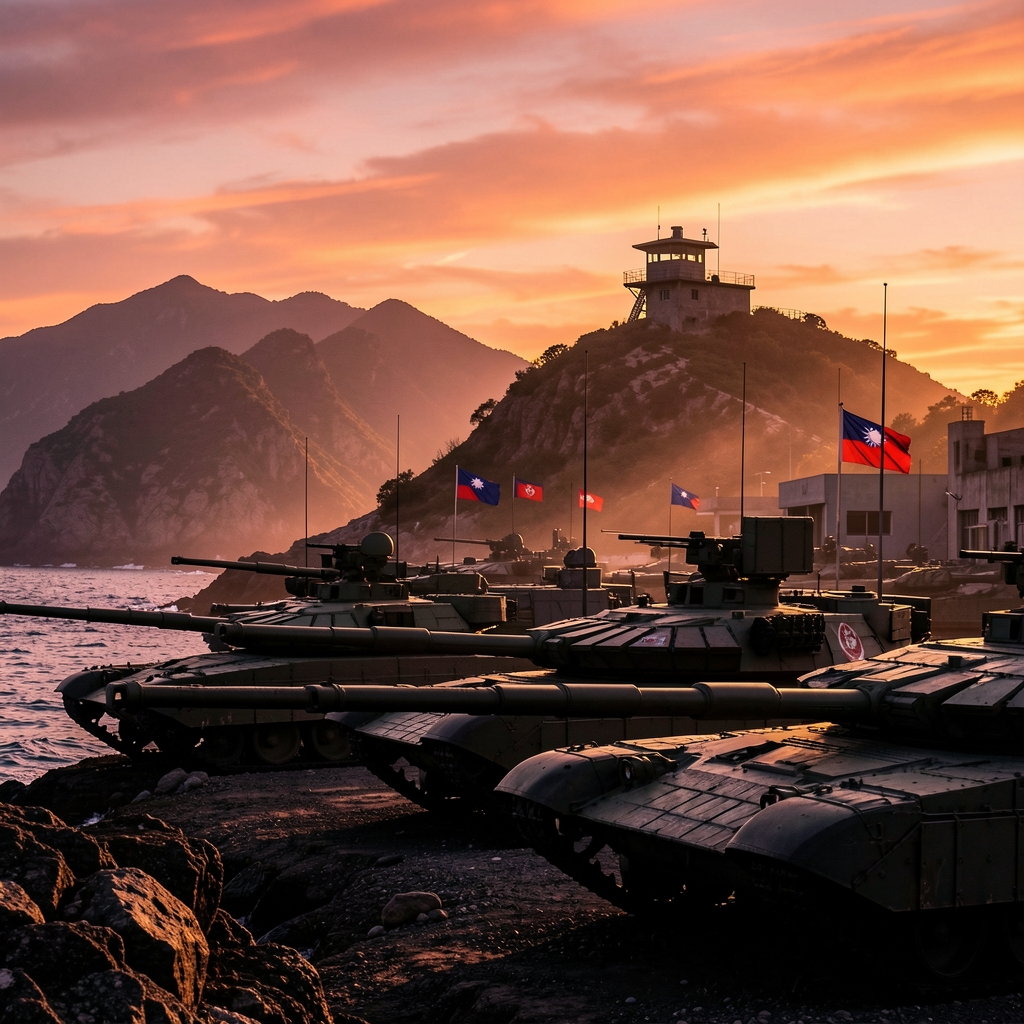
Taiwan’s Ground Game Strengthens: Nearing Full Deployment of U.S. Abrams Tanks
In a significant development for regional defense, Taiwan is on track to complete the delivery of 108 U.S.-made M1A2T Abrams main battle tanks by early 2026. As tensions in the Asia-Pacific region continue to simmer, Taiwan’s commitment to boosting its ground combat capabilities with cutting-edge American military technology has garnered extensive attention from defense experts and policymakers alike.
The Ministry of National Defense of Taiwan recently confirmed that the deployment schedule remains intact, with particular emphasis on the large-scale integration of the Abrams platform into the island’s existing military structure. A report submitted to Taiwan’s Legislative Yuan detailed that the program’s second batch, consisting of 42 tanks, is slated for completion and delivery in the coming months. This milestone underscores a broader strategy aimed at strengthening Taiwan’s deterrence posture amidst evolving regional security dynamics.
Historically, Taiwan’s military modernization efforts have consistently pursued the balance between indigenous capability development and strategic procurement from trusted allies. The U.S. arms sale to Taiwan, particularly in the domain of armored warfare, represents an extension of decades-long defense ties. The Abrams tanks, renown for their advanced firepower, superior armor, and integrated technology systems, have become emblematic of both U.S. military prowess and a robust defense relationship. Over the past several years, public documents, including reports from the Legislative Yuan and briefings from U.S. defense officials, have highlighted the imperative to upgrade Taiwan’s hardware in the face of regional challenges.
At its core, the expansion of Taiwan’s armored forces occurs against the backdrop of a shifting strategic balance. While air and maritime domains have traditionally dominated the defense discourse in the region, modern combat scenarios emphasize the integrated and hybrid nature of warfare. The introduction of the M1A2T Abrams into Taiwan’s arsenal serves to recalibrate its ground-based operational capabilities, ensuring not only a hardened defense posture but also improved interoperability with its allies.
In practical terms, the Abrams tanks offer several tactical advantages. They feature advanced armor composites designed to withstand anti-tank guided missiles, state-of-the-art fire-control systems, and enhanced mobility that is crucial for navigating diverse terrains. Incorporating these capabilities with rigorous training and strategic planning could provide Taiwan with a much-needed upgrade to its ground combat role. This development is not merely a quantity exercise but a qualitative leap intended to bolster Taiwan’s deterrence against potential adversaries.
The operational and strategic rationale behind the deployment is clear. With increased pressure in the region, Taiwan’s reliance on the iconic Abrams is twofold: first, as a bulwark against emerging threats; and second, as a signal to regional and global actors that the island is committed to maintaining its security. Reports from various defense analysts have underscored that modern armored warfare demands platforms that are not only technologically sophisticated but also logistically sustainable over extended combat periods. The delivery timeline for the Abrams tanks, culminating in early 2026, fits within broader timelines anticipated by defense planners, paving the way for enhanced readiness amid a fluid geopolitical climate.
An expert perspective on this matter can be gleaned from assessments by well-regarded defense research institutions such as the International Institute for Strategic Studies and the RAND Corporation. Analysts from these agencies have noted that while the Abrams platform is a formidable element in the U.S. arsenal, its integration into Taiwan’s force structure requires overcoming training and maintenance challenges. They emphasize that such a shift is as much about transforming military culture and logistics as it is about increasing firepower on the field. In essence, the successful deployment of the Abrams tanks will be measured by both their battlefield performance and how effectively Taiwanese forces adapt to their operational requirements.
- Enhanced Protection: With next-generation armor technology, the M1A2T Abrams provides robust defense against modern anti-tank systems.
- Superior Firepower: The tanks come equipped with advanced targeting and fire-control systems, supporting both offensive and defensive maneuvers.
- Integrated System Upgrades: Modernized electronics and communications capabilities ensure that the Abrams performs optimally in network-centric warfare scenarios.
From the perspective of U.S. policymakers, the continued arms sale to Taiwan underscores a strategic commitment to regional stability. Officials in Washington have repeatedly emphasized that the provision of advanced military technology, such as the Abrams tanks, is not intended to escalate tensions but rather to fortify Taiwan’s defensive posture in a volatile regional environment. This nuanced policy stance aligns with a broader American strategy of forward engagement, ensuring that allies in the Indo-Pacific remain resilient against coercive pressures.
Looking ahead, the completion of this procurement program is poised to have several implications. Firstly, Taiwan’s enhanced ground combat capability could recalibrate strategic calculations in any potential conflict scenario, contributing to a more robust deterrence framework. Secondly, the program’s successful implementation might prompt further collaboration between Taiwan and U.S. defense contractors, fostering additional technology transfer and joint training initiatives. Moreover, as regional tensions persist, observers will be keenly watching how neighboring states recalibrate their own defense priorities in response to Taiwan’s bolstered armored capabilities.
Beyond the immediate military context, the deployment of the Abrams tanks carries broader implications for public trust and national morale. In a democratic society where defense spending and procurement decisions are subject to constant scrutiny by the electorate and legislative bodies alike, transparent and timely implementation of such programs is vital. This is particularly important in Taiwan, where public confidence in national security measures is intertwined with the perception of state resilience against external threats.
As Taiwan nears the final phase of this significant transition, questions remain open: How will the integration of the Abrams tanks influence broader defense doctrines in the region? Will this strategic infusion of technology serve as a catalyst for further modernization efforts? Ultimately, the evolution of Taiwan’s military capabilities is a story of adaptation—the balancing act between technological innovation, strategic autonomy, and collaborative partnerships with global allies.
In an era marked by rapid technological advances and shifting geopolitical landscapes, Taiwan’s engagement with the M1A2T Abrams program serves as both a beacon of defensive modernization and a reminder of the enduring human imperative to secure one’s homeland. As policymakers, military strategists, and citizens alike monitor these developments, the interplay between advanced technology and national security continues to define the modern state’s response to emerging threats.



