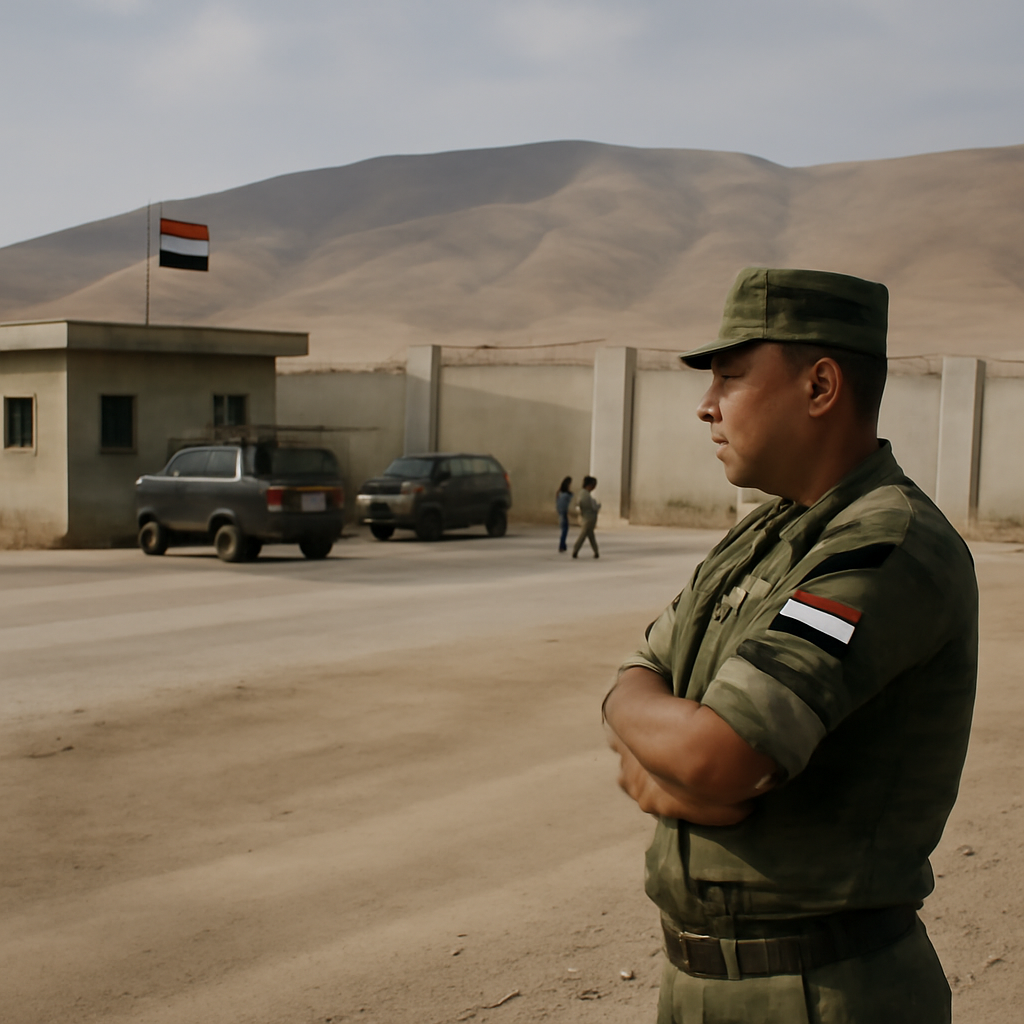
"They had around 170 military bases, and now there are only two bases," President Ahmad al-Sharaa said, a numerical shorthand for a rapid contraction of foreign footprints on Syrian soil.
From roughly 170 to two: Russia’s footprint in Syria
At an Atlantic Council event, President Ahmad al-Sharaa framed recent changes in Syria’s security map as an effort to restore state sovereignty. He said that prior to his coming into power in December 2024, "Russia operated from dozens of military bases in Syria, which it used to help keep the Assad regime in power." He added that "since the regime was overthrown, the number of Russian military bases has shrank considerably," and gave the specific count: roughly 170 down to two.
Al-Sharaa presented that contraction not simply as a withdrawal but as a negotiated conversion of purpose: after "long discussions with them, we reached a point where we changed or we transformed those bases into training bases for the Syrian army," he said, stressing that these facilities are "not military bases that can oversee or provide any logistical work for operations that are launched from those bases against other countries."
Hmeimim and Tartus: the August memorandum of understanding
The two remaining Russian-linked sites named by the president are Hmeimim Air Base and Tartus Naval Base. In August, Syria and Russia signed a memorandum of understanding (MOU) to "turn them into 'joint training and qualification centers,'" according to al-Sharaa. The MOU is presented as a formal step to recast those installations away from expeditionary or logistics roles and toward training functions jointly managed with the Syrian armed forces.

Audit-ready is a season. It shouldn't be.
Evidence in spreadsheets, controls drifting between audits, frameworks multiplying on flat headcount. Nubivance runs continuous compliance on Rapid7 Cyber GRC - SOC 2, HIPAA, ISO 27001, PCI, CMMC.
End the scrambleTurkey’s presence: reduced numbers and the push for legal status
Al-Sharaa said Syria has "also reduced the number of military bases owned by neighboring Turkey," without specifying prior or remaining numbers. He noted that during the Assad regime, Turkey maintained a military presence and observation posts in the northern and northwestern parts of Syria "to protect its borders from an infiltration of terrorists and armed militias."
Those Turkish bases were, he said, "not previously endorsed by Syrian parliament," and Damascus is now seeking to regularize any remaining Turkish presence. The president said the country is looking to get "legal status" for the remaining Turkish bases because "any presence or any foreign presence should be under the endorsement of the People’s Assembly and to have a legal status."
Sovereignty, diplomacy, and a claimed end to foreign military necessity
Framing the broader objective in normative terms, al-Sharaa said that "very soon [Syria] will not have the necessity to have any military or foreign military presence," and added that he believes Syria can move forward "through the relations, diplomatic relations, and respect with all the countries in the neighborhoods and the friends of Syria." He pointed to a concrete sign of warming defense ties with Turkey: Syria's participation in May in Turkey’s Efes military exercise, its first time taking part in that exercise.
How Damascus, Moscow, and Ankara are positioned
- Damascus (the Syrian government): Pursuing legal endorsement of remaining foreign bases through the People’s Assembly and recasting remaining foreign facilities as training centers, with the stated aim that Syria will "very soon" have no need for foreign military presence.
- Moscow (Russia): Agreed with Damascus to convert the two remaining Russian-linked facilities at Hmeimim Air Base and Tartus Naval Base into "joint training and qualification centers," per the August MOU cited by al-Sharaa.
- Ankara (Turkey): Saw a reduced footprint in Syria, according to al-Sharaa, and demonstrated closer defense ties when Syria participated in Turkey’s Efes exercise in May; Turkish presence along northern and northwestern borders had been described as aimed at protecting against "an infiltration of terrorists and armed militias."
The president’s account ties three concrete developments into a single narrative: a sharp reduction in Russian bases from about 170 to two, an August MOU to recast those two sites as training centers, and a drive to regularize the remaining Turkish presence through parliamentary endorsement. The next concrete items to watch inside that narrative are implementation of the Hmeimim–Tartus MOU as joint training centers and whether the People’s Assembly grants the "legal status" al-Sharaa says he seeks for remaining Turkish installations — steps that would transform diplomatic declarations into formal legal and operational arrangements.