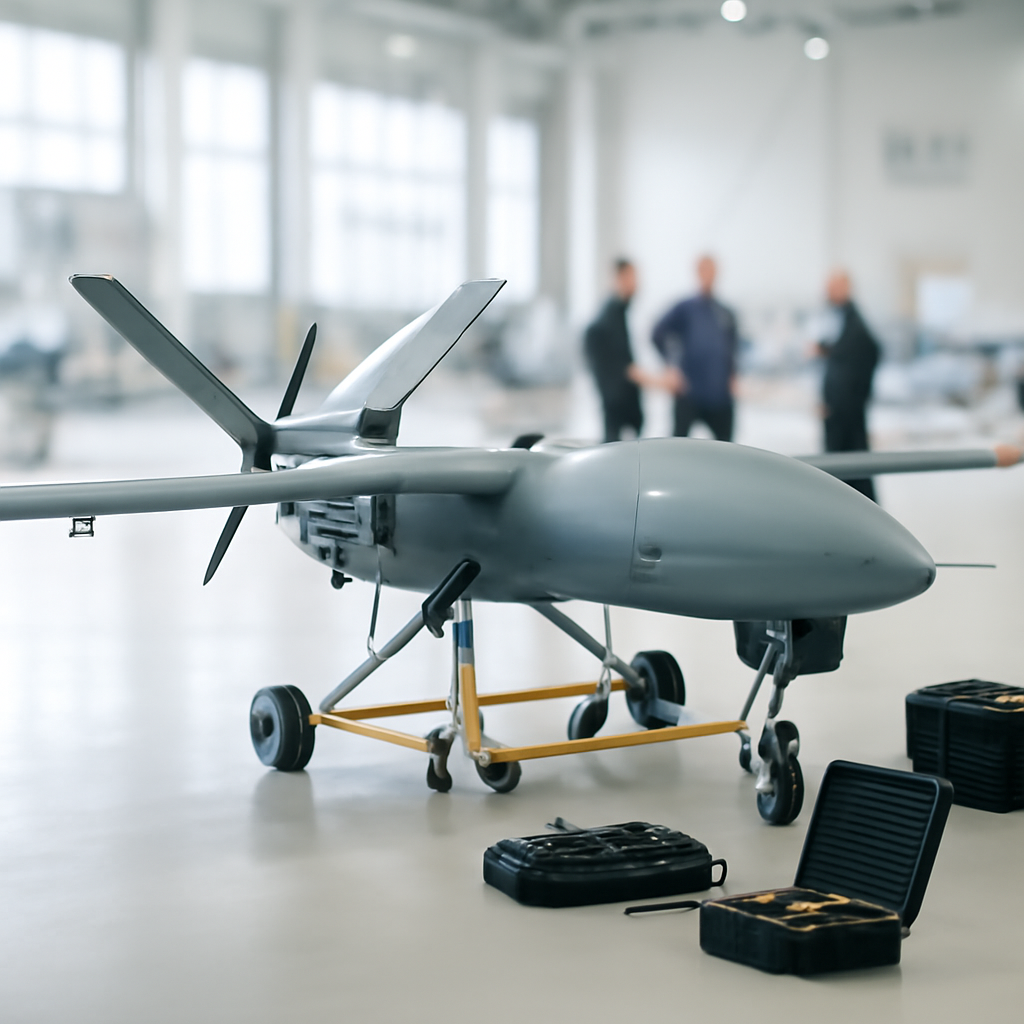
“The Bronco tail is really there to provide us that flexibility. So it allows us to use a variety of payloads, whether they’re released, whether they’re rocket‑powered, and it really gives us it… it really sets into the flexibility goal here, which is we can carry a whole bunch of different payloads, whether they’re strike, whether they’re sensing,” Peter Kalogiannis, CEO of Swarm Aero, said on the show floor in Washington, D.C.
Design choices: Bronco tail, dry wings, and mass production
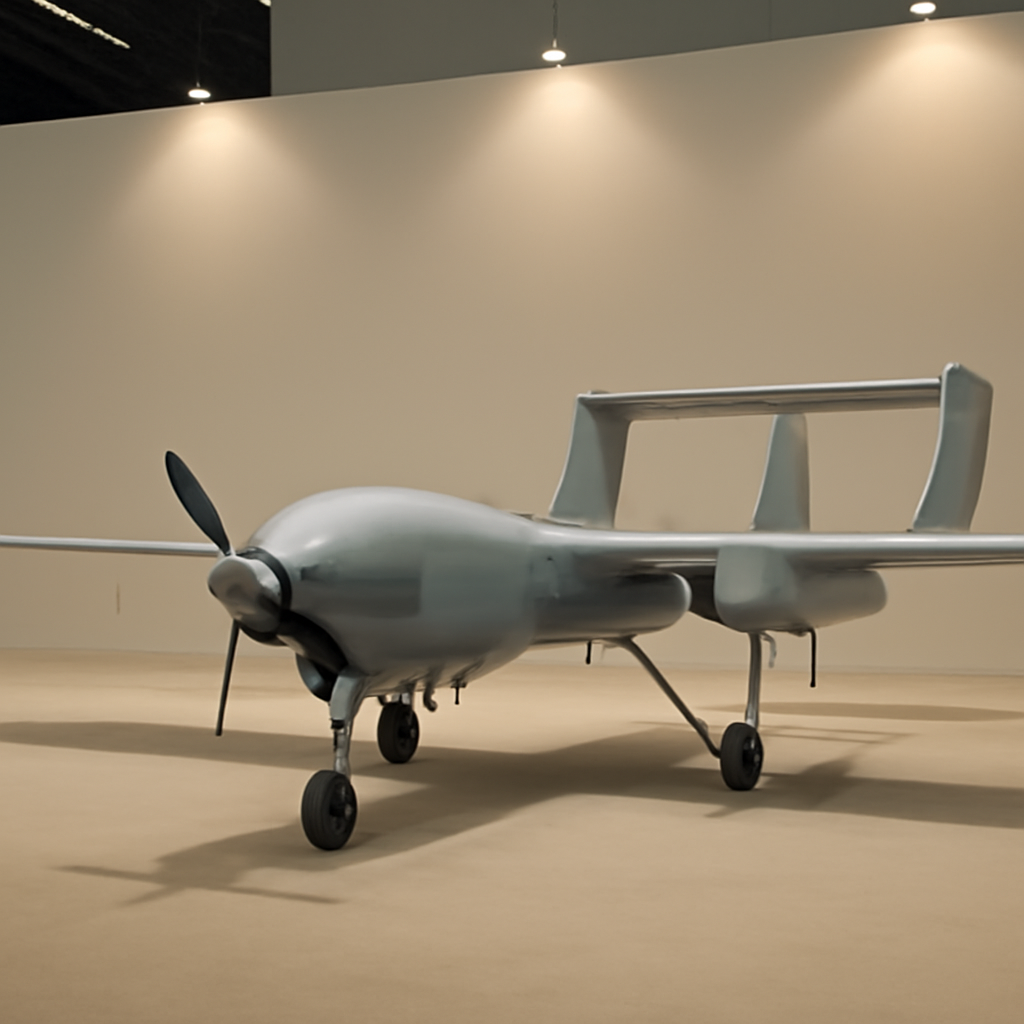
Swarm Aero unveiled a full‑scale mockup of Gamera at the Air & Space Forces Association’s Air, Space & Cyber Conference, presenting a clean‑sheet Group 5 UAS the company says was built “around a unique manufacturing approach.” The configuration pairs a single‑propeller central fuselage with an OV‑10 Bronco‑style twin‑boom t‑tail, large sponson fuel cells on either side, and removable “dry” wings that separate from the fuel system. Company executives framed those features as deliberate cost‑and‑manufacturability choices: “Low cost isn’t something that you kind of sprinkle on an existing design… You have to design the aircraft, design the company around that,” Kalogiannis said.
Range, payload, and armament: JASSM‑ER and seven hardpoints
Gamera’s headline performance claims are sizeable: a roughly 72‑foot wingspan, a 2,800‑pound payload capacity, a “Pacific‑spanning” unrefueled range of 9,000 miles, and a combat radius of about 2,300 miles with “hours” of on‑station time once on station. Swarm Aero said the aircraft’s native payload will be the JASSM‑ER cruise missile, described in the announcement as having a “plussed‑up range of 600 miles.” The mockup shows a JASSM‑ER on the centerline hardpoint, and the airframe includes seven stores stations in total. Swarm Aero claimed the JASSM‑ER option will deliver “comparable strike effects to exquisite systems for roughly one‑tenth the cost‑per‑effect of existing platforms.”

Audit-ready is a season. It shouldn't be.
Evidence in spreadsheets, controls drifting between audits, frameworks multiplying on flat headcount. Nubivance runs continuous compliance on Rapid7 Cyber GRC - SOC 2, HIPAA, ISO 27001, PCI, CMMC.
End the scrambleSwarming and Legion: up to 80 aircraft and single‑operator control
Beyond individual performance, Swarm Aero emphasized massed operations. The company says Gamera is most effective in “groups of up to 80,” controlled by its Legion command‑and‑control and autonomy system. Legion, the company noted, is intended to let a single operator or a team direct a cluster of dozens of uncrewed systems across multiple domains; Swarm said the system has already been experimentally deployed by the Navy to direct air and sea drones and was tapped by the Defense Innovation Unit as a C2 source for its Autonomous Collaborative Teaming program.
How the U.S. Air Force, General Atomics, and the Defense Innovation Unit are affected
- U.S. Air Force: Swarm Aero positioned Gamera to meet the Air Force’s Massed Modular Aircraft (MMA) requirements, including a 2,800‑pound payload and a 2,300‑nautical‑mile unrefueled combat radius. The service has publicly targeted a unit cost of $10 million for MMAs and confirmed plans to buy 500 MMAs by 2032; Swarm’s Chief Revenue Officer Oliver Palmer said Gamera would come in under the $10 million target and be “competitive.”
- General Atomics: Reaper maker General Atomics earlier this month unveiled Wildfire, a MALE drone developed from the MQ‑9. The report notes General Atomics’ public caution that achieving full Reaper capabilities at a fraction of the cost is an “unrealistic challenge,” and that it has not yet said whether Wildfire will meet the $10 million target—facts that frame the competitive context for Gamera.
- Defense Innovation Unit and Navy: Both have existing experimental experience with the Legion C2 concept and swarm control; Swarm highlighted that Legion has been used by the Navy and selected by the Defense Innovation Unit for Autonomous Collaborative Teaming, suggesting those organizations are potential early adopters or evaluators of the company’s operational concept.
Context from the Reaper legacy and procurement math
Swarm Aero framed Gamera as a response to recent attrition of the Air Force’s MQ‑9 Reaper fleet. The Air Force’s Reaper force is “reportedly now around 135 units,” down from a desired floor of 189, with “dozens lost over Iran and Yemen,” the announcement notes. By contrast, existing kitted‑out Reapers reportedly cost $30–50 million apiece and have payload capacity up to 3,800 pounds; the Air Force has only purchased up to 337 MQ‑9s across the program’s life. Swarm argues that an attritable, mass‑producible Group 5 UAS priced under $10 million would change the force‑structure equation and could push the service toward larger acquisition targets than the Air Force’s stated minimum of 180 MMAs.
Swarm also described work on primary materials tied to cost targets: the company referenced a $10 million Air Force Research Laboratory contract to develop metal composites and said its first engineering hire was a materials and process engineer, signaling a materials‑centric approach to reducing unit price.
Swarm’s unveiling positions Gamera as a deliberately low‑cost, mass‑manufacturable MALE platform coupled to a swarming command system and optimized for long‑range strike with multiple hardpoints. The company claims it will deliver comparable strike effects at roughly one‑tenth the cost‑per‑effect of “existing platforms,” while undercutting the Air Force’s $10 million MMA goal. Whether Gamera’s design choices, materials program, and Legion C2 will translate into the production cost, reliability, and operational performance the Air Force has signaled it wants remains the central question as the service and competitors move toward the 500‑aircraft MMA buy planned through 2032.