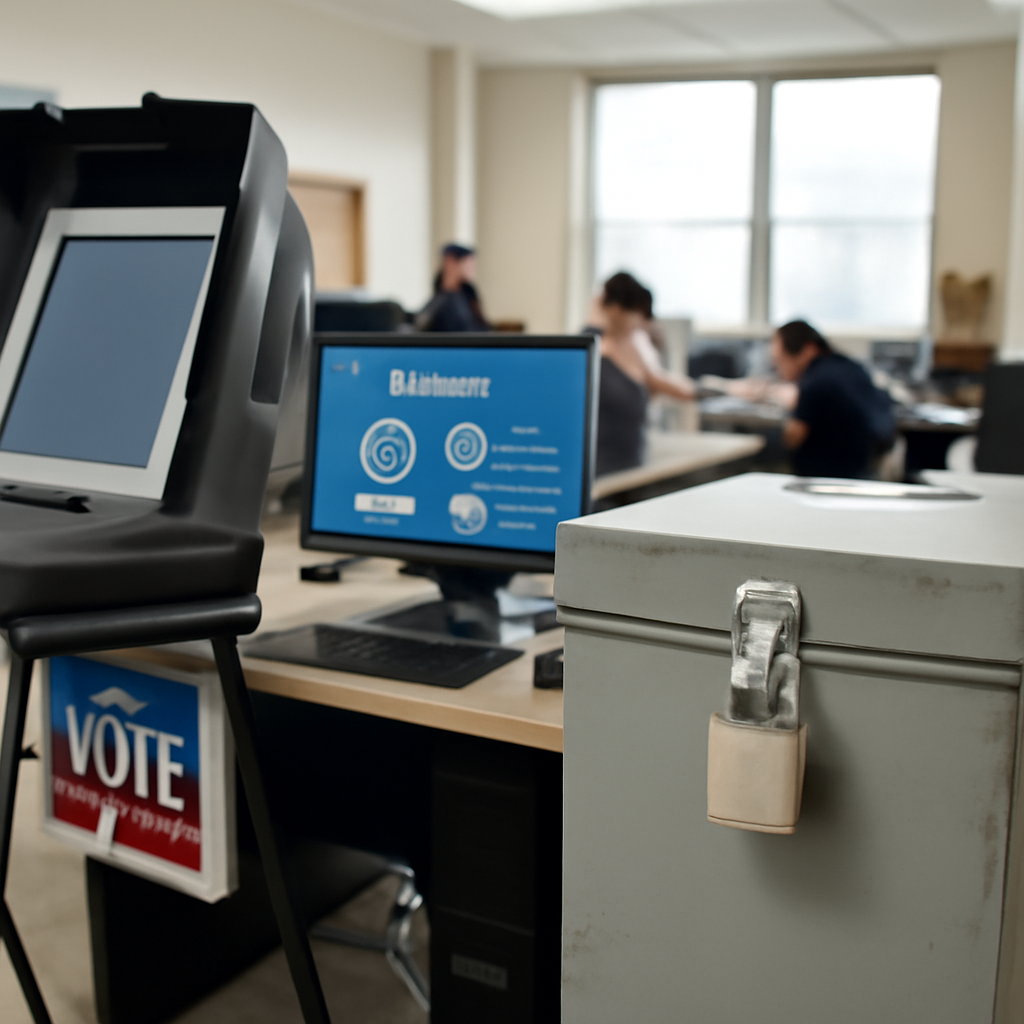
"And as you eliminate things – or if you get rid of commissioners, for example – or as you eliminate some of these other sort of safeguards or norms, it certainly strains the system," said Ben Hovland after he and Commissioner Thomas Hicks were fired by the White House on July 10, a move that has forced states to rebuild election defenses previously supported by federal agencies.
Election Assistance Commission firings and what the EAC does
The Election Assistance Commission (EAC) is charged with overseeing testing and standards for voting machines, including around security, and its federal certification has long been a voluntary but relied-upon stamp when states purchase voting equipment. On July 10, Democratic Commissioners Ben Hovland and Thomas Hicks were fired by the White House, and reports indicate Republican Commissioner Christy McCormick resigned. The source notes that Congress mandated the commission be bipartisan and that the Supreme Court has recently given the President broad authority to fire executive branch officials at will.
Department of Justice warning to all 50 states
Also last week, the Department of Justice sent a letter to all 50 states saying the department will investigate and prosecute any election official "who knowingly retains non-citizens on the state’s voter registration list or facilitates noncitizens in receiving and casting ballots." Secretaries of State in Colorado, Nevada, Minnesota, Rhode Island and others described the DOJ letters as an attempt at federal intimidation, and West Virginia Secretary of State Kris Warner reiterated his refusal to hand over state voter data — a refusal a federal judge upheld on Monday. Warner wrote to the DOJ that West Virginia state law "prohibits the disclosure of sensitive personally identifiable information contained in voter registration records" while saying the state was "available to discuss our existing voter registration list maintenance."

Audit-ready is a season. It shouldn't be.
Evidence in spreadsheets, controls drifting between audits, frameworks multiplying on flat headcount. Nubivance runs continuous compliance on Rapid7 Cyber GRC - SOC 2, HIPAA, ISO 27001, PCI, CMMC.
End the scrambleOregon Secretary of State Tobias Read: local precautions and tracking
Tobias Read, Oregon's Democratic Secretary of State, said his office is focused on providing the state's 36 county clerks with resources and support for smooth elections while "playing defense in a lot of ways [from] the intrusion from the federal government." Read said federal agencies like the Cybersecurity and Infrastructure Security Agency (CISA), which once deployed cybersecurity and technical expertise to help states fix vulnerabilities and share threat intelligence, have "largely gone quiet." Oregon plans to offer new ballot tracking this year that provides text or email updates when a voter's ballot is moving through the mail and has been certified; Reed estimated the service costs "pennies per voter per election" and called it a good option for cash‑strapped counties. Read also urged voters to use drop boxes as an alternative to the U.S. Postal Service, citing a lack of confidence in the Postal Service despite a recent Supreme Court decision blocking an executive order about mail‑in ballot distribution.
Arizona Secretary of State Adrian Fontes: building a state-level defense network
Adrian Fontes, Arizona's Secretary of State, said his office is directly supporting local jurisdictions on election security and coordinating more closely with state law enforcement, intelligence agencies and other states following Iranian hackers' defacement of Arizona's candidate bio portal last year. Fontes told CyberScoop his office's network of information sharing is "hobbling together a loose and often informal network" that "doesn't violate any rules," but that it operates with "a fraction of the resources and coordination" the federal government provided under prior administrations. Fontes said he does not have a formal relationship with CISA and would not accept CISA's help even if offered, citing a "lack of trust between states and the Trump administration" and saying the administration has "demonstrably and explicitly threatened me and local election administrators of all political stripes with criminal prosecution."
What this means for technologists, state election officials, and voters
- Technologists and security teams: With CISA regional advisors reportedly fired and federal technical engagement reduced, cybersecurity and operations teams at the state and county level are being asked to fill gaps previously supported by federal deployments of expertise and shared threat intelligence. A former CISA official estimated that on Election Day 2024 more than 1,000 representatives from federal, state and local governments, vendors and other stakeholders sat together to coordinate — a level of joint presence state officials now say is gone.
- State election officials and county clerks: Secretaries of State like Tobias Read are emphasizing legal preparedness — ensuring county clerks have county counsel on speed dial and the ability to distinguish legitimate federal warrants or subpoenas — and practical tools such as ballot‑tracking systems and drop box options. Officials are also reviewing ballot retention and destruction schedules amid concern about federal subpoenas and FBI raids that have seized ballot records related to the 2020 and 2024 elections.
- Voters and public confidence: Officials quoted in the source warn that the removals and federal actions may erode public trust. Hovland said the firings "likely causes people to lose faith in our democracy and in the process and their confidence in our elections," and state leaders are introducing tracking tools and urging alternate return methods to reassure voters that ballots are secure and counted.
The net effect described by state officials interviewed by CyberScoop is a shift from federal-led coordination to a patchwork of state and local measures — a transition that officials say is being driven both by a withdrawal of federal technical support and by legal pressure from the Department of Justice. Whether the "pennies per voter per election" fixes and informal interstate coordination can scale in the absence of robust federal engagement remains the practical question left on the table as states prepare for upcoming elections.