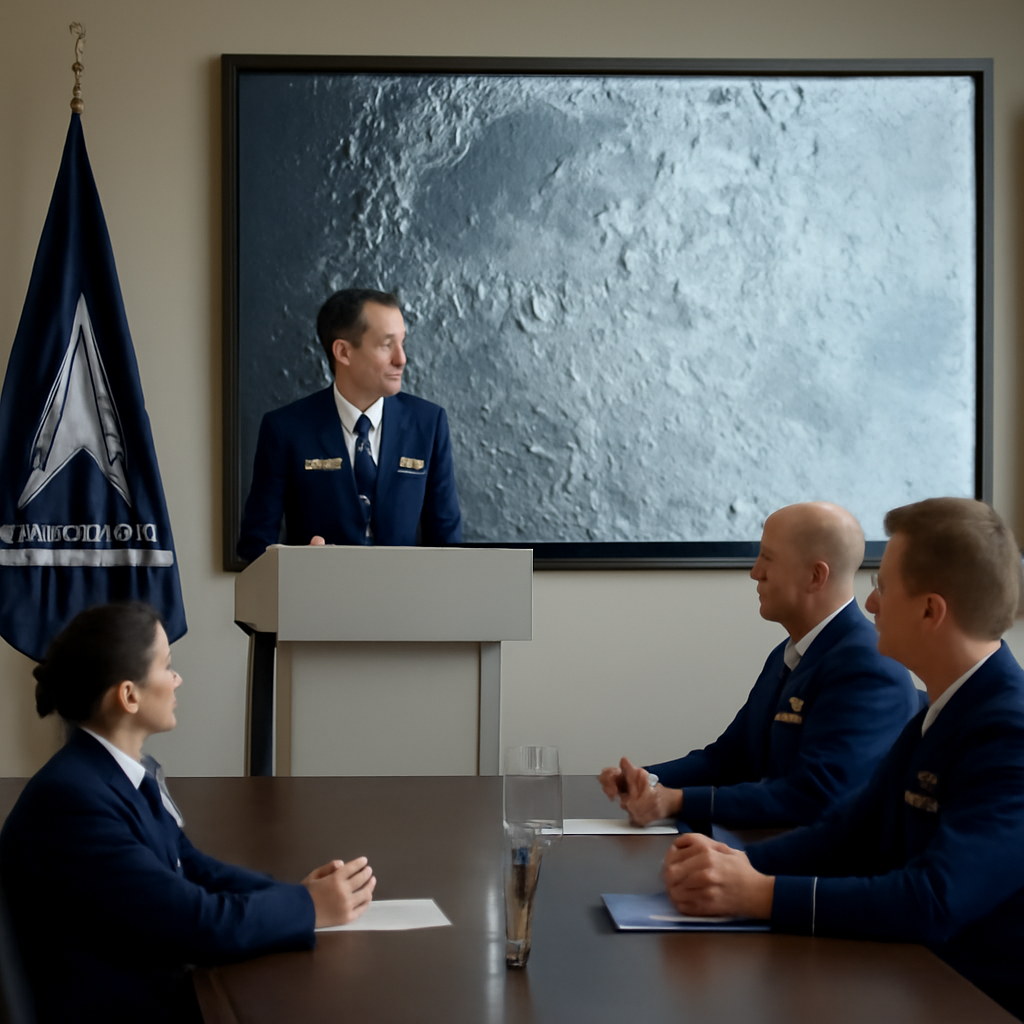
"I think at that point, once we have military members on the moon. Again, the treaty would need to be updated," retired Space Force Colonel Kyle Pumroy said during a webinar this week, summarizing a conclusion at the heart of a new Mitchell Institute policy paper urging the Space Force to prepare for what the report calls a potential "in person" lunar conflict with China.
Mitchell Institute's central proposal: a Space Force human spaceflight program
The Mitchell Institute's 22-page policy report, published Thursday, argues that the Space Force should prioritize creation of a formal "human spaceflight" program and reframe Title 10 active-duty orders to include space and lunar habitation. The paper urges leveraging the Space Test Course (STC), partnerships with NASA, and collaboration with commercial space companies to build "the skills, tools, and concepts needed for future Title 10 activities to enforce U.S. spacepower-enabling norms and standards," and it calls for additional Congress funding to support both Space Force human spaceflight opportunities and residencies at commercial space stations.
Title 10 orders, lunar habitation, and the Outer Space Treaty
The report recommends blurring long-standing lines between exploration and militarized operations by allowing Title 10 orders to encompass "space and lunar habitation" and to instill "warfighting authorities and a national defense mindset in the advancement of human spaceflight." That recommendation sits in tension with the 1967 Outer Space Treaty (OST), which the report notes "calls for the governments to use the moon and other planets for 'peaceful purposes' and forbids military bases, testing, and maneuvers."
The paper explicitly pushes back on those treaty norms: "Although The 1967 Outer Space Treaty (OST) prohibits claims of lunar sovereignty and militarizing the moon, China’s habitation plans are closely aligned with their military and are inconsistent with the provisions," it states. Pumroy went further in the webinar, saying the treaty "would need to be updated" once nations station military members on the moon.

Audit-ready is a season. It shouldn't be.
Evidence in spreadsheets, controls drifting between audits, frameworks multiplying on flat headcount. Nubivance runs continuous compliance on Rapid7 Cyber GRC - SOC 2, HIPAA, ISO 27001, PCI, CMMC.
End the scrambleChina, Taikonauts, and the stated risk picture
The report frames its recommendations around reported Chinese ambitions, including a reported goal of putting Taikonauts on the moon by 2030. It warns that, despite Chinese officials' recent statements that the country believes in the "peaceful use" of space, "future competition for control of lunar resources and territory will likely reach a tipping point" and the U.S. military must be prepared for competition that could become in-person.
Space Force's current human-spaceflight footprint
The Mitchell Institute notes that the Space Force has not yet sent uniformed personnel into space for active-duty military operations, though guardians have been loaned to NASA exploration missions. The report recounts prior transfers and flights: in 2020, astronaut Mike Hopkins transferred from the Air Force into the Space Force while aboard the International Space Station, and in 2024, Space Force Col. Nick Hague commanded NASA's SpaceX Crew-9 mission, a 171-day flight that made Hague the first active-duty guardian to ever launch into space.
Building on that limited experience, the report urges either funding residencies at commercial stations or, in future National Defense Authorization Act legislation, consideration of purchasing "a Space Force-dedicated space station" to provide on-orbit training, experimentation, and "first-hand experience" to inform future military requirements.
Victoria Samson and the blurring of exploration and militarized operations
Victoria Samson, the Secure World Foundation’s chief director of space security and stability, described the report as an example of how the line between exploration and militarized operations is shifting. "It used to almost be a separation of church and state between the two," Samson said. "Now, that line is being blurred, and I think it’s more a matter of, we have an administration that is supportive of a very active and expanding Space Force," she added, as quoted in the Mitchell Institute coverage.
What this means for Congress, NASA, and commercial space stations
- Congress: The report calls on Congress to provide additional funding for Space Force human spaceflight programs and to finance residencies at commercial space stations; it also suggests future NDAA language could authorize purchase of a Space Force-dedicated station.
- NASA: The paper recommends closer partnership with NASA to develop skills and operational concepts, leveraging NASA missions and the Space Test Course as training and testing pathways for Title 10 activities.
- Commercial space companies and stations: The report positions commercial stations as near-term venues for guardian training and experimentation and urges Congress to fund residencies or procure dedicated on-orbit infrastructure to build "realistic testing" opportunities.
The Mitchell Institute frames its prescription as pragmatic and long-term: "With a potential 'in person' lunar conflict with China as the contextual touchstone, the U.S. must begin a pragmatic multi-decade effort," the report says. Whether the United States will redefine the legal contours of lunar activity, translate commercial station partnerships into routine military residencies, or pursue a dedicated Space Force station remains to be decided by policymakers and Congress. The report leaves a clear next step on the table: additional funding and statutory changes to align Title 10 authorities with the prospect of human operations beyond low Earth orbit.