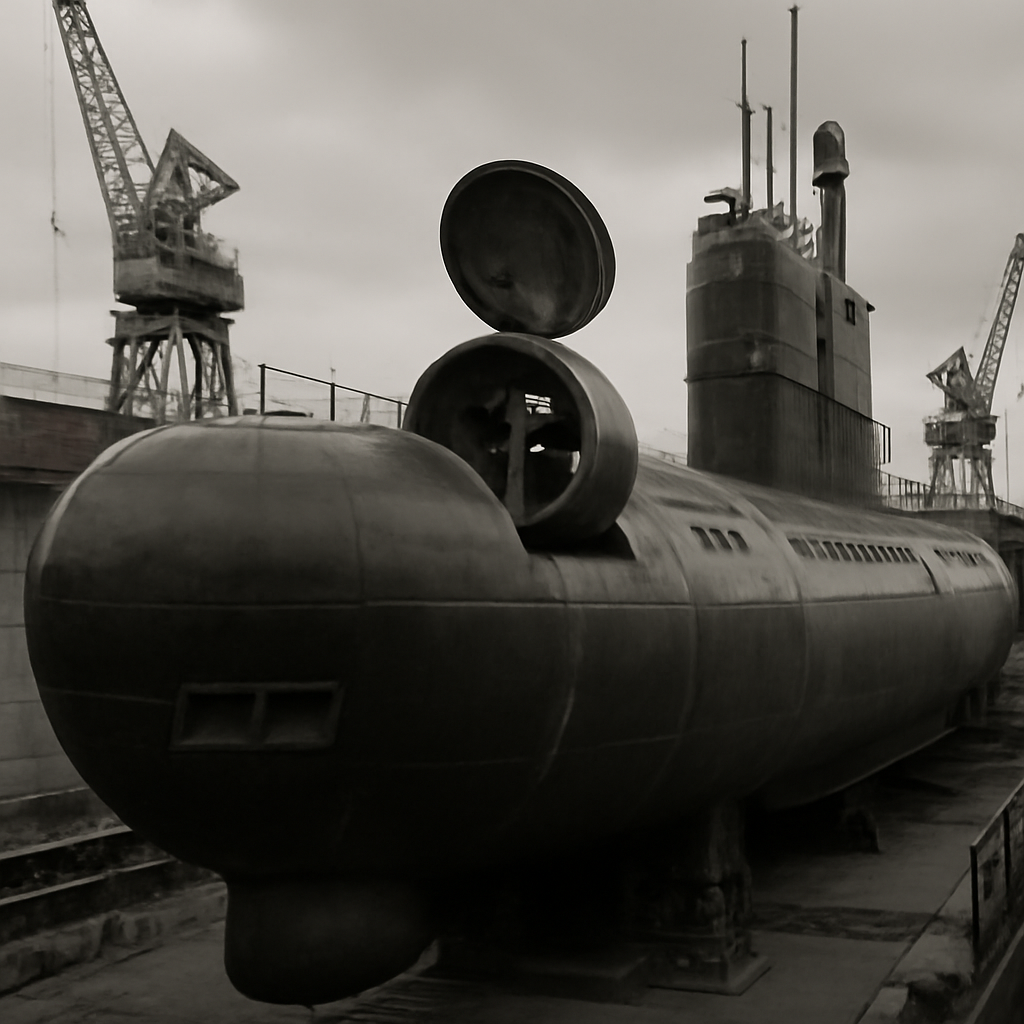
In December 1972 S-49 conducted the first Soviet underwater launch of a Vodopad missile-torpedo from a depth of 50 meters — the opening act in a decade-long program that turned a Romeo-class attack submarine into a purpose-built underwater weapons laboratory.
Project 633RV conversion of S-49
S-49 began life as a conventional Project 633 (NATO: Romeo class) diesel-electric attack submarine: keel laid in March 1961, launched in July, and commissioned in December of the same year. After routine service with the Black Sea Fleet, a transfer to the Northern Fleet in 1962, and a permanent return to the Black Sea Fleet in 1969, S-49 was chosen for a major refit. Between December 1971 and October 1972 the boat underwent reconstruction at Sevmorzavod in Sevastopol and emerged as Project 633RV, a specially configured testbed for next-generation Soviet underwater weapons.
RPK-6 Vodopad and RPK-7 Veter anti-submarine missiles
The conversion answered a concrete engineering problem: the Soviet Navy was developing two distinct anti-submarine missile systems. RPK-6 Vodopad was designed for the 533mm torpedo-tube launch system; RPK-7 Veter required larger 650mm tubes and could carry a nuclear depth charge. Because the Veter's external diameter was too large for the Romeo hull, S-49’s forward superstructure was radically altered to house two giant external 650mm tubes, producing the submarine’s distinctive “double‑barrel” bow. At the same time two internal 533mm launch tubes were modified to support Vodopad tests.

Audit-ready is a season. It shouldn't be.
Evidence in spreadsheets, controls drifting between audits, frameworks multiplying on flat headcount. Nubivance runs continuous compliance on Rapid7 Cyber GRC - SOC 2, HIPAA, ISO 27001, PCI, CMMC.
End the scrambleTesting milestones, 1972–1975
Project 633RV was fitted with specialized systems to replicate the operating environment of Soviet nuclear attack boats then planned for Project 671. Normal forward compartments and torpedo storage were removed and replaced with test instrumentation: weapon programming equipment, pre-launch electrical connections, fire‑control elements, sealing arrangements, guide tracks and upgraded sonar and navigation suites. The goal was a full-spectrum test platform capable not only of firing missiles but of measuring launch behavior, weapon performance, submarine effects, underwater pressures, guidance operation and reliability.
After conversion, S-49 conducted the first underwater Vodopad launch in December 1972 from 50 meters. In 1973 and 1974 the submarine completed 24 successful launches from depths between 50 and 150 meters; in 1975 it received an improved deep-water launch system and recorded another 22 launches, including a launch from 240 meters — a depth described in the record as unprecedented for that program.
Expanding roles: Granat testing, overhaul, and later duties
S-49’s mission extended beyond anti-submarine missiles. In 1977 the boat took part in testing the 3M10 Granat (SS-N-21 Sampson), a land-attack cruise missile deployed from a 533mm launch tube and described in the source as analogous to the U.S. Tomahawk. From 1977 through 1985 S-49 continued to support missile-torpedo development. A major overhaul between 1986 and 1991 preceded continued weapons-related duties until the submarine was removed from active naval service in 1995.
Late in 1995 S-49 was redesignated PZS-50 and converted into a floating battery charging station, supporting the Black Sea Fleet by charging batteries and assisting submarine training activities. The PZS-50 remained in service as a support vessel into the 2010s and was finally retired around 2019.
Balaklava museum and an uncertain future
After dock repairs and a museumification process, S-49 (PZS-50) was towed to the Southern Bay of Sevastopol in late 2021 for temporary mooring and, according to public posts, was due to be moved to Balaklava. In May 2022 S-49 became part of the Balaklava Underground Museum Complex, preserved in a former Soviet subterranean submarine base. The source notes the preservation of the boat as part of the museum but also flags that, with Russia occupying the peninsula and engaged in a war with Ukraine during which Crimea has been repeatedly targeted, the ultimate fate of the submarine is not certain.
What this means for the Black Sea Fleet, weapons developers, and museum operators
- Black Sea Fleet: S-49’s long life after conversion — first as a weapons test platform, later as PZS-50 — illustrates how a single hull served operational, developmental and logistical roles: testing before frontline deployment and then sustaining submarine operations through battery-charging and training support.
- Weapons developers: The Project 633RV refit allowed engineers to test the full launch sequence and measure launch dynamics at depth, enabling multiple launch campaigns (24 launches in 1973–74; another 22 in 1975) and experiments with greater depths and alternate missile types such as the 3M10 Granat.
- Museum operators and preservationists: The boat’s transfer into the Balaklava Underground Museum Complex preserves a rare example of a purpose-built Cold War test submarine, but the source explicitly notes that regional conflict and repeated targeting of Crimea create an uncertain preservation environment.
S-49 never fired in combat. Yet as a converted Romeo-class hull with an unmistakable double-barrel bow, it became a laboratory that validated systems later fielded in Soviet service — and then a support ship and museum exhibit whose presence today is a reminder of Cold War innovation and of the fragility of technological heritage in contested regions.