"HICAR’s got me excited," Lt. Col. Alan Wood, SOCOM’s Program Manager for Special Operations Forces Lethality, told The War Zone during SOF Week in Tampa.
HICAR: a hypervelocity improved carbine tied to existing 5.56 logistics
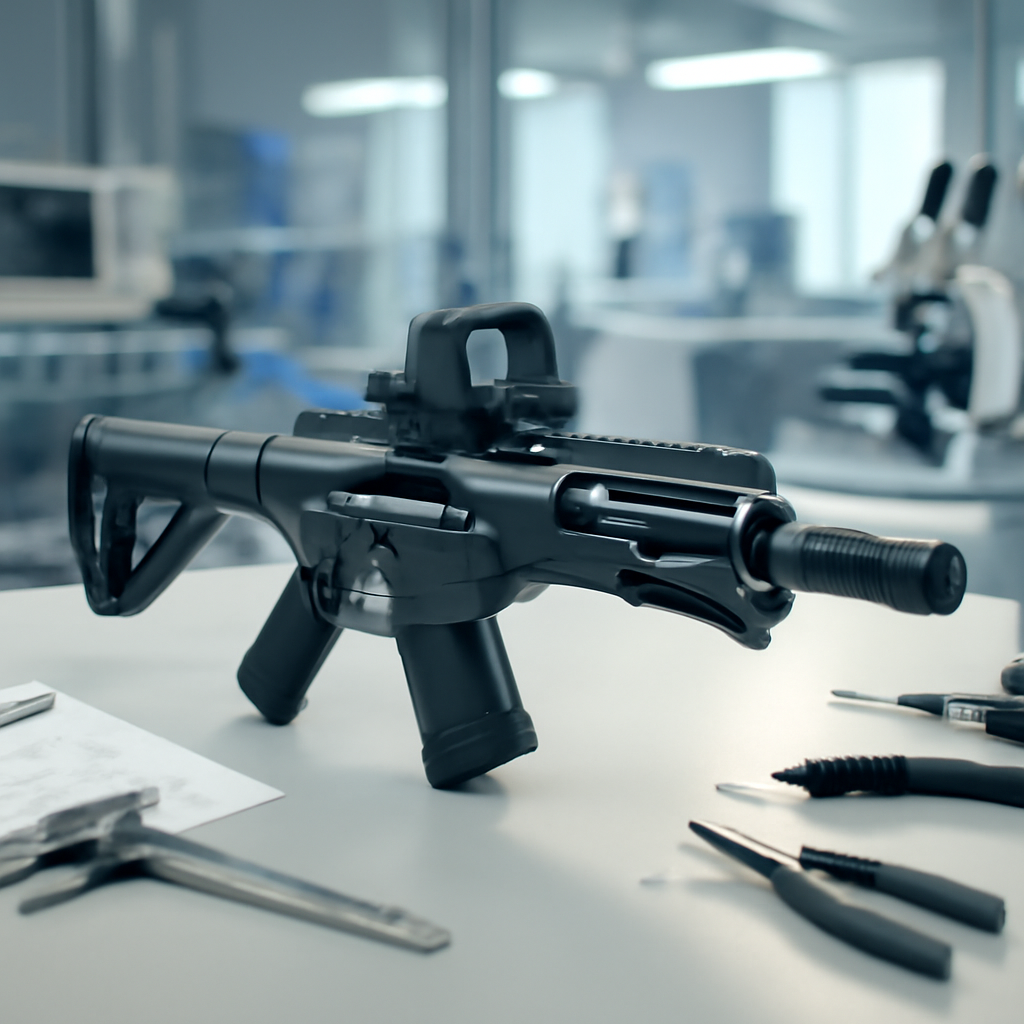
SOCOM has issued an Area of Interest for a Hypervelocity Improved Carbine (HICAR) that, by the program text, aims to "develop an improved carbine capable of operating with currently issued 5.56 NATO ammunition, while also incorporating design features to ensure reliability, durability, and longevity with the use of future hypervelocity 5.56x45mm ammunition." Lt. Col. Wood described the effort as an R&D-heavy science project: "At this point, it’s still a significant science project, and so there are no specific high velocity rounds that are fielded at this point."
Wood emphasized interoperability as a design constraint: special operators such as the Green Berets partner with foreign SOF units in areas where nonstandard calibers are scarce, so solutions that work with common 5.56mm mags and supply chains are attractive. He pointed to advances in case metallurgy — citing Federal’s move into steel-case ammunition and new alloys — noting that the newer cases "far exceed performance of the standard brass" and can be "cheaper than brass as well."
Mid-Range Gas Gun (MRGG) — sniper fielding, assault variant in production
SOCOM has been fielding the Mid-Range Gas Gun in a sniper configuration since 2023, Wood said. The command "just recently started procurement of the assault variant" from Lewis Machine & Tool (LMT) and is under a production contract, but the assault model "has not begun to field." Wood said timelines for fielding remain under discussion with vendors.
LMT described the Mid-Range Gas Gun–Assault (MRGG-A) as addressing extended range in mid-range calibers including 7.62 NATO and 6.5mm Creedmoor. The vendor states the weapon "exceeds a 1,200-meter point target in 6.5mm Creedmoor" and called it "a phenomenal, accurate weapon system" for SOF operators.

Audit-ready is a season. It shouldn't be.
Evidence in spreadsheets, controls drifting between audits, frameworks multiplying on flat headcount. Nubivance runs continuous compliance on Rapid7 Cyber GRC - SOC 2, HIPAA, ISO 27001, PCI, CMMC.
End the scramble.338 Norma Magnum and the LMG-M evaluation
SOCOM’s Light Machine Gun–Medium (LMG-M) program, designed around the .338 Norma Magnum, is paused for broad fielding. Wood said SOCOM "has paused that program at this time as far as a significant fielding," but the command is "fielding a small portion to one unit" for a combat evaluation and "we’re going to see how that works out in that unit." The LMG-M was identified as being provided by Sig Sauer.
Wood outlined the tradeoffs for .338: it offers "significant range" and, in his words, "has greater range than traditional .50 cal" with a particular .338 round SOCOM is testing that is "more effective on target than the .50 caliber at those greater ranges." He also acknowledged the weight penalty compared with lighter cartridges and described practical benefits: replacing a .50-caliber system with a .338 can save "hundreds of pounds" on light vehicles and keep them under gross vehicle weight rating limits, or ease stresses when vehicles are air-dropped or subjected to hard impacts.
Lightweight Machine Gun–Assault (LMG-A) and MK 48 replacement timetable
SOCOM has awarded an Other Transaction Authority (OTA) contract for the Lightweight Machine Gun–Assault (LMG-A) in a 7.62 variant. Wood said "we just got into an OTA for the Lightweight Machine Gun–Assault (LMG-A), the 7.62 variant," with multiple competitors developing designs. He expects the program to produce a replacement for the MK 48 in the Fiscal Year 2028–2029 timeframe.
Counter‑drone rounds, shotguns and 40mm experiments
On counter‑drone measures, Wood confirmed SOCOM "have definitely been looking at counter-drone rounds specifically in the current calibers" to augment the rifles operators already carry. The command is also "experimenting with various other things, from shotguns to 40 millimeters," but Wood declined to go deeper for OPSEC reasons.
What this means for Green Berets, partner SOF, and vehicle crews
- Green Berets and partnering SOF: SOCOM is prioritizing weapons that can use common 5.56mm logistics in regions where alternate calibers are uncommon; HICAR explicitly targets compatibility with existing 5.56 NATO rounds while preparing for future hypervelocity rounds.
- Partner SOF and foreign units: designs that maintain common calibers ease interoperability during partnering missions, a specific operational constraint cited by Wood.
- Vehicle crews and light formations: adoption of .338 systems in place of .50 cal can reduce vehicle weight by "hundreds of pounds," a tangible benefit for gross vehicle weight and for vehicles that face hard landings or parachute insertion stresses.
SOCOM’s small-scale evaluations, production contracts and AOI-driven R&D together show a programmatic approach: pursue near-term capability improvements that fit existing logistics (HICAR and counter‑drone efforts), field proven extended‑range systems where ready (MRGG-Sniper since 2023 and procurement of assault variants), and test heavier‑caliber options (.338) on a limited basis before committing to large-scale fielding. Key near-term milestones to watch in the record are the HICAR documentation on Sam.gov, the ongoing vendor discussions around MRGG-A production timelines, the limited .338 combat evaluation with a single unit, and the planned FY2028–2029 window for an LMG-A to replace the MK 48.