“We don't plan to build bigger systems,” Seasats CEO Mike Flanigan told Defense One — a terse line that frames a larger argument now playing out across U.S. defense procurement: smaller, more numerous unmanned surface vessels (USVs) may deliver tactical and strategic value that big, costly platforms cannot.
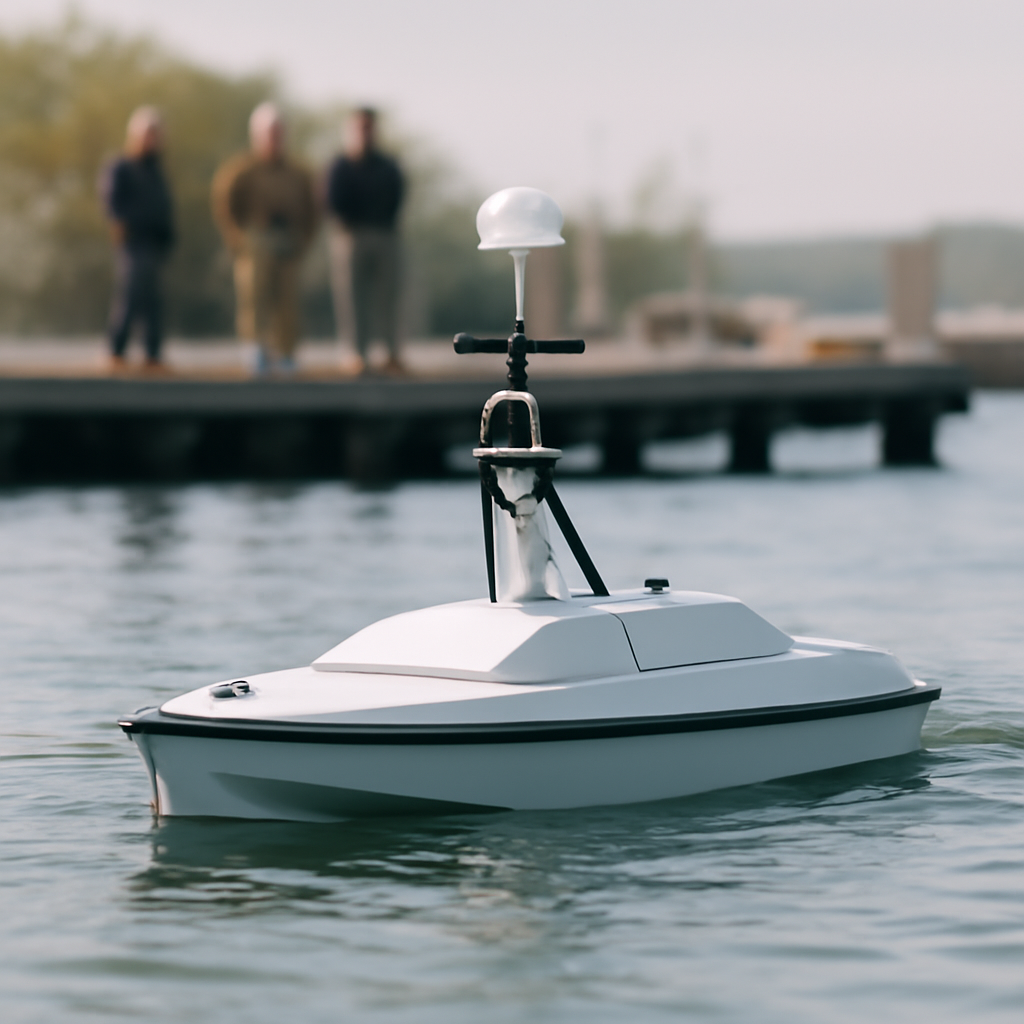
Seasats’ Lightfish, Quickfish, and Heavyfish
San Diego-based Seasats is betting on small USVs. The company markets three variants: the roughly 12-foot Lightfish, the 20-foot Quickfish, and the 35-foot Heavyfish, which Flanigan said will make its water debut later this year. “All of our substantial business is on Lightfish,” he said, adding that Lightfish supports the Marine Corps, Navy, and Special Forces and accounts for about 95 percent of the company’s focus.
Seasats positions Quickfish as a “reactionary tool” for repositioning assets or intercepting targets, while Heavyfish is described as “essentially a Lightfish, but stretched out,” offering larger payload capacity for subsea and aerial systems without needing an expeditionary force to haul it off a beach. The company has operational experience: a Lightfish conducted a trans-Pacific autonomous transit from San Diego to mainland Japan last year, and one used for surveillance “recently spotted a Chinese warship near the Philippines.”
Flanigan stresses endurance and survivability as key advantages of sub-40-foot craft: “Vessels under 40 feet are much harder to spot. They're much faster to build. You can use them with much less regret,” he said, arguing that those attributes can yield strategic value over platforms “over 100 feet.” He also described broad demand: “Right now we're seeing huge adoption…definitely, we're in the thick of scaling and hiring.”
Congressional Budget Office: battleship program balloons to $275 billion
The Congressional Budget Office estimated the proposed nuclear-powered battleship program would total about $275 billion, with the first ship costing roughly $23.4 billion — a sharp increase from the administration’s original $15.1 billion estimate. The CBO report, requested by Sen. Jeff Merkley (D-Ore.), also projects that as a fleet of 15 ships is built through 2056 the per-ship cost would fall to about $18 billion.
The report drew an explicit comparison: “A new DDG-51 destroyer costs more than $3 billion. Thus, if the average BBGN cost about $18 billion, the Navy could buy five destroyers for the price of one battleship.” The CBO noted that while five destroyers would require more crew and run on fossil fuel — increasing maintenance and operational costs — the office “does not have enough information to estimate” whether switching battleships to nuclear power would reduce operating costs, since that would depend on the ships’ final design.
The CBO findings arrive as the Pentagon pushes for a $1.5 trillion budget and ramps production on multiple programs, including new initiatives like Golden Dome; HII CEO Chris Kastner told investors the company has begun initial “design work for the battleship” with the Navy on a limited basis.

This site is the portfolio.
OSINTSights runs on Cloudflare Workers, D1, R2, and Vectorize, with an AI pipeline on Hetzner ARM. Nubivance designed, built, and operates it. We do the same for clients.
See what we buildJames Rainey goes to Bain Capital — and other market moves
James Rainey, identified in the brief as the former commanding general of Army Futures Command, has joined Bain Capital.
Other developments reported this week include a $1.37 billion Series D for Hadrian that values the company just under $8 billion and funds expansion of factories and production lines for munitions and autonomous systems; Lockheed Martin signing a memorandum of understanding with NioCorp for the rare-earth metal scandium and holding talks with Teck Resources and 5N Plus about germanium (per Reuters); and Ondas landing a $50 million award under the Army’s Lethal Unmanned Systems program as part of a $982 million prime contract, with Ondas hiring David Barnea, the former director of Mossad, as global president and chairman.
Contracts, partnerships, and demonstrations
- The Navy used a Saildrone USV to support intelligence gathering tied to an $81 million cocaine bust from a ship interdiction in October 2025; the Voyager drone has operated with Fourth Fleet for three years.
- Blue Water Autonomy will join a $40 million IDIQ with the Naval Oceanographic Office to map the ocean floor with uncrewed surface vessels, competing for task orders alongside multiple vendors.
- Fuse signed a research deal with the Nevada National Security Site to evaluate pulsed power technologies; Daniel Lowe, NNSS’s chief scientist, said the collaboration could “evaluate emerging technologies” and “generate insights that benefit both national security missions and the broader fusion community.”
- Tiberius Aerospace signed a cooperative research and development agreement with the Army Combat Capabilities Development Command Armaments Center to further develop Sceptre, a next-generation precision-guided, ramjet-powered 155mm artillery munition.
How the Navy, Congress, and small vendors are responding
Navy planners and doctrine writers are increasingly folding maritime drones into planning, giving decision-makers options that range from autonomous Lightfish patrols to higher-cost capital ships; the Saildrone example shows USVs being used beyond advertising demos and into interdiction support. Congress, represented here by Sen. Jeff Merkley and the Senate Budget Committee’s interest in a CBO analysis, is exercising budgetary oversight by probing program costs and comparisons to conventional platforms.
Small vendors and systems integrators appear to be moving fast: Seasats says Lightfish is driving most of its business and that the company is “scaling and hiring.” Firms such as Hadrian, Ondas, and Blue Water Autonomy are securing large rounds, awards, or IDIQs, signaling appetite among investors and buyers for rapid production and specialized unmanned capabilities rather than—or alongside—major, high-cost shipbuilding efforts.
There is a clear tension in the record: doctrine and demand are tilting toward widely distributable, harder-to-spot USVs, while Congress and the Department of Defense wrestle with the scale and cost of traditional, high-end platforms. Will procurement choices favor rapid, distributed unmanned systems that industry can mass-produce, or will political and strategic priorities continue to fund billion-dollar capital ships? The answer will shape budgets, industrial hiring, and the kinds of vessels seen at sea for years to come.