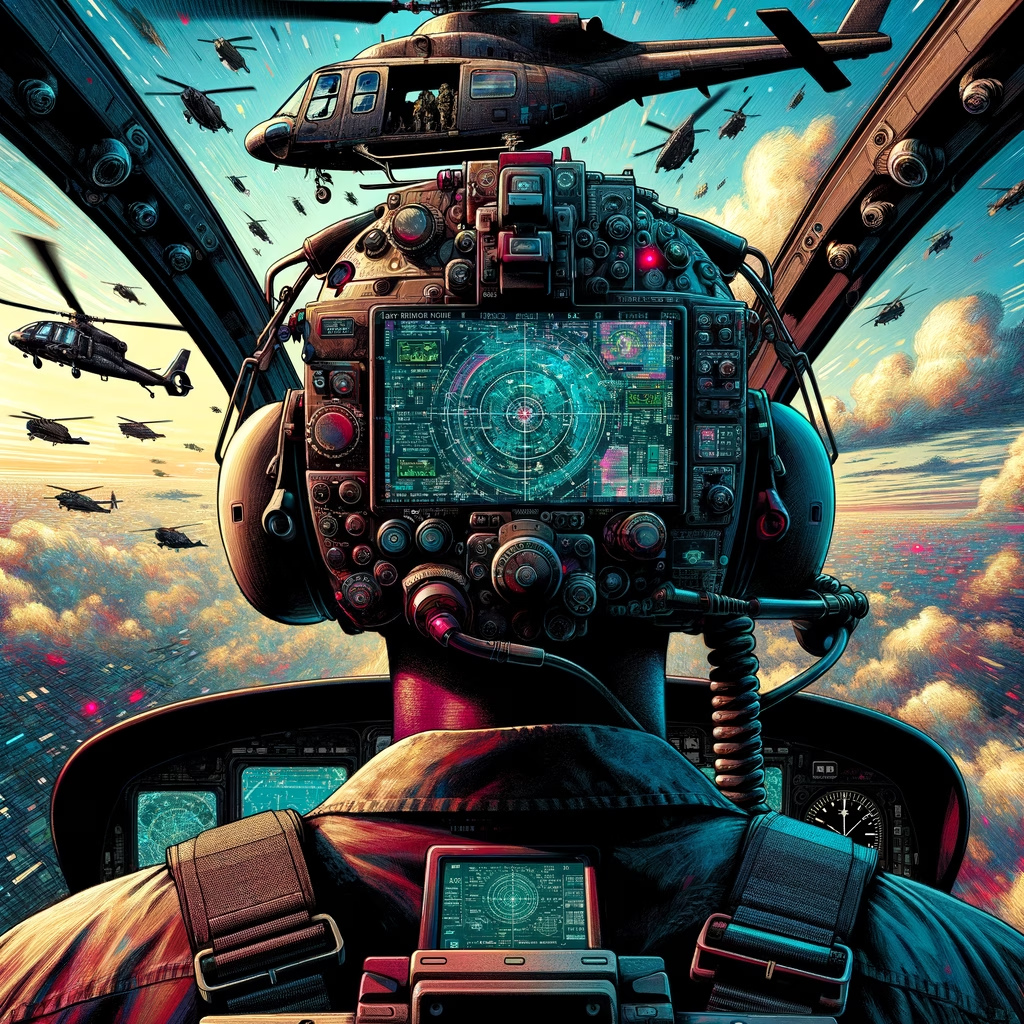
Can a visor tilt the balance between life and death during a single rotorcraft sortie? That provocative question drives a growing Department of Defense push to use helmet‑mounted displays (HMDs) to close the situational awareness gap between pilots and their crews. In low‑altitude, cluttered airspace—often at night or in degraded visual environments—every second and every shared datum can matter. HMDs promise to move critical information into the line of sight of those who must act on it, shortening decision timelines and reducing costly miscommunications.
Reducing the situational awareness gap with HMDs
Rotary‑wing and tilt‑rotor operations present a unique set of challenges: terrain, wires, small arms, and troops concentrated in limited airspace while crews manage sensors, weapons, and casualty evacuation. Traditional mixes of night‑vision goggles, analog instruments, and voice‑centric coordination create an uneven flow of information. Radio calls are noisy, paper charts and cockpits demand glances down, and sensor feeds often live in separate consoles. The result is a persistent situational awareness gap—who sees what, and when—that erodes effectiveness and can cost lives.
HMDs aim to change that dynamic by fusing navigation, targeting, flight symbology, and sensor feeds into a single overlay. When integrated with avionics and mission systems, modern helmet displays can present synthetic terrain, target cueing from electro‑optical sensors, and threat warnings tied to defensive aids. That lets pilots and crew members perceive the same operational picture in real time without interrupting critical tasks. For a crew chief or gunner, seeing the same aiming reticle and coordinates as the pilot can turn a disjointed maneuver into a coordinated action.
Why HMDs matter now
The historical baseline helps explain the urgency. Legacy helicopter systems were designed for different threats and operational tempos. Contemporary DoD documents emphasize contested lower airspace, rapid decision cycles, and distributed lethality—conditions under which electronic warfare, precision engagement, and irregular threats compress time and raise the premium on clear, shared awareness. HMDs are the intersection of three enabling trends: sensor miniaturization, interoperable network data links, and lightweight, low‑latency optics. When those pieces come together, crews can spend less time interpreting data and more time executing.
Operational gains and real‑world benefits
Shared symbology reduces repetitive radio exchanges and minimizes task switching between flying and mission management. Keeping a pilot “eyes‑out” during brownout, marginal weather, or dynamic engagements reduces spatial disorientation and improves safety. These benefits tighten the observe‑orient‑decide‑act (OODA) loop—shorter loops mean faster responses to emergent threats. In casualty evacuation and special operations, shaving seconds off target acquisition or threat recognition can directly improve survivability and mission success.
Engineering and integration challenges
Despite the promise, adoption is not without hurdles. Engineers focus on three technical problems: reducing helmet weight to prevent neck strain over long sorties; expanding the field of view without introducing distortion; and eliminating latency so virtual cues remain aligned with rapid aircraft motion. Integration is also complex: symbology must be tailored to each platform, sensor mix, and mission set, and certification requires exhaustive testing to ensure reliability in austere conditions.
Human factors and training
Equally important are human factors. More data does not automatically produce better decisions; information overload and misplaced trust in automation are real risks. Crews must be trained to interpret symbology under stress, resist complacency when automated cues appear plausible but are wrong, and maintain core manual skills. Training pipelines will need to incorporate simulator time in degraded and contested environments, while standards must define how crews should use shared displays when GPS or datalinks are degraded.
Resilience, security, and adversary response
Adversaries will target the data that feeds HMDs. Electronic attack and cyber operations could mask or corrupt overlays, creating false cues or denying critical inputs. That threat elevates requirements for multi‑source navigation (inertial, terrain‑referenced, celestial), anti‑spoofing measures, and graceful degradation modes that allow crews to revert to baseline procedures without catastrophic workload spikes.
Practical steps to success
To tilt implementation toward operational benefit, programs should prioritize interoperable standards so displays can share common formats across allied platforms; invest in human‑centered design and robust simulator training; field incremental capabilities and iterate based on user feedback; and harden information chains against jamming and deception by validating cues through redundant sensors. Modularity matters—operators want control over automation level and symbology layers tailored to mission needs—and durability matters in austere environments of dust, salt, temperature swings, and hard landings.
A cautionary note and the path ahead
Technology is not a panacea. Shared displays can accelerate a flawed plan, and brittle systems can become single points of failure. The right balance is to augment, not replace, fundamental crew discipline and redundant procedures. HMDs should be treated as force multipliers that enhance human decision‑making while preserving backup instincts and skills.
Conclusion: closing the situational awareness gap
As rotary‑wing forces prepare for a more complex and contested future, helmet‑mounted displays offer a pragmatic way to shrink the situational awareness gap between pilots and their crews. When designed with attention to ergonomics, integration, rigorous training, and resilience against adversary interference, HMDs can deliver actionable information where it matters most—directly into the line of sight of those who must act. Whether the visor becomes decisive will be proven in repeated missions, honest user feedback, and adaptation under operational pressure—not in vendor slides or lab demonstrations.



