“Having a single aircraft that can seamlessly transition from high-intensity strike to humanitarian rescue gives any nation a decisive operational edge while dramatically cutting lifecycle costs,” said Ken Demaree, Sikorsky’s Army and Air Force Systems vice president.
Sikorsky’s modular armed kits: what they do
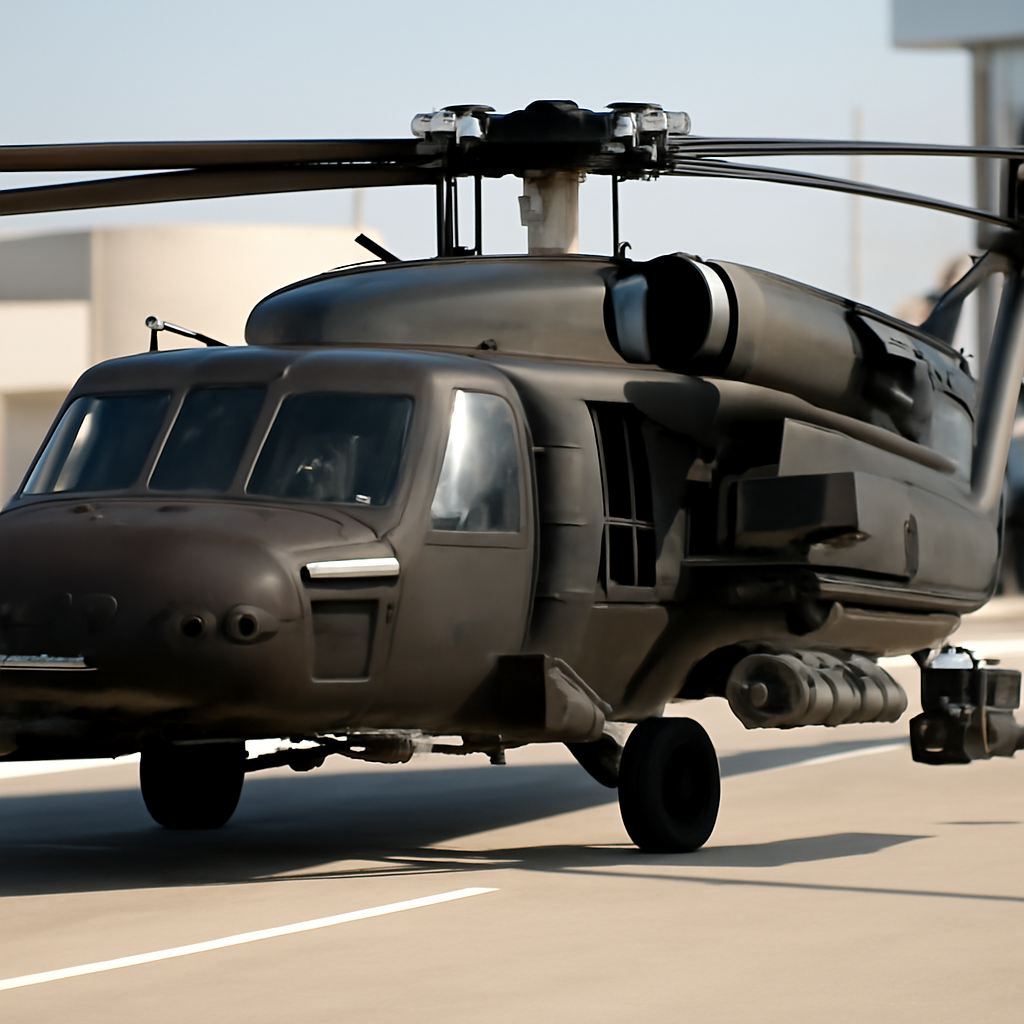
Sikorsky, a Lockheed Martin company, is offering modular kits that convert a UH-60M or S-70i Black Hawk helicopter from a utility aircraft into an armed one and back again. The kits are available as an option on new aircraft and as a retrofit to UH-60 and S-70 fleets already in service. Sikorsky describes the result as an “Armed Black Hawk” that retains the Black Hawk’s medium-category mission set — airmobile assault, close support, medical evacuation, ISR and tactical lift — in a single airframe.
Capabilities and weapons compatibility
The kits come in two mission configurations: a Close Support Mission Kit for “post penetration fire support against light armor and dismounted troops,” and a Precision Strike Mission Kit for “penetration attacks on hardened targets, air defense suppression, and precision strike for high-value objectives.” Mount-point configurations range from two to six weapons stations. Even with the wing installed and a weapons load aboard, Sikorsky says the aircraft still carries 11 fully equipped troops or 3,000 pounds of internal cargo.
- Reconfiguration time: fewer than three hours to convert to attack configuration; minutes to remove, using tool-free latching hardware.
- Compatible weapons listed by Sikorsky: 7.62mm machine guns, .50-cal GP 19 guns, M261 rocket pods, HELLFIRE II, JAGM, APKWS and Spike NLOS missiles, plus a Modular Effects Launcher for other air-launched effects.
- Airframe attributes cited: 15 million flight hours of service record, crash‑worthy airframe and redundant systems.

Audit-ready is a season. It shouldn't be.
Evidence in spreadsheets, controls drifting between audits, frameworks multiplying on flat headcount. Nubivance runs continuous compliance on Rapid7 Cyber GRC - SOC 2, HIPAA, ISO 27001, PCI, CMMC.
End the scrambleEconomics of a shared fleet
Sikorsky positions the kits as a budget-conscious alternative to maintaining a dedicated attack-helicopter fleet. Because the armed and unarmed configurations share 95 percent of common parts, crews train on one cockpit layout and maintainers service one fleet instead of two. Sikorsky argues that fewer training pipelines and smaller spare‑parts inventories reduce total‑ownership cost while preserving operational flexibility.
Built in Poland, sustained through Europe
Production and sustainment are explicitly European in scope. PZL Mielec, a Lockheed Martin company and one of Poland’s largest aircraft manufacturers, began production in July on Europe’s first S-70 Firehawk helicopters that will go to the Czech Republic. PZL Mielec has produced Black Hawks since 2010 “for 18 customers in 11 countries.” Sikorsky named Czech firm Česká letecká servisní a certified European Union distribution center for Black Hawk parts, and the Czech Firehawk aircraft now in production are being built in partnership with that company.
The story of European sustainment also intersects with EU emergency planning: Romania acquired its S-70 fleet through an EU-funded program and received an additional aircraft in December 2025 under rescEU, the bloc’s shared emergency reserve that can be dispatched to other member states at the European Union’s request. And the political context is clear: NATO members agreed at The Hague in June 2025 to reach 5 percent of gross domestic product on defense and security spending by 2035, a commitment that the source frames as prioritizing sustainment and modernization “as Ukraine defends itself against Russia.”
What this means for NATO members, air arms, and emergency responders
- NATO members and policymakers: The Armed Black Hawk offers a way to modernize and expand capabilities within existing acquisition and sustainment frameworks while aligning with The Hague commitment to increase defense spending to 5 percent of GDP by 2035.
- Air arms and procurement leaders: The kits’ retrofit option and 95 percent commonality mean fewer supply chains and training streams to manage; the platform’s claimed compatibility with improved engines, larger fuel tanks, autonomy options and expanded payloads targets a long service life and upgrade path.
- Emergency responders and domestic operators: The aircraft is already used in civilian crises — Polish Black Hawks flew equipment and personnel during floods in September 2024 and evacuated over 100 people — and PZL Mielec’s president Janusz Zakrecki framed the armed configuration as “the same helicopter, made in Europe, with one more mission added to its arsenal.”
Sikorsky casts the Armed Black Hawk as a way to “future‑proof” a widely used platform: the kits are designed to interface with ongoing Black Hawk upgrades the company cites — improved turbine engines, larger fuel tanks, autonomy options and expanded payload capability — so the airframe can “absorb next-generation sensors, weapons and autonomous flight control packages without major structural changes,” Demaree said. The result, the company says, is a single, combat‑proven airframe that can meet a broad set of missions for the coming decades while leveraging European production and sustainment lines.
The tradeoff these facts imply is straightforward: nations can buy one airframe that does more, faster and cheaper than fielding separate specialized fleets — but they will also consolidate missions, training and logistics onto a single platform. Whether that consolidation becomes an operational advantage or a vulnerability will turn on choices in force structure, rules of engagement and how nations integrate the Black Hawk’s armed configuration into their doctrine and reserves.