Shield AI’s X-BAT 001 prototype: what the photos show
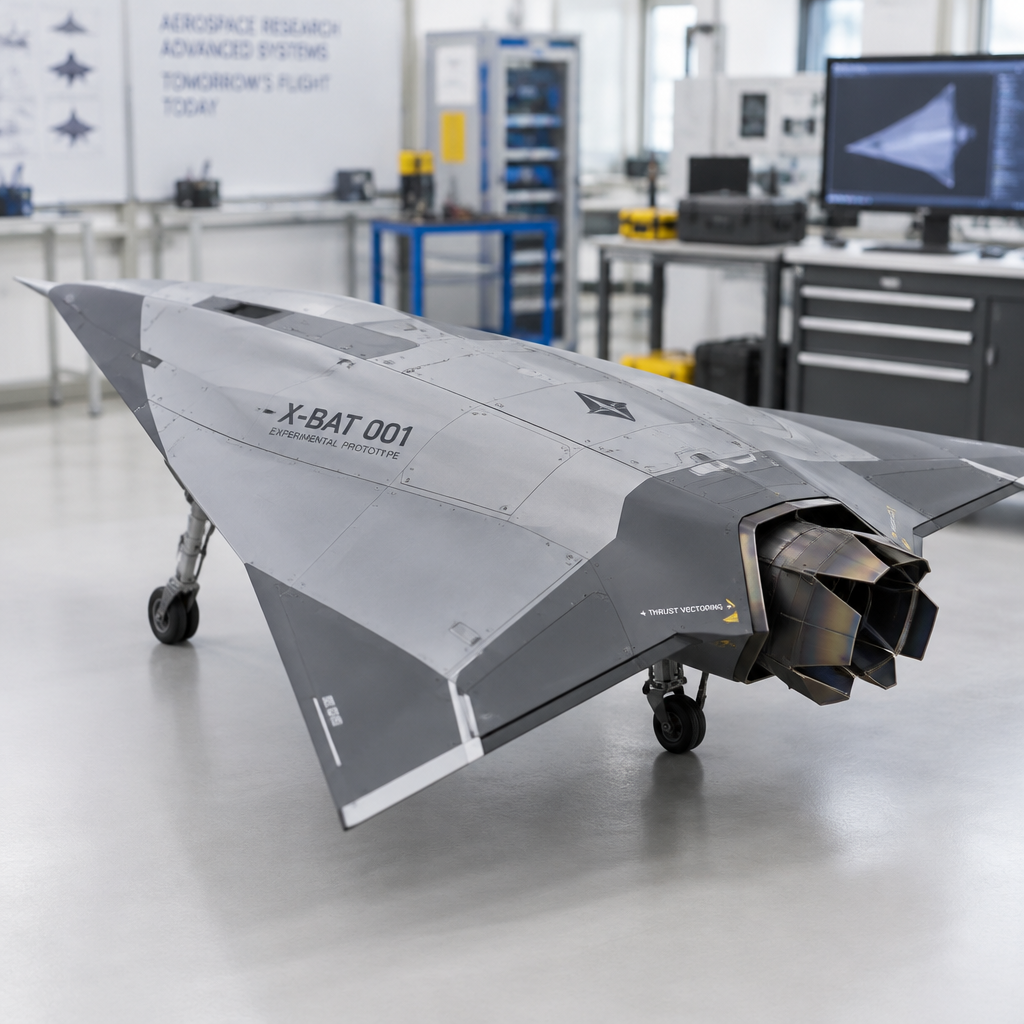
Shield AI released video and imagery of X-BAT 001, the first of two full‑scale prototypes, as the aircraft is moved from X‑Forge 1 in Frisco, Texas, to X‑Forge 2 in Newton, Kansas. The airframe is tailless and tail‑sitting, with an arrowhead planform and a straight leading edge with pronounced sweep consistent with renders shown earlier this year. Notable, visible departures from prior models include a thrust‑vectoring exhaust nozzle that extends well beyond the wing trailing edges and two pronounced bulges flanking a dorsal “spine,” each with a small forward opening. Two circular, mesh‑screened openings on top of the spine — with small fans visible inside in the imagery — are also new. Shield AI declined to comment on the purpose of these features.
Axisymmetric Vectoring Exhaust Nozzle (AVEN) and propulsion
Shield AI says X‑BAT’s ability to take off and land vertically depends on its propulsion arrangement together with guidance, navigation, and control (GNC) systems. The company is leveraging work on an Axisymmetric Vectoring Exhaust Nozzle (AVEN), originally developed in the 1990s, and has been using the original test nozzle taken from storage as part of development. Shield AI and GE Aerospace completed engine light‑off testing of the AVEN, a milestone the company described in a July 20, 2026 tweet that noted engineers from both firms had integrated the AVEN into GE Aerospace’s engine for X‑BAT testing. Shield AI has said the prototype nozzle lacks low‑observable attributes for initial testing, and the company has indicated that LO features will be added later; the current nozzle is described in the published images as “well blended” for a development vehicle.

This site is the portfolio.
OSINTSights runs on Cloudflare Workers, D1, R2, and Vectorize, with an AI pipeline on Hetzner ARM. Nubivance designed, built, and operates it. We do the same for clients.
See what we buildGuidance, controls, and the airframe concept
X‑BAT will use thrust vectoring for pitch and yaw, while bleed air routed through thrusters in the wings is intended to provide roll control. Shield AI plans to leverage GNC experience from its smaller, internal‑combustion tail‑sitting V‑BAT to manage the larger vehicle’s vertical transition and recovery without conventional landing gear. The design is intended to be launched and recovered from a trailer‑based system that can be deployed on land or ship decks with sufficient space, enabling a “shoot‑and‑scoot” approach the company argues improves survivability.
Test sequence, crane trials, and development schedule
Shield AI outlined a staged test plan for the prototypes: initial horizontal engine runs while the vehicle rests on its launch and recovery trailer, followed by vertical engine runs and vertical testing. The company says it has arranged one of “the biggest cranes in the world” at the Kansas test site to suspend the vehicle for free‑flight testing from a tether before removing the crane and conducting untethered flights. Armor Harris, Shield AI’s Senior Vice President and General Manager of the aircraft division, emphasized the prototypes are full‑scale demonstrators with an “outer mold line,” an F110 engine, and the full propulsion path. Shield AI has said it aims to fly a fully missionized X‑BAT in 2028, start series production in 2029, and has raised the prospect of at least a limited operational capability in 2029 — an aggressive timeline the company acknowledges will depend on flight‑test performance and operational evaluations.
U.S. Navy funding and the RIMES program
The U.S. Navy is actively supporting X‑BAT development through a program called Runway Independent Maritime Expeditionary Strike (RIMES). This year Shield AI received $200 million in Navy funding for RIMES, with some of that money channeled via the Office of the Under Secretary of War for Acquisition and Sustainment. Shield AI has committed an equal amount of internal funding to the project. The Department of the Navy Rapid Capabilities Office (DONRCO), in partnership with the Defense Innovation Unit (DIU), described RIMES as focused on delivering a runway‑independent, long‑range maritime strike capability “at the speed of relevance,” with specific timelines to be determined by operational evaluations, flight‑test performance, and fleet requirements. Shield AI envisions X‑BATs deployed from trailer systems aboard amphibious and expeditionary sea base–type vessels and has shown renderings of the drone operating from the future America‑class amphibious assault ship USS Bougainville.
How Shield AI engineers, the Department of the Navy, and expeditionary operators will respond
- Shield AI and GE Aerospace engineers: they will focus on validating the AVEN integration, propulsion path, and the novel bleed‑air thrusters for roll control during crane‑suspended and untethered flight testing while refining aerodynamic and LO design elements as the development aircraft matures.
- The Department of the Navy acquisition offices (DONRCO and DIU): they will use flight‑test performance and operational evaluations to set timelines for RIMES and to decide whether the prototype program meets fleet requirements for runway‑independent maritime strike capability.
- Maritime and expeditionary operators (amphibious and expeditionary ships): they will examine how trailer‑based launch and recovery concepts scale aboard ships with limited deck space and how the system’s “shoot‑and‑scoot” mobility fits expeditionary and distributed operations scenarios.
Shield AI has moved the first full‑scale X‑BAT prototype to its Kansas test site and outlined a stepwise program of crane‑suspended and untethered trials. The prototype’s visible innovations — a long, vectored exhaust, dorsal bulges, and new intake openings — make clear the program is in active experimental configuration. The speed of the company’s next milestones, and how the AVEN, F110 engine, and GNC systems perform in the crane and free‑flight phases, will determine whether the ambitious 2028–2029 schedule can be met.