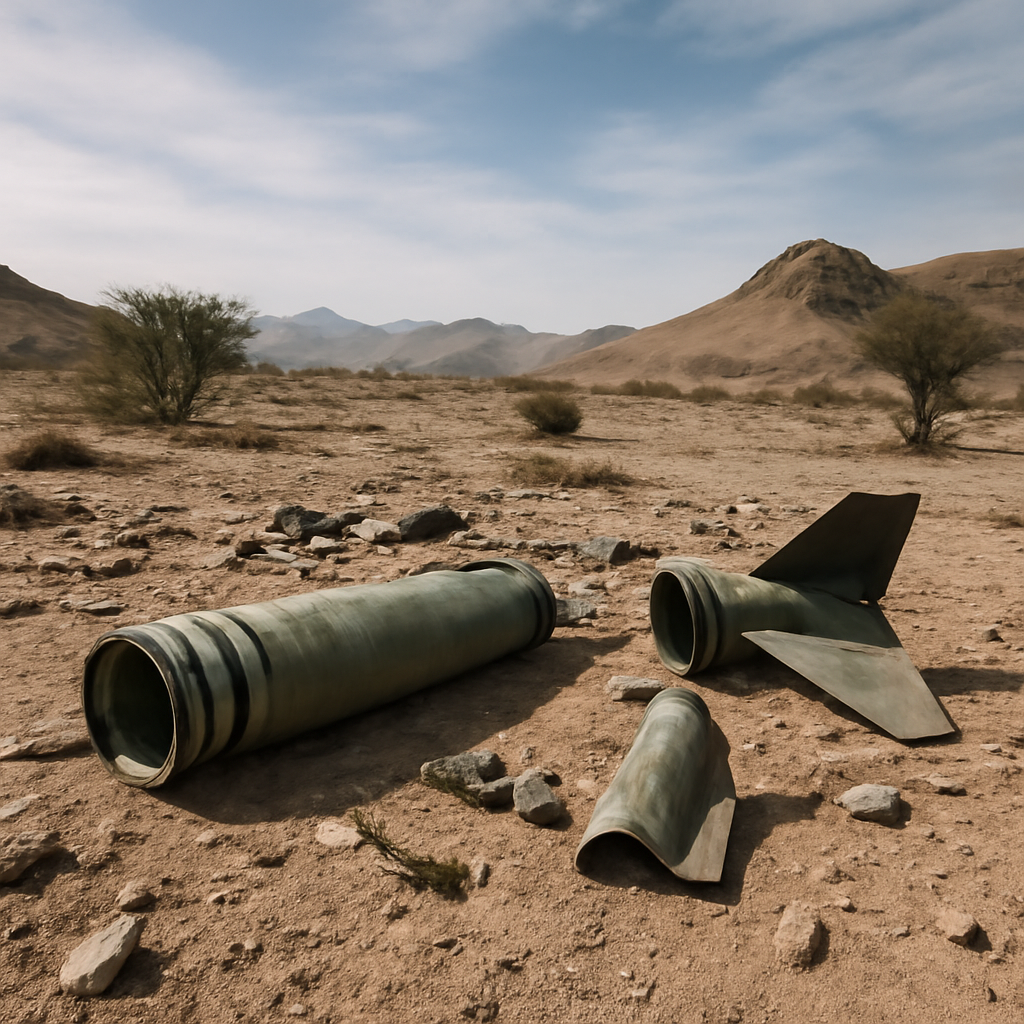
Debris identified online as parts of a Chinese-made DF-15A short-range ballistic missile was found in Raghwan District, Marib Governorate, in northern Yemen, a discovery that could — if verified — mark the first known combat use of an SRBM tied to Saudi Arabia’s long-secret missile inventory.
What was found in Raghwan District, Marib Governorate
Imagery and video circulating on social platforms show wreckage that observers have identified as a DF-15A (Dong Feng-15A). A screenshot in those posts clearly displays the DF-15A name on the missile’s side, and at least one online report described the booster stage as having “fallen in Raghwan District, Marib Governorate.” Those same open posts also include a mix of claims and commentary; the identification and ownership of the missile debris remain unconfirmed in independent reporting.
The DF-15 family and the weapon allegedly observed
The DF-15 family, known in NATO parlance as CSS-6, is a road-mobile, solid-fueled short-range ballistic missile family developed by China in the 1980s. Open-source descriptions in the record note that the DF-15A reportedly entered Chinese service in the mid-1990s, and assessed ranges for the family vary substantially in public reporting — from roughly 600 kilometers (373 miles) for the original DF-15 to as much as 900 kilometers (559 miles) for later variants. Later members of the family, including a DF-15B redesign, are externally distinguished by a triconic reentry vehicle with control fins — a configuration widely interpreted in open sources as indicative of a maneuverable reentry capability.
China is the only confirmed operator of the DF-15 family. There have been longstanding, disputed reports of transfers of DF-15 or the M-9 export version to Egypt, Iran, Pakistan and Syria, but those export records are contested and sometimes conflated with the broadly similar DF-11.

Audit-ready is a season. It shouldn't be.
Evidence in spreadsheets, controls drifting between audits, frameworks multiplying on flat headcount. Nubivance runs continuous compliance on Rapid7 Cyber GRC - SOC 2, HIPAA, ISO 27001, PCI, CMMC.
End the scrambleHow this fits into the recent Saudi–Houthi escalation
The emergence of the wreckage comes amid a sharp uptick in fighting after years of relative de‑escalation following the 2022 truce. Open reporting documents that Houthi forces have recently overrun Saudi‑backed Yemeni government positions around Marib and Taiz, and concurrently stepped up missile and drone attacks against southern Saudi Arabia, striking military and energy infrastructure and threatening the kingdom’s ability to move oil through the Red Sea. The Houthis have also publicly declared the Bab el‑Mandeb closed to Saudi oil traffic.
The debris suggests the missile experienced a stage separation or broke apart before reaching its intended target; the available reporting notes that the Houthis are not known to possess weapons capable of intercepting such a missile, leaving the cause of breakup or crash unclear in the public record.
Implications for Riyadh’s strategic missile posture
Saudi Arabia has a documented but largely secretive history of acquiring Chinese ballistic missiles. Publicly available reporting traces Riyadh’s early strategic capability to secret imports of DF‑3A missiles from China beginning in the late 1980s and notes later links to DF‑21 family systems. Satellite imagery and other open-source intelligence have shown Chinese‑designed ballistic‑missile infrastructure inside the kingdom. Saudi officials have never publicly acknowledged operating the DF‑15 family, though a 2013 visit by Prince Fahd bin Abdullah bin Mohammed, then Deputy Minister of Defense, to the kingdom’s Strategic Missile Forces is cited in the record alongside imagery enthusiasts’ long speculation that smaller Saudi missiles were DF‑15 variants.
If the wreckage ultimately reflects an operational DF‑15A launched by Riyadh, the operational logic laid out in reporting is straightforward: a solid‑fueled SRBM allows fast, responsive strikes deep inside Yemen within minutes while keeping crewed aircraft and crews outside the immediate engagement area. A conventionally armed SRBM of this class can deliver a large warhead at very high speed, making it useful against fixed, high‑value, or hardened targets — and it would signal Riyadh’s willingness to draw from a previously shadowed strategic missile inventory as the conflict intensifies.
What this means for the Houthis, the Saudi military, and regional energy transit
- For the Houthis: the arrival of an SRBM in the battle space — whether launched by Saudi forces or otherwise — reinforces the asymmetric pressure on Houthi-held terrain and complicates their operations, especially around contested areas like Marib and Taiz.
- For the Saudi military: use of a road‑mobile, solid‑fueled SRBM would expand response options when ground forces face rapid territorial losses or when air operations are constrained by robust Houthi air defenses.
- For regional energy transit and oil shipping: the broader pattern of Houthi strikes on Saudi military and energy infrastructure, combined with any reciprocal use of strategic missiles, heightens the direct risk to routes such as the Red Sea and the Bab el‑Mandeb — routes the reporting says the Houthis have declared closed to Saudi oil traffic.
The online discovery of DF‑15A‑marked wreckage in Yemen opens a rare window into a secretive corner of regional arsenals. If corroborated as a Saudi DF‑15A launch, the find would be the first public example of such a weapon used in combat by Riyadh and would materially change assessments of how quickly and how far the kingdom might strike inside Yemen. For now, key questions remain: who fired the missile, what target was intended, and whether the missile failed in flight or separated by design. The answer to those questions will determine whether this remains a single, puzzling wreckage or the first sign of a broader shift in the conflict’s weapons calculus.
Original story: https://www.twz.com/news-features/saudi-arabia-appears-to-have-used-its-secretive-stash-of-ballistic-missiles-for-the-first-time