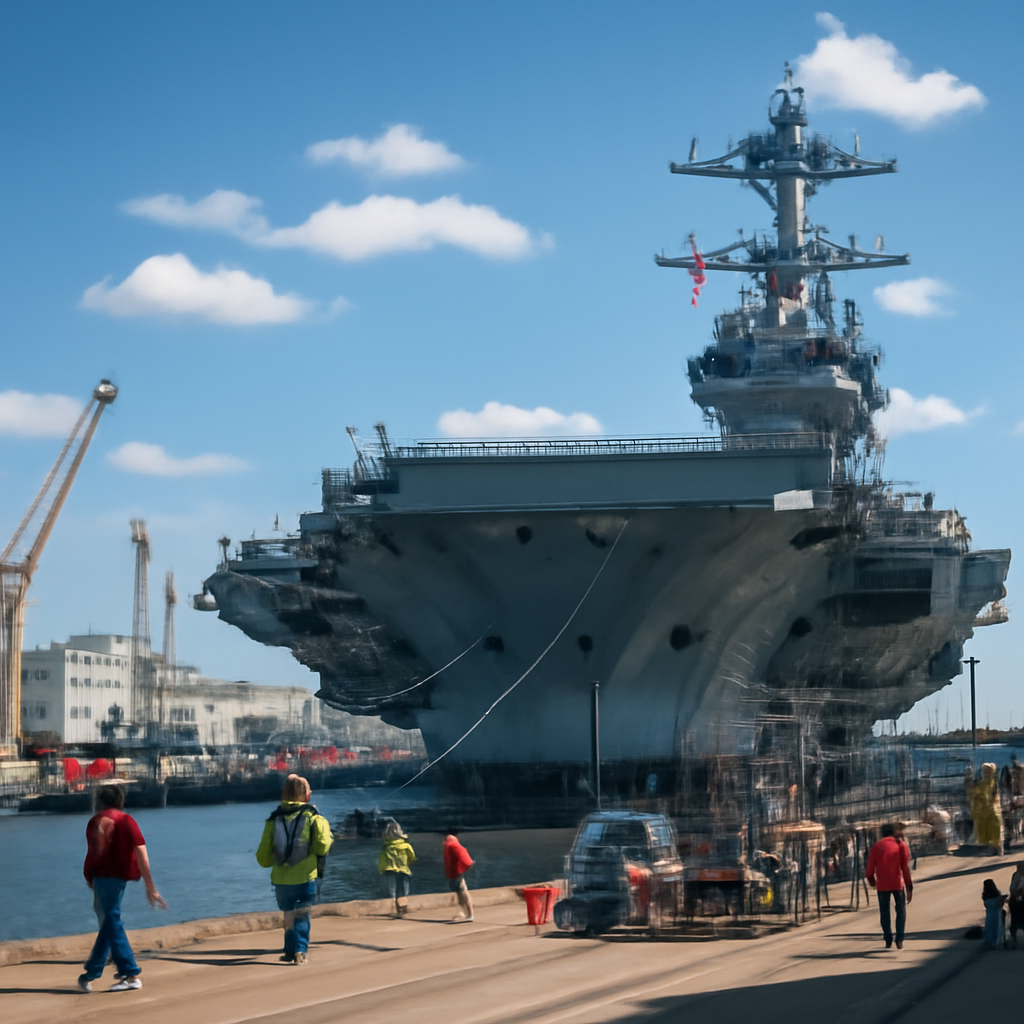
“I’m still going to deliver that ship back in six months,” Rear Adm. Kavon Hakimzadah said, insisting the Navy will meet a compressed maintenance timeline for USS Gerald R. Ford despite an onboard fire and an unusually long deployment.
Hakimzadah’s six‑month commitment and how it’s structured
Rear Adm. Kavon Hakimzadah, commander of Norfolk Naval Shipyard, told reporters during a roundtable that the shipyard had planned a six‑month planned incremental availability (PIA) for Gerald R. Ford and that he had promised the Fleet commander he could meet that deadline even after the carrier’s deployment and a subsequent fire. The PIA began in July at Norfolk Naval Shipyard to address maintenance and modernization initiatives.
Hakimzadah acknowledged the shipyard had originally planned a 10‑month window but compressed the work into six months. He allowed that there could be some “follow up” and “clean up” to support the ship’s company at the end of the six months, but reiterated his expectation that the ship would be delivered back on that schedule.
Two concurrent availabilities: planned work and fire repairs
The Navy has launched a second availability explicitly to repair damage from a fire that broke out aboard Ford in March. That second availability is being overseen by the regional maintenance center and a commercial partner — described in the reporting as a commercial vendor — running that separate repair effort alongside the PIA at Norfolk.
Hakimzadah framed the arrangement as parallel activities: the Norfolk Naval Shipyard executing the compressed PIA while the regional maintenance center and a commercial vendor manage the separate fire‑repair availability.

This site is the portfolio.
OSINTSights runs on Cloudflare Workers, D1, R2, and Vectorize, with an AI pipeline on Hetzner ARM. Nubivance designed, built, and operates it. We do the same for clients.
See what we buildDeployment duration, mission profile, and maintenance implications
Gerald R. Ford returned to Naval Station Norfolk in May after remaining at sea for 326 days. That total eclipsed the aircraft carrier Abraham Lincoln’s previous record of 294 days at sea in 2019 and 2020, according to a USNI News carrier database tracking flattop deployments.
While underway, the carrier operated in US Southern Command during the Trump administration’s naval buildup in the region ahead of Venezuelan leader Nicolas Maduro’s ouster in January, then shifted to support operations in the Middle East, including Operation Epic Fury, alongside the aircraft carrier Abraham Lincoln.
Acting Secretary of the Navy Hung Cao previously told lawmakers on the House Appropriations Committee in May that maintenance needs increase with extended deployments: “For every 30 days that the ship is extended on deployment, it adds 6 percent of maintenance, so five months extra would add 30 percent for maintenance.” That calculation framed concern within Navy leadership that Ford could require more work than a carrier that completed a standard seven‑month deployment.
Precedent at Norfolk: Eisenhower and George H.W. Bush PIAs
Hakimzadah said in a July statement that he expected Gerald R. Ford to follow the footsteps of carriers Dwight D. Eisenhower and George H.W. Bush, both of which completed a PIA at Norfolk Naval Shipyard. The Navy described those PIAs as having been conducted ahead of schedule.
PIAs are usually planned to last between six to eight months, the Navy told reporters in July, but the service did not share exact specifics regarding the Ford’s PIA timeline beyond Hakimzadah’s six‑month target.
What this means for Norfolk Naval Shipyard, the Fleet, and the regional maintenance center
- Norfolk Naval Shipyard: The shipyard is running a compressed six‑month PIA that was originally planned to be longer. Meeting that schedule will require coordinating modernization tasks alongside routine and deployment‑driven repairs.
- The Fleet (ship’s company and operational commanders): Ford’s crew can expect the ship to be returned within six months, though Hakimzadah warned of potential follow‑up and cleanup activities to support the ship’s company after delivery.
- The regional maintenance center and commercial vendor: The second availability to address March fire damage is being overseen by the regional maintenance center with a commercial partner, creating a parallel repair track that must synchronize with the PIA to avoid conflict or rework.
The Navy has set a specific, short clock for returning Gerald R. Ford to the Fleet: a six‑month PIA running in parallel with a fire‑repair availability. Whether that compressed schedule holds will become clearer as the two availabilities proceed under the shared constraints of time, damage assessment and coordination between Norfolk Naval Shipyard, the regional maintenance center, and commercial partners.