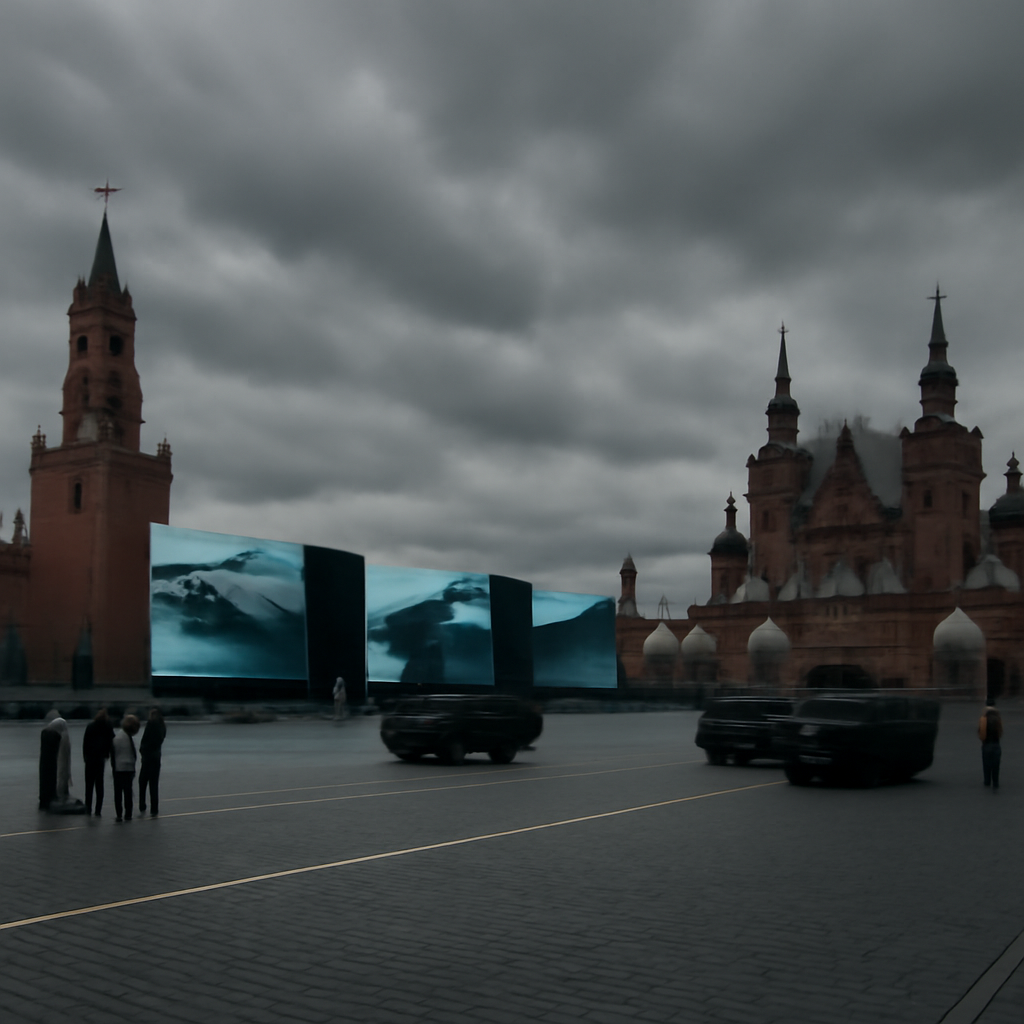
"The parade on Saturday was 'quite extraordinary' and showed 'real vulnerability' on the part of Russia," said Timothy Ash, capturing a rare theme of overt anxiety at this year’s Victory Day event in Red Square.
What happened on May 9: a scaled-back parade and security explanations
The Victory Day parade in Red Square proceeded on May 9 without the usual display of hardware and personnel, as Moscow intentionally reduced visible military presence amid what officials called security concerns. President Vladimir Putin told journalists that military equipment was not displayed because of "security reasons" and because "the armed forces must focus their attention on the final defeat" of Ukraine, according to state news agency TASS. Screens around Red Square projected images of rockets, jets, tanks, and submarines, the BBC reported, even as physical platforms were absent.
Analysts: absence of gear is a signal, not simply prudence — Timothy Ash and Alexander Baunov
Several analysts interviewed or cited by Breaking Defense interpreted the restrained parade as an implicit admission by Moscow of vulnerability. Timothy Ash, associate fellow in the Russia and Eurasia programme at Chatham House, said the event revealed "real nervousness now in Moscow about the sustainability of all this" — referencing the war in Ukraine and Russia’s economy. Alexander Baunov, editor-in-chief at the Carnegie Russia Eurasia Center, wrote that holding a parade "furtively, without rehearsals, and with the internet jammed (to reduce the chances of a Ukrainian attack drone being able to navigate to the site), it demonstrates nothing but fear and weakness."

This site is the portfolio.
OSINTSights runs on Cloudflare Workers, D1, R2, and Vectorize, with an AI pipeline on Hetzner ARM. Nubivance designed, built, and operates it. We do the same for clients.
See what we buildPropaganda and optics: Natia Seskuria on diminished domestic messaging
Natia Seskuria, associate fellow for international security at the Royal United Services Institute, observed that removing military equipment "weakens the propaganda value of the event, particularly for domestic audiences, as it reduces one of the most visible symbols of Russian power and military prestige." She contrasted this year's subdued parade with last year's display, which included a range of new tanks and drones shown in front of invited world leaders. Janes reported that last year’s showcased tanks — the T-72B3M, T-80BVM, and T-90M — were all upgraded following operations in Ukraine, and that a single truly new land vehicle, a 4×4 ZA-SpN Titan MRAP, was paraded.
Long-range drones and battlefield dynamics: Federico Borsari and the operational picture
Federico Borsari, a non-resident fellow at the Center for European Policy Analysis, framed Kyiv’s drone capabilities as a central reason for Moscow’s caution. He said Ukraine had developed "an array of dedicated long-range one way attack" drones "able to penetrate deep into Russian territory and hit high value targets and critical infrastructure at a sustained pace," and that strike packages have become more successful as more drones reach their targets. The story noted that Russian officials said they intercepted dozens of drones flying toward Moscow just days before the parade, and it referenced Ukraine’s Operation Spider’s Web in June 2025 as an earlier, ambitious drone strike on Russian air assets.
What this means for the Kremlin, Kyiv, and EU policymakers
- The Kremlin: Analysts quoted fears that domestic political costs constrain options. Seskuria warned another wave of mobilisation remains politically sensitive given the backlash from the 2022 partial mobilisation; she said the Kremlin is therefore likely to avoid another large-scale draft for as long as possible. Ash said public complaints about the economy and the human toll from the war are building pressure on the administration.
- Kyiv: The reporting casts Kyiv as willing to press long-range strike capacities, with Ash arguing that a change in U.S. policy after a separate strike on Iran removed restraints that had previously limited Ukrainian actions. Federico Borsari’s comments flagged that Ukraine’s growing success with drone strike packages has operationally altered Moscow’s threat calculus.
- European policymakers: The parade unfolded in the aftermath of a three-day ceasefire announced by Donald Trump covering "the suspension of all kinetic activity." Ukrainian President Volodymyr Zelenskyy said Russia continued fighting along front lines despite the ceasefire, prompting condemnation from European Union foreign policy chief Kaja Kallas.
Analysts converged on a theme: absent hardware on Red Square is not merely a precaution; it is a public marker of constraint. Ash compared current pressures on the administration to the moment after the short-lived Wagner coup by Yevgeny Prigozhin, and Baunov said Russian society had moved from initial fears to euphoria and now into "a new cycle of doubt and fear," with even official approval ratings noticeably declined.
Whether the pared-back display marks a temporary adaptation or a longer-term shift in how Moscow stages power is unresolved. "It remains to be seen what the next May 9 parade will bring, or if there will even be one at all," the reporting concludes.



